
Residual values have become a key part of BYD’s fleet strategy as the brand works to build confidence among Fleet Managers considering whole-of-life cost rather than simply purchase price.
Marcus Walker, National Fleet Sales Manager at BYD Australia and New Zealand, told the Fleet News Group podcast that protecting resale values has been an important focus for the company as its fleet volumes increase.
“Residual values is a key strategy pillar of the fleet team and our broader business too,” Walker said.
For fleets operating vehicles on three, four or five-year replacement cycles, resale performance can materially change the total cost of ownership.
A vehicle with an attractive purchase price can become more expensive over its lifecycle if values fall sharply before disposal. For Fleet Managers and Fleet Management Organisations, that means pricing strategy and used-vehicle demand need to be considered alongside running costs, servicing and energy consumption.

Avoiding heavy discounting
One part of BYD’s approach has been to avoid large discounts on existing models simply to reach a lower price point.
Walker said BYD has instead preferred to introduce additional variants where possible.
“We will never do heavy discounts on a model to try and put it into a new price bracket,” Walker said.
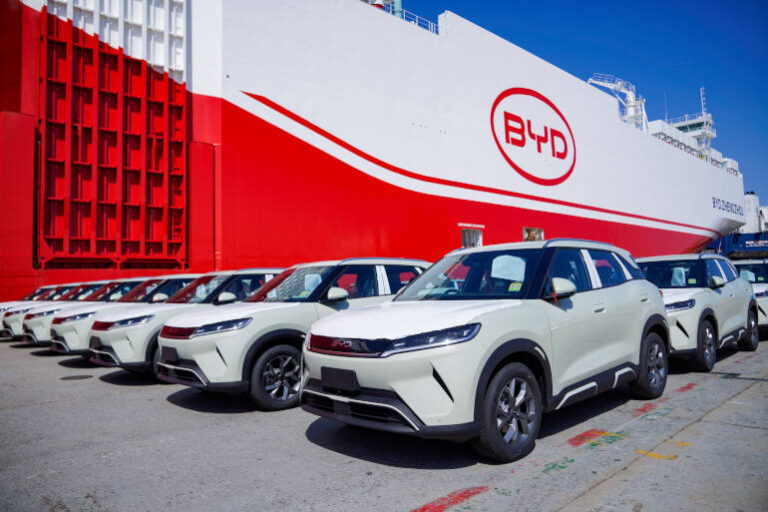
He pointed to the introduction of lower-priced variants such as the ATTO 3 Essential as an example of that strategy.
Rather than discounting an existing higher-specification model, BYD can introduce another variant aimed at customers with a different budget.
Walker said the intention is to avoid undermining the value of vehicles already in the market.
“What that does is it keeps the residual value of the previous one, but also brings in another sub model that helps get people into the EV bracket,” he said.
For Fleet Managers, that approach matters because substantial manufacturer discounting can influence used-vehicle expectations.
If new vehicles are routinely sold well below their original positioning, it can place additional pressure on existing vehicles approaching disposal.
Using auctions to create market evidence
BYD is also using the used-vehicle market to provide Fleet Management Organisations with more information about actual resale outcomes.
Walker said BYD has partnered with Pickles to put vehicles through public auctions, allowing fleet partners to observe what vehicles are achieving in the secondary market.
“We have partnered with Pickles Auctions to be able to put our vehicles through public auction,” Walker said.
He said the process gives Fleet Management Organisations greater visibility of market results and helps provide data that can be used when assessing future residual assumptions.
“Our FMOs can see real time and live what our vehicles are going through on the public side,” Walker said.
That type of information becomes increasingly valuable as more battery electric vehicles enter the used market.
While established internal-combustion models may have years of historical disposal data available, newer EVs have a shorter remarketing history. Actual auction results provide another data point for fleets and finance providers trying to understand future values.
Early ATTO 3 results provide a benchmark
During the interview, Walker was also asked about early BYD ATTO 3 vehicles reaching the used market after around three years.
He said the information provided to BYD indicated a residual of approximately 55 per cent after three years, although he noted that some ex-rental vehicles produced different results.
“There were some ex rentals that went through that obviously were a little bit different,” Walker said. “If you take those out, it’s about the 55% residual after three years was the information we’ve been given.”
The figure provides an early reference point rather than a guarantee of future resale performance.
Vehicle condition, kilometres travelled, specification, market supply and broader demand can all affect disposal outcomes, while the Australian used-EV market continues to develop.
For Fleet Managers, the more useful point may be that BYD is now gathering actual disposal data as its earliest vehicles reach traditional fleet replacement ages.
Warranty changes may also support confidence
BYD’s move to retrospectively improve warranty coverage for vehicles already sold in Australia could also influence confidence among used-vehicle buyers.
Rather than limiting the revised warranty conditions to new customers, the company extended the changes to existing vehicles.
Walker said the decision was intended to demonstrate confidence in the product and support existing owners.
“We don’t want to draw a line in the sand. We want to grow ourselves in as an Australian business, and part of that is really showing trust in the brand,” Walker said.
He suggested the decision may also encourage repeat purchases, although he acknowledged he had not seen data confirming the effect.
From a fleet perspective, transferable warranty coverage and confidence in ongoing manufacturer support can become relevant when vehicles reach the second-hand market.
Whole-of-life cost remains the bigger question
As BYD competes for more fleet business, purchase price alone will not determine whether its vehicles become established within major fleet replacement programs.
Fleet Managers will increasingly be looking at the full lifecycle: acquisition cost, charging or fuel, maintenance, downtime and eventual disposal value.
BYD’s decision to avoid heavy discounting, introduce additional variants and provide more visibility of auction results shows the company is trying to influence one of the areas that remains difficult to predict for newer EV brands.
For fleet buyers, the next few years will provide considerably more evidence.
As larger numbers of BYD vehicles complete their first fleet replacement cycles, actual disposal results will begin to show whether those strategies are translating into consistent whole-of-life cost outcomes.