Ausgrid is a finalist in the Fleet of the Year category in the 2026 Fleet News Group Awards.
In the second article in our six-part series, we look at one of the most ambitious parts of its fleet strategy: electrifying a large operational fleet without compromising the work it exists to perform.
Electrifying passenger cars is becoming familiar territory for many Australian fleets. The harder question is what happens when vehicles also need to carry tools, support field crews, move freight and respond to emergencies.
That is the challenge Ausgrid is taking on.

Passenger vehicles were only the beginning
At the time of the Fleet News Group Awards interview, approximately 11 per cent of Ausgrid’s fleet had been electrified.
The organisation was targeting 24 per cent by the end of FY2027 and close to 60 per cent by the end of FY2029.
Most of the passenger fleet had already transitioned to electric vehicles, giving Ausgrid experience with vehicles, charging and driver adoption at scale.
But the passenger fleet is only one part of the operation.
Moving into harder applications
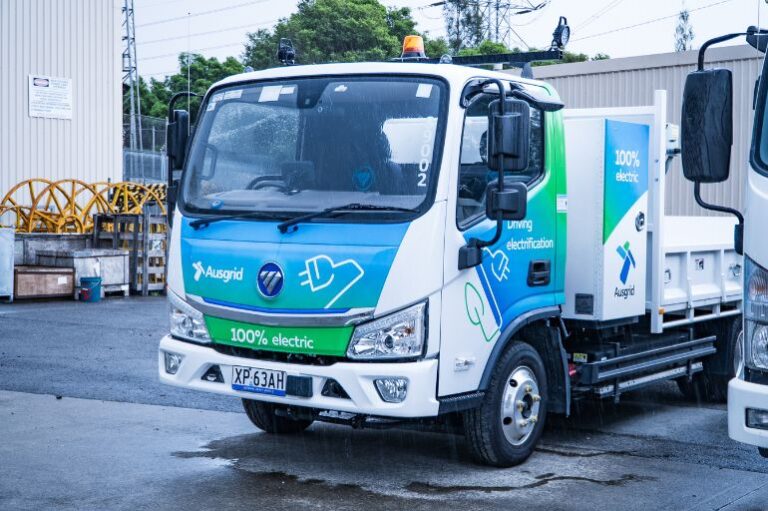
Ausgrid had also introduced close to 30 electric vans and five electric trucks in the 4.5-tonne class at the time of the interview.
The fleet team had also been testing a Volvo electric prime mover as it considered how electrification might extend into heavier applications.
This is where the transition becomes more complex.
Range, payload, charging time, operating location, emergency requirements and the equipment carried on the vehicle all need to be considered before a conventional asset can be replaced by an electric equivalent.
Electrification sits inside the fleet strategy
The transition is not being managed as a stand-alone sustainability project.
Electrification is one of four pillars in Ausgrid’s CEO-endorsed fleet strategy for FY2026 to FY2029, alongside safe to work, fit for purpose and value for money.
That means every electric vehicle still has to satisfy the other three requirements.
It must be safe. It must be suitable for the duty cycle. And it has to make sense from an operational and financial perspective.
Testing before scaling
Ausgrid’s approach is based on learning from real use before increasing deployment.
Passenger vehicles have provided the first large-scale step, followed by vans, smaller trucks and heavier vehicle trials.
That staged approach is especially important for an organisation that may need to respond to storms at short notice.
A vehicle that performs well on a predictable metropolitan route may face a very different challenge when crews are travelling longer distances during an emergency response.
Scale changes the problem
As the percentage of electric vehicles increases, the challenge also moves beyond vehicle procurement.
Charging infrastructure, depot electricity demand, home charging, driver reimbursement and access to charging away from depots all become fleet management issues.
This is what makes large-scale electrification a systems project rather than a purchasing exercise.
Why this matters for Fleet of the Year
Ausgrid is trying to move electrification from the easier parts of the fleet into applications where fleet managers have traditionally had fewer alternatives.
The important part of the story is not just the target. It is the way electrification is being integrated with safety, operational suitability and value for money.
Ausgrid is a finalist in the 2026 Fleet News Group Fleet of the Year Award. If you believe operational fleets should be recognised for pushing electrification beyond passenger vehicles, you can vote for Ausgrid.
Vote for Ausgrid in the Fleet of the Year Award
The Fleet News Group Awards winners will be announced in Sydney on 14 October 2026.
Register your interest to attend the Fleet News Group Awards Night
Next week: Buying electric vehicles is only part of the transition. We look at Ausgrid’s approach to depot, substation and home charging.