

Australia’s new vehicle market may have declined slightly in May 2026, but the month will be remembered as a turning point in the nation’s transition to lower-emission vehicles.
According to VFACTS data, Australians purchased 100,206 new vehicles during May, down 4.8 per cent compared with the same month last year. However, battery electric vehicles (BEVs) reached a record 20 per cent market share, while electrified vehicles overall — including hybrids, plug-in hybrids and BEVs — accounted for 46 per cent of all new vehicle sales.
The results suggest Australian consumers are rapidly moving away from traditional petrol and diesel vehicles, particularly in the popular SUV segment.
Federal Chamber of Automotive Industries (FCAI) Chief Executive Tony Weber said the market is undergoing a significant transformation.
“The shift is particularly evident in the SUV segment, where consumer preferences are changing rapidly. Today’s SUV buyer is increasingly choosing hybrid, plug-in hybrid and electric options,” said Weber.
In the SUV category, EV sales increased 167 per cent compared with May 2025, while plug-in hybrid sales jumped 377 per cent. Over the same period, petrol SUV sales fell 31 per cent and diesel SUV sales declined 41 per cent.
Toyota remained Australia’s top-selling brand with 16,342 deliveries, followed by BYD with 8,211 sales, Ford with 7,195, Hyundai with 7,007 and Kia with 6,761. BYD continued its remarkable growth trajectory, increasing sales by 155 per cent compared with May 2025.
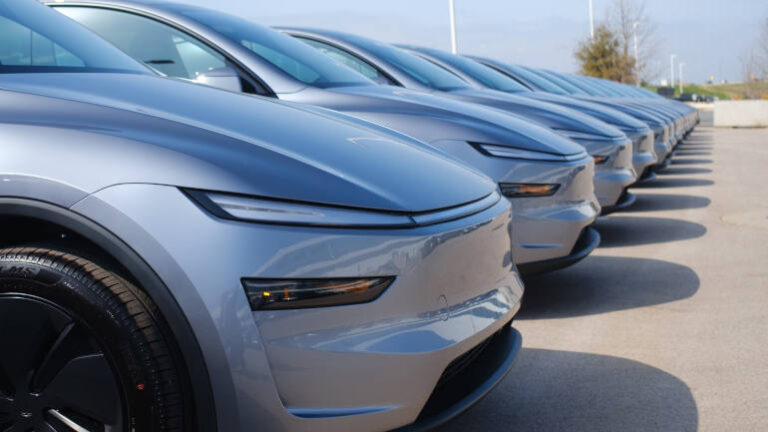
The Tesla Model Y became Australia’s best-selling vehicle for the first time with 5,605 deliveries, ahead of the Ford Ranger (4,474 ), Toyota HiLux (4,052) and Toyota RAV4 (3,865).

Record Month for EV Sales
Separate data released by the Electric Vehicle Council (EVC) highlighted the strength of the EV market.
The EVC reported Tesla delivered 6,433 battery electric vehicles during May, the highest monthly sales result ever recorded in the organisation’s dataset. Combined Tesla and Polestar deliveries reached 6,681 vehicles, also a record high.
Electric Vehicle Council Chief Executive Julie Delvecchio said the result demonstrates growing consumer confidence in electric vehicles.
“May 2026 is an important moment for Australia’s EV transition – the strongest month on record for combined Tesla and Polestar sales,” said Delvecchio.
“Tesla’s record-breaking 6,433 sales in a single month, the highest ever recorded in the Electric Vehicle Council’s dataset, shows more Australians are choosing electric.”
Tesla’s result was driven largely by the Model Y, which accounted for 5,605 deliveries during the month and represented 84 per cent of Tesla and Polestar sales captured in the EVC report.
Delvecchio linked the surge in EV demand to growing cost-of-living pressures.
“When fuel prices hurt, people look for alternatives. Electric vehicles offer exactly that – no trips to the servo, no price spikes at the pump, savings of around $3,000 a year.”
Electric Car Discount Driving Demand
The National Automotive Leasing and Salary Packaging Association (NALSPA) believes government incentives are playing a major role in accelerating EV adoption.
NALSPA Chief Executive Rohan Martin said battery electric vehicles accounted for around 20 per cent of all new vehicle sales during May, representing the highest monthly market share ever recorded.
“EVs are surging in unprecedented volumes in Australia, and the Electric Car Discount is the main driver,” Martin said.
“The Electric Car Discount is the enabler getting these EVs into driveways and on our roads. It’s making the switch affordable and feasible for everyday Australians.”
Martin said the combination of novated leasing and the Electric Car Discount is helping households manage rising transport costs.
“Cars are one of the most expensive purchases families make, with the Australian Automobile Association estimating that the typical Australian household spends 15.8 per cent of its income on transport.”
“However, the Electric Car Discount combined with novated leasing is helping families to minimise those costs.”
According to NALSPA, more than half of all EVs sold today are purchased using the Electric Car Discount, with the Tesla Model Y, BYD Sealion 7 and Tesla Model 3 leading novated lease EV purchases during the first quarter of 2026.
Infrastructure Now the Next Challenge
While the sales figures demonstrate strong momentum for low-emission vehicles, industry leaders agree that infrastructure investment must keep pace.
Weber warned that the rapid growth in EV adoption is increasing pressure on Australia’s charging network.
“As the number of EVs on the road continues to grow, charging infrastructure must become more of a priority. Continued investment and enabling policy settings will be essential to ensure infrastructure keeps pace with consumer adoption,” he said.
The May results also provide an early indication that the New Vehicle Efficiency Standard (NVES) is influencing the mix of vehicles being offered to Australian consumers.
“The evidence increasingly demonstrates that NVES is encouraging manufacturers to bring more low emissions vehicles to Australia, increasing both consumer choice and technology availability,” Weber said.
With electrified vehicles now approaching half of all new vehicle sales and battery electric vehicles achieving a record 20 per cent market share, May 2026 may be remembered as the month Australia’s automotive market decisively shifted towards a lower-emissions future.