For emergency services, choosing a 4×4 truck has traditionally been about capability: payload, ground clearance, traction and the ability to keep moving when road conditions disappear.
But Isuzu believes another factor is becoming just as important — how easy the truck is to drive.
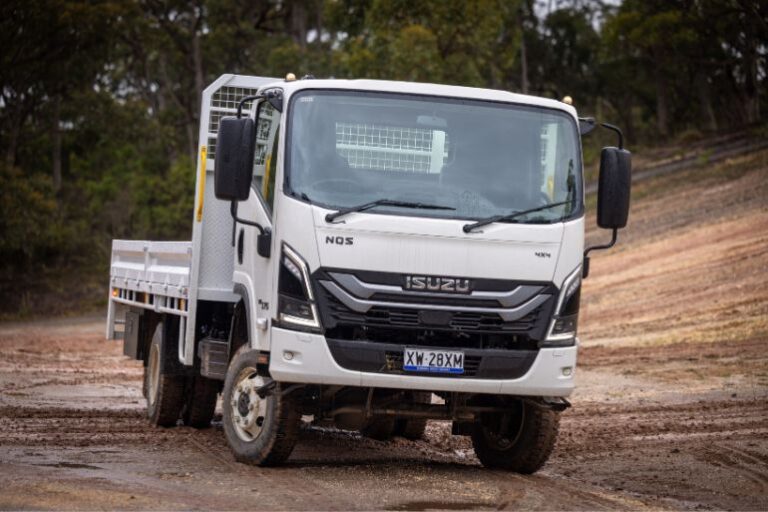
That thinking is reflected in the new NQS 4×4, which introduces Isuzu’s nine-speed dual-clutch transmission into a vehicle aimed squarely at emergency services, mining and other multi-driver fleet applications.
For Fleet Managers, the significance is not simply that the truck has an automatic-style transmission. It is that a vehicle which may need to be driven by dozens of different people can be made easier to operate consistently and safely.
Not every driver is a truck driver
During Isuzu’s 4×4 launch program, Isuzu Australia Limited Head of Sales Craig White said emergency service fleets present a very different operating challenge to many other commercial vehicle applications.
A rural fire truck or SES vehicle may be used infrequently, but when it is needed, it has to perform immediately.
The driver may also be a volunteer who does not spend every day operating a heavy vehicle.
“The purpose of what we want to achieve out of this product is to make it user-friendly, make it easy to operate for the volunteers,” White said.
That has clear implications for fleet management.
A vehicle can be mechanically capable, but if it requires a high level of familiarity to operate effectively, that can add complexity around training, driver allocation and emergency response.
A simpler driving experience reduces one of those barriers.
Two pedals can make a big difference
The new NQS is fitted with Isuzu’s MYR9 nine-speed dual-clutch transmission, providing a two-pedal configuration rather than a conventional manual gearbox.
Isuzu Australia Limited Head of Product Management & CV Chief Engineer Simon Humphries said that transmission choice was particularly important for emergency services.
He explained that emergency fleets often want vehicles that can be driven by a broader range of operators without the additional workload that comes with a manual transmission.
For an experienced truck driver, changing gears off-road may be second nature.
For a volunteer who only drives the vehicle occasionally, removing that task can allow greater concentration on vehicle placement, terrain, surroundings and the job at hand.
Humphries described the NQS as being aimed “squarely at the mining companies, the fire services, emergency services and the like”.
That positioning helps explain why Isuzu has retained the manual NPS alongside the NQS rather than replacing it completely.
The two models are intended for different users.
More ratios, more control
Ease of use does not mean removing off-road capability.
Humphries said the nine-speed transmission provides a much broader spread of ratios than the previous five-speed automated transmission used in earlier NPS models.
That becomes particularly useful in low-range driving, where selecting the right gear can be critical to maintaining momentum and control.
During the off-road drive program, Humphries said the lowest ratios were so short that they were effectively reserved for extreme situations.
“In low range through the really tough stuff, first and second gear are too short,” he said.
“Third gear low range seems to be the sweet spot for just going through the tough stuff.”
For Fleet Managers, that illustrates the practical value of additional ratios.
Rather than asking the driver to manage a relatively narrow gear spread, the transmission gives the vehicle more flexibility to match engine speed and wheel speed to the terrain.
That can make the truck more forgiving for drivers with different levels of experience.
Emergency fleets are multi-driver fleets
This is where the fleet argument becomes stronger.
Emergency service vehicles can be shared across a large driver pool.
Some operators may use the vehicle regularly. Others may only drive it during training, major incidents or seasonal events.
White said this creates a requirement for vehicles that can deliver predictable performance regardless of who is sitting behind the wheel.
Reliability remains central, but operational simplicity also matters.
“If you’re relying on a product for a particular moment to do its job, it is crucially important that this product is reliable and does what it says it’s going to be doing every single time,” White said.
For a Fleet Manager, that extends beyond mechanical reliability.
It also means creating a vehicle specification that makes it easier for drivers to achieve the same result every time they use it.
Easier driving can support training
A simpler drivetrain can also reduce the number of tasks a driver needs to manage during training.
Emergency vehicle operators still need to understand vehicle dimensions, braking distances, off-road technique, low-range operation and safe recovery practices.
But removing clutch operation and manual gear selection from the equation can make familiarisation less complicated. That does not eliminate the need for training. It changes what the training can focus on.
Instead of spending time teaching drivers how to manage a manual transmission in difficult terrain, fleets can spend more time on vehicle placement, situational awareness and application-specific procedures.
For organisations relying heavily on volunteers or rotating driver pools, that can be a meaningful operational advantage.
Payload also enters the equation
The NQS also increases Gross Vehicle Mass to 8,000kg compared with the 7,500kg NPS.
Humphries said that increase has particular value for emergency service applications, where additional payload can translate directly into extra equipment or water.
He noted that the additional capacity could allow a fire vehicle to carry hundreds of kilograms more water compared with a previous NPS-based configuration.
So the NQS proposition is not simply about creating an easier truck to drive.
It combines easier operation with additional payload capability and a broader safety package.
The fleet decision is changing
Traditionally, fleets buying an off-road truck may have focused heavily on mechanical specifications. Those remain important. But as emergency fleets become more safety-focused, more diverse and more reliant on shared vehicles, usability is becoming part of the specification process as well.
The question is no longer simply whether a truck can climb the hill.
Fleet Managers also need to ask how many people can confidently drive it up that hill when the call comes.
For Isuzu, the NQS represents an answer to that question: maintain the off-road capability expected from the brand’s 4×4 range, but make the vehicle easier for a broader pool of drivers to operate.
For emergency fleets, that may prove just as important as the hardware underneath it.