
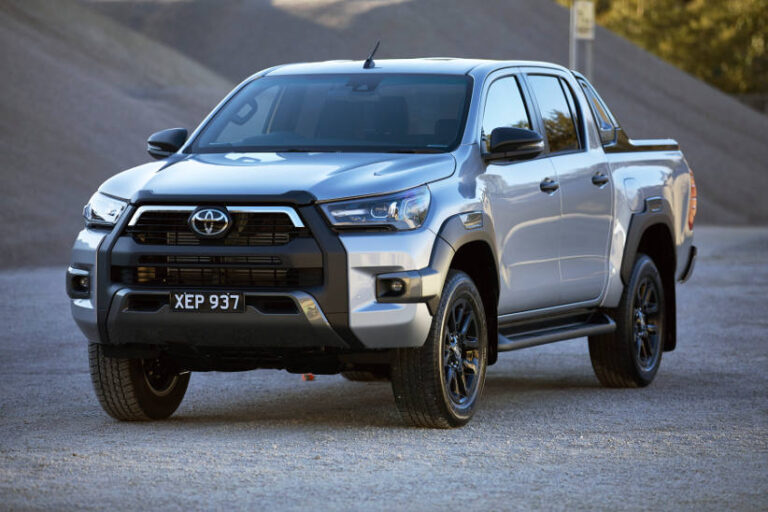
Toyota’s Sean Hanley, Vice President of Sales, Marketing and Franchise Operations, has once again declared that Australia has reached “peak ute,” a call he first made earlier in 2025 — and one he’s now doubling down on following the launch of the new HiLux.
Speaking at an exclusive media event attended by Fleet News Group to launch the new HiLux, Hanley said the sales momentum of dual-cab utes has started to level out after more than a decade of dominance. It’s a brave statement from the executive whose brand has built its reputation around the country’s best-selling ute. But as Hanley explained, this shift doesn’t spell the end of the HiLux story — rather, it reflects the changing priorities of Australian buyers and fleets.
“The ute market has reached its peak,” Hanley said. “Recent sales data already shows a shift in consumer preferences, with RAV4 taking the title as our best-selling vehicle last year. That strength has continued into 2025, and even with the current HiLux in run-out, demand has remained remarkable — but the trend is clear. The market is changing.”
For Toyota, which has sold more than 1.4 million HiLuxes in Australia since 1968, this is not a concession — it’s a recognition of evolution. The ute isn’t disappearing; it’s simply no longer the default choice for every fleet or business.
And that sentiment aligns perfectly with what Fleet News Group is hearing from readers. The conversations among Fleet Managers today are very different from five years ago. The focus is shifting from badge loyalty to fit-for-purpose decision-making — choosing the right vehicle (or sometimes, no vehicle at all) to meet operational needs while cutting emissions and costs.
For many organisations, that means the replacement cycle no longer automatically leads back to another diesel ute. Instead, Fleet Managers are weighing smaller hybrids, plug-in hybrids and BEVs with lower whole-of-life costs (WOLC), or exploring entirely new approaches to mobility.
As one local government Fleet Manager recently told Fleet News Group:
“We used to just replace like-for-like — if a ute came off lease, we ordered another one. Now, we’re asking whether that vehicle even needs to exist. In some cases, a pool car, an e-bike, or a car-share account makes more sense.”
That real-world mindset mirrors the pressure Hanley acknowledged across the broader market.
“We’ve got family buyers, recreational buyers, fleets, and tradies — and they all have different needs,” he said. “Hilux will continue to deliver for those customers, but we’re seeing fleets and governments set clear CO₂ reduction targets. They’re looking at total cost of ownership and emissions together — and that’s shaping what they buy next.”
Fleet data supports this shift. Across Australia, organisations are now applying more rigorous utilisation analysisbefore replacing vehicles. If a ute has only travelled a few thousand kilometres a year, or spends more time parked than working, it’s no longer being justified on the balance sheet. That’s pushing procurement teams toward right-sizing their fleets — choosing vehicles that fit the job rather than the job fitting the vehicle.
Hanley’s “peak ute” remark isn’t an alarm bell; it’s a reflection of this maturity. After years of exponential growth, the market for large dual-cab workhorses has stabilised as new segments — like compact SUVs, plug-in hybrids and battery-electric light commercials — start to fill the gaps.
The challenge for Fleet Managers now is balancing operational flexibility with sustainability. In many cases, the lowest-emission vehicle is the one you don’t replace. That means embracing mobility solutions such as shared vehicles, outsourced logistics, and active transport for short trips — ideas that are becoming mainstream in fleet policy discussions.
Toyota, for its part, isn’t fighting the trend. The company is expanding its multi-pathway strategy to offer multiple powertrain options — from hybrids and plug-in hybrids to the upcoming battery-electric HiLux in 2026 and hydrogen fuel-cell version in 2028. Each represents a step toward giving fleets the right vehicle for the right job, rather than forcing them into one powertrain path.
Hanley summed it up succinctly:
“The ute market is still significant — but the peak doesn’t mean decline, it means diversification. Customers are choosing vehicles based on their purpose, not just their category. That’s the future.”
For Fleet Managers, that future is already here. As budgets tighten and sustainability goals sharpen, the new question isn’t “What ute should we buy?” but “Do we still need a ute at all?”