

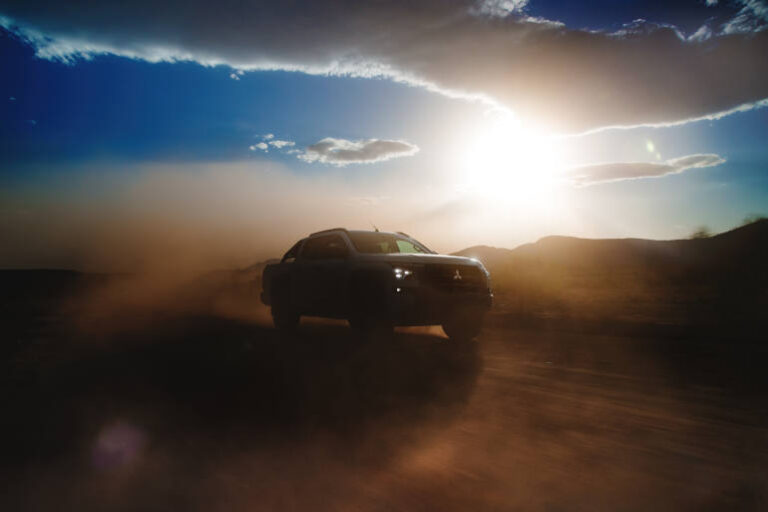
Mitsubishi Motors Australia has offered an early glimpse of its toughest new ute variant, revealing the upcoming Triton Raider after a series of demanding durability tests in South Australia’s remote Flinders Ranges.
Designed with adventure and resilience in mind, the Triton Raider is being positioned as a more extreme interpretation of the brand’s well-known workhorse—drawing inspiration from rally raid competition vehicles while maintaining the practicality expected by Australian fleet and commercial buyers.
The vehicle recently completed final pre-launch testing in harsh local conditions, including a sandstorm at Arkaroola, as engineers validated performance in terrain that closely mirrors the operating environments faced by mining, construction, utilities and regional service fleets.
Built for Harsh Conditions and Hard Work
For organisations operating in remote or demanding environments, the message behind the Raider concept is straightforward: durability and off-road capability remain core requirements for many fleet applications, even as the market shifts toward electrification and new technologies.
According to Mitsubishi, the Triton Raider has been developed with Australian engineering input and tested in some of the country’s toughest terrain, reinforcing its suitability for customers who rely on vehicles to perform reliably in challenging conditions.
This approach reflects a broader trend in the ute segment. While comfort and connectivity continue to improve, capability remains a non-negotiable factor for fleets operating beyond metropolitan areas.
Typical use cases likely to align with a vehicle like the Triton Raider include:
- Regional and remote operations such as utilities, telecommunications and emergency services
- Mining and construction support roles where terrain and payload demands are unpredictable
- Field service and infrastructure maintenance requiring reliable access to difficult locations
- Recreation and lifestyle fleets where off-road capability is part of the job requirement
A New Variant Strategy for the Triton Range
The introduction of the Raider also signals how manufacturers are continuing to diversify ute line-ups to meet more specialised customer needs.
Rather than relying on a single specification to serve all buyers, OEMs are increasingly offering targeted variants that balance capability, comfort and brand positioning. In practical terms, that means fleet procurement teams may see more niche models designed for specific operational scenarios.
For Fleet Managers developing replacement strategies or reviewing vehicle categories, this trend reinforces the importance of maintaining flexible specifications and regularly revisiting fit-for-purpose assessments.
What It Means for Fleet Planning
From a fleet management perspective, the Triton Raider preview highlights three practical considerations:
1. Capability remains a core procurement driver
Even as sustainability and technology dominate industry conversations, many fleets still require vehicles that can handle extreme environments without compromise.
2. Variant selection is becoming more complex
The growing number of specialised models means procurement frameworks need to be structured and data-driven to ensure the right vehicle is selected for each application.
3. Testing in local conditions matters
Vehicles validated in Australian operating environments tend to deliver stronger real-world performance and reliability outcomes.
Launch Timing and Market Position
Mitsubishi has confirmed that the Triton Raider is preparing to arrive in Australian showrooms during 2026, following completion of its final validation program.
While detailed specifications are yet to be released, the positioning suggests the Raider will sit toward the more rugged end of the Triton range—appealing to customers who prioritise off-road capability and durability alongside everyday usability.
For fleet buyers, the key takeaway is less about a single model and more about the direction of the segment. Utes are continuing to evolve into highly specialised tools, and procurement strategies need to evolve with them.