

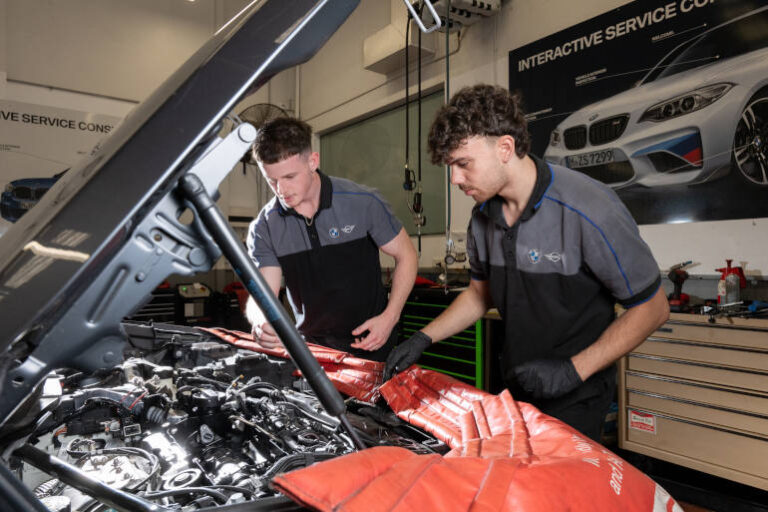
BMW Australia has announced an expansion of its award-winning #NextTech Mentored Apprenticeship Program, extending the initiative in 2026 to include motorcycle and body repair training as the automotive industry grapples with an ongoing skills shortage.
Since launching in 2021, the program has enrolled 167 light vehicle apprentices nationwide, achieving retention rates above 80 per cent — well ahead of the national average of around 50 per cent. To date, 37 apprentices have graduated with dual qualifications as light vehicle technicians and automotive electricians.
The program was recently recognised by the Apprenticeship Employment Network (AEN), receiving the Group Training Organisation Service Excellence Award at its Apprentice Training Awards ceremony, acknowledging its training model and industry impact.
Building capability for a changing fleet environment
Delivered in partnership with NextGen Jobs and the Bendigo Kangan Institute Automotive Centre of Excellence, the #NextTech program combines structured training with hands-on experience in BMW dealerships across Australia.
BMW says the initiative forms part of its broader corporate social responsibility approach, with a focus on long-term workforce development as vehicle technology continues to evolve.
“Australia is facing a severe shortage of automotive technicians, with nearly 40,000 skilled roles unfilled nationwide,” said Brett Hocking, General Manager of Aftersales, BMW Group Australia. “The BMW #NextTech program demonstrates our commitment to helping develop the industry, upskill apprentices, and prepare the next generation of automotive technicians for the challenges of a rapidly evolving industry that includes electrification.”
Higher participation from women
Female participation in the #NextTech program currently stands at 12 per cent, significantly above the industry average of 2.6 per cent for trade roles. BMW says this reflects a deliberate effort to encourage greater diversity in automotive careers.
Sophia Kim, a third-year #NextTech apprentice at Brisbane BMW, said the program provided opportunities that extended well beyond traditional training pathways.
“Joining the BMW NextTech program as a woman in a non-traditional trade was an incredible opportunity,” Kim said. “Through training across both Light Vehicle Mechanical and Auto Electrical disciplines, along with additional BMW certifications, I gained access to advanced facilities and the latest BMW technology. The ongoing support and mentoring made all the difference.”
Structured pathways and strong demand
Apprentices in the program complete their Certificate III in Light Vehicle Mechanical Technology within three years, alongside BMW Registered Technician Certification. Participants can also extend into a fourth year to gain an automotive electrician qualification focused on high-voltage systems, graduating as BMW Certified High Voltage Technicians.
Demand for the program has been strong since inception. BMW noted the first intake in 2021 was oversubscribed, with the initial vacancy filled within 52 minutes.
Al Gonzalez, a #NextTech graduate from Berwick BMW, described the experience as career-defining.
“The BMW NextTech program helped me to grow and push myself to become the technician I am today, with state-of-the-art facilities, vehicles, instruction and all the tools I’d ever need,” he said.
Expansion from 2026
From 2026, BMW will broaden the program to include BMW Motorrad and body repair pathways, opening additional career options across its dealer network. A new BMW Brand Immersion Scholarship will also be introduced, allowing two apprentices each year to travel to BMW headquarters in Munich for further development.
Andrew Robson, Head of Business and Operations at NextGen Jobs, said the expansion highlighted the value of collaboration in tackling workforce challenges.
“The program’s success in generating strong demand from both apprentices and industry provides a blueprint for how to address skills gap challenges,” Robson said.
For fleet buyers and Fleet Managers, the program underscores the growing importance of technician capability as vehicles become more complex, electrified, and software-driven — and the role OEM-led training programs can play in supporting long-term fleet uptime and service readiness.