

Ask a fleet manager where vehicle 47 is, and they’ll have it on screen in about four seconds. Ask them which state it’s registered in, and you’ll get a pause, then a spreadsheet, then a caveat about how current the spreadsheet is.
Both are location questions. Only one of them is a compliance question. Those are different questions, and the second one is the compliance question.
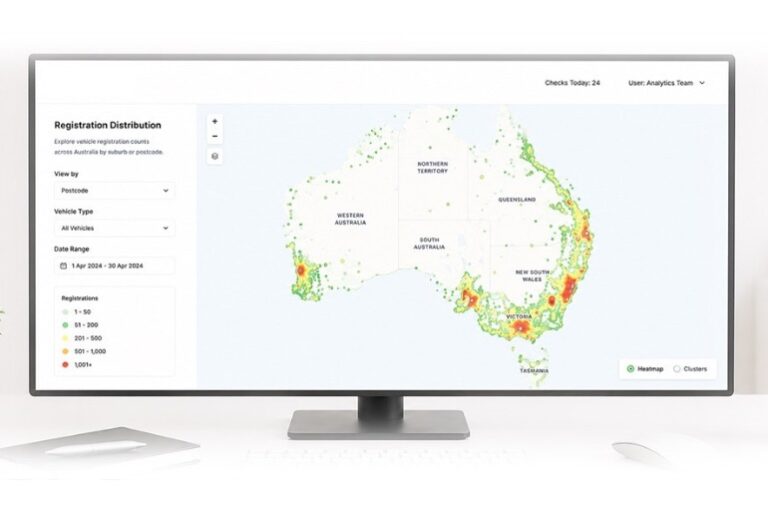
Registration locality is the suburb, postcode and state recorded against a vehicle’s registration with the road authority. It comes from NEVDIS, the national system that consolidates registration data from every state and territory. It is not a location feed. It reflects the suburb and postcode the registered operator has declared, and it updates only when registration details change, not continuously.
“It’s worth being clear about what this isn’t,” says Paul Hardiman, General Manager at InfoAgent. “It won’t tell you where a vehicle is parked tonight. Telematics does that, and does it well. What it tells you is what the road authority believes about that vehicle, which is a different thing entirely, and it’s the version that matters when there’s a compliance question.”
The interstate drift problem
Vehicles drift. A ute goes from a Melbourne depot to a job in Albury for what was meant to be six weeks, and two years later it’s still there with Victorian plates. Nobody did anything wrong. Nobody did anything at all, which is the point: reassigning a vehicle interstate doesn’t trigger a single administrative event. The fuel card works, the servicing happens, the rego renewal arrives at head office and gets paid.
Meanwhile, the vehicle has been operating outside the jurisdiction it’s registered in for longer than that jurisdiction allows.
Each state and territory has its own registration requirements, CTP scheme, and rules on how long a vehicle can operate in the jurisdiction before it needs to be registered there. A fleet operating across borders quietly accumulates these gaps.
“Fleet managers aren’t ignoring this. They just can’t see it,” says Hardiman. “The vehicle is working, the driver is happy, and nothing in the system flags that it’s been in another state for eight months. The first anyone knows is usually an insurance conversation after an incident, and that’s an expensive way to find out.”
What it gives a fleet manager
Running registration locality across a fleet gives you four things worth having.
A jurisdiction list you can trust. Every vehicle mapped to the state it’s actually registered in, sourced from the register rather than from your own records. For multi-state fleets, that’s the foundation of any compliance review.
Early sight of drift. Compare the registered locality with where the vehicle is operating, and mismatches surface. Some will be legitimate. Others are vehicles that should have been transferred months ago.
Accurate renewal and cost planning. Registration costs and CTP premiums vary by jurisdiction. If your cost model is built on where you think vehicles are registered rather than where they are, the forecast drifts along with the vehicles.
Where it sits in a fleet workflow
Lookups run by rego or VIN and return locality alongside registration status, so one call tells you where it’s registered and whether that registration is live.
Nobody should be keying plates in one at a time. Batch the whole asset register, run it quarterly or at renewal, and treat the output as an exception report rather than something to read line by line. Most of it will be fine. You’re looking for the dozen that aren’t.
For most fleets, the sensible pattern isn’t a one-off audit. It’s a periodic sweep, run quarterly or at renewal, across the whole asset register. Batch processing handles that without anyone having to key in plates.
“Fleet managers tend to find this most useful at two moments,” Hardiman says. “When they inherit a fleet and need to know what they’ve actually got, and at renewal when the invoice doesn’t match the assumption. Both are moments where the register is the only source that settles it.”
The honest limitation
Registration locality reflects a declared location, not a garaged one. A vehicle registered to a head office address may live two hundred kilometres away, and a company-registered fleet will often show a single corporate address across the whole book.
That doesn’t make it useless, but it does mean it answers a compliance and administrative question rather than an operational one. Used that way, it fills a genuine gap. Used as a proxy for location, it will mislead you.
For fleets running across state lines, it’s one of the few data points that shows the administrative picture rather than the operational one, and that picture is usually the one nobody has looked at recently.