

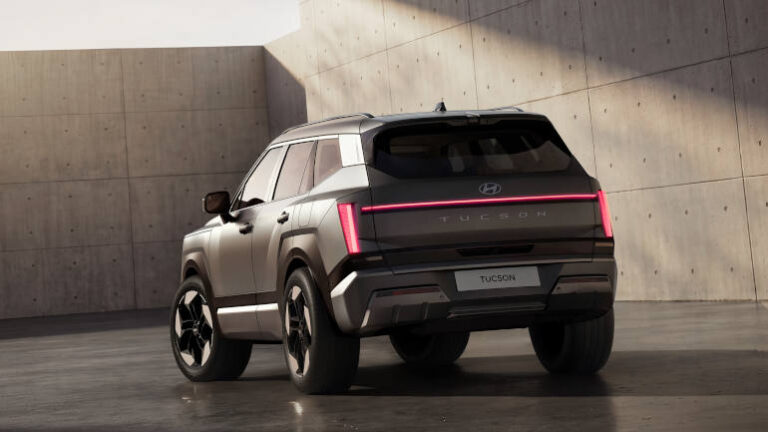
Hyundai’s next-generation Tucson will arrive in Australia in mid-2027 with a hybrid-only line-up, bringing a larger body, redesigned cabin and new digital technology to the SUV market.
Unveiled globally in New York, the all-new Tucson introduces Hyundai’s next-generation hybrid system and a design direction the company calls “Art of Steel”.
For fleet managers planning replacements in 2027, the Australian powertrain decision is the key development. Hyundai has confirmed hybrid power for the local range, although Australian pricing, model grades, fuel consumption and detailed specifications are yet to be announced.
The rugged-looking XRT variant is also confirmed for Australia. The more extensively equipped XRT PRO will be exclusive to North America.
More space and easier access
Australia will receive the long-wheelbase Tucson, which grows to 4,700mm long, 1,905mm wide and 1,685mm high. These dimensions represent increases of 60mm, 40mm and 20mm respectively over the previous model, while the wheelbase increases by 30mm to 2,785mm.
The larger footprint provides additional cabin space, with Hyundai reporting rear legroom of 1,064mm. Door opening angles increase from 73 to 83 degrees, improving access for passengers.
For fleets using SUVs as pool vehicles or transporting staff between sites, cabin access and passenger space are practical considerations. The increased exterior dimensions will also need to be considered where parking and depot space are tight.
“Millions of families around the world count on the Hyundai TUCSON, and this is the best one we have ever built,” said José Muñoz, President and CEO of Hyundai Motor Company.
Hybrid technology adds parked comfort
Hyundai says its next-generation hybrid system has been developed to balance fuel efficiency with performance and everyday driving refinement.
Among the features announced globally is HEV Stay Mode, which allows air conditioning, heating, audio and device charging to operate while the engine is switched off.
That capability could be useful for employees taking breaks or waiting between appointments, although local availability and operating conditions will need to be confirmed.
The hybrid also introduces E-Traction, a system designed to manage driving torque and reduce wheel slip during cornering.
Hyundai has released overseas efficiency targets, but Australian fuel consumption figures remain outstanding. Fleet buyers will need those local figures, together with acquisition and servicing costs, to assess whole-of-life cost against existing vehicles.
Physical controls remain part of the cabin
The redesigned interior combines a slim 9.9-inch driver display with a central touchscreen measuring either 12.9 or 17 inches, depending on specification.
Hyundai has retained tactile buttons for frequently used climate and audio functions beneath the central display. The company says the layout is intended to reduce driver distraction and the need to interact with touchscreen menus.
Gear selection moves to a steering column-mounted shift-by-wire lever, freeing space around the centre console. Storage includes an open tray beneath the dashboard and a concealed console tray, while dual wireless charging pads are available.
The new Pleos Connect infotainment system uses Android Automotive OS and supports over-the-air updates. It also introduces Gleo AI, a conversational assistant designed to respond to natural-language requests.
For shared fleet vehicles, the usability of these systems will be an important part of vehicle assessment and driver familiarisation.
Driver monitoring joins the safety package
The global Tucson announcement includes an in-cabin monitoring system that assesses driver eye activity and drowsiness to provide fatigue alerts.
Other announced technologies include child presence detection, rear occupant alerts, intelligent speed limit assistance and navigation-linked cruise control that can respond to upcoming curves and other road features.
Hyundai has also highlighted greater use of hot-stamped steel, reinforced centre pillars and revised collision energy management.
Australian safety equipment and an independent local safety rating are yet to be confirmed. Availability of the globally announced features will vary by market and model grade.
A 2027 fleet planning consideration
The new Tucson’s hybrid-only Australian range gives fleet buyers a clear indication of Hyundai’s direction ahead of its mid-2027 arrival.
Its larger cabin, physical controls and new hybrid functions offer several points for fleets to evaluate. The next step will be assessing the Australian specification, safety credentials and whole-of-life costs when local details are released.