
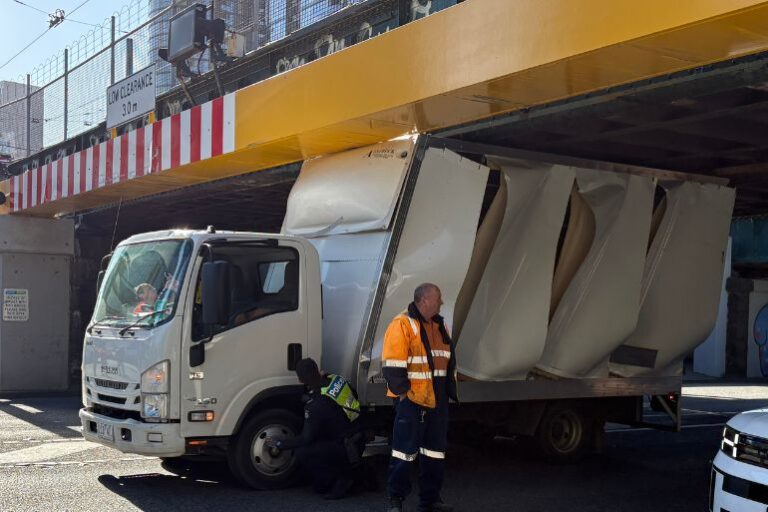
Australia’s bridge strike problem is not simply a question of drivers failing to read a clearance sign. The combination of growing freight volumes, pressure for more productive heavy vehicles, an ageing road network and a changing driver workforce is making the issue more complex for fleet operators.
That was one of the themes to emerge from a Fleet News Group conversation with Lex Vasdekis, Head Of Transport & Logistics – ANZ at HERE Technologies, following the release of The economic costs of bridge strikes in Australia.
Prepared by HoustonKemp Economists for HERE Technologies and the Australian Logistics Council, the report estimates around 1,220 bridge strikes occurred in Australia in FY2025, including incidents involving protection beams and signage. It puts their economic cost at approximately $101 million for the year.
Rather than declining, the report estimates incidents have increased by around 38 per cent since FY2018 and could reach approximately 1,500 a year by FY2035 without intervention.
For Vasdekis, the numbers highlight a risk that people working inside transport recognise, but which is not always visible outside the industry.
“We’re surprised that people don’t realize how many times bridges are getting hit each year,” Vasdekis said.
More freight meets existing infrastructure
The HoustonKemp report links its bridge strike forecast to continued growth in the freight task. It notes that increased heavy vehicle activity, combined with concentrations of height-restricted infrastructure, creates greater exposure to bridge strikes.
That becomes particularly relevant as operators look for greater productivity from every vehicle movement.
Vasdekis said major fleets are continually looking at ways to increase carrying capacity.
“They want bigger trailers where they can max out their their cube and utilization and productivity to get more product on,” he said.
The challenge is that the infrastructure the vehicles need to travel through has not necessarily evolved at the same rate.
“The infrastructure that we have in place is old,” Vasdekis said.
For fleet managers, the issue is not that larger or more productive vehicles are inherently a problem. It is that every change in vehicle or combination dimensions can change the routes available to it.
A route suitable for one truck may not be suitable for another. As combinations become higher, wider or longer, accurate vehicle dimensions and route information become increasingly important to daily fleet planning.
Experience is also leaving the industry
Vasdekis believes another change is occurring at the same time — experienced drivers are leaving while fleets continue trying to attract people into heavy vehicle driving.
He pointed to the heavy vehicle driver shortage and the resulting movement of people through the workforce as another reason fleets may need to reconsider how route knowledge is transferred.
“The churn of drivers coming in and out of the industry is really high,” he said.
A driver who has spent years operating in the same city may know which streets, bridges and rail underpasses need to be avoided without consulting a map. A new driver, someone moved onto an unfamiliar run, or a driver operating interstate may not have the same knowledge.
Vasdekis said that loss of familiarity increases the importance of providing drivers with assistance.
“If you’re not familiar with the road network and you haven’t lived in the city or the country, and you’re put into a vehicle with minimum levels of training and understanding of the road network, you really need you really need assistance,” he said.
It creates an important question for fleet managers: how much of the organisation’s route knowledge sits inside the heads of experienced drivers?
If a safe route depends on a driver remembering a particular low bridge, that knowledge can disappear when the driver retires, changes employer or moves to another run.
Turning local knowledge into fleet knowledge
The report identifies inadequate route planning and unfamiliarity with vehicle height among the factors associated with bridge strikes. It also points to GPS-based route planning and in-vehicle height warning systems as potential preventative measures.
Vasdekis said bridge-height data already exists, so the challenge is making relevant information available to drivers and operators in a practical way.
“It’s not that we haven’t had the data around Bridge Heights,” he said. “It’s more about you know ensuring that those people that have the capability of having applications in in vehicles, whether it be in a tablet form or a mobile phone form, that they actually have the capability to have warning and alerts available to them.”
There are legitimate questions around how that technology is introduced.
Some fleets limit the use of turn-by-turn navigation while vehicles are moving because of concerns about driver distraction, while others rely heavily on navigation and fleet-management systems. Smaller operators may have very different technology budgets and systems to large national fleets.
That means there is unlikely to be one approach that works for every operation.
The broader opportunity is to make information about vehicle dimensions and route restrictions part of the fleet’s operating process rather than relying entirely on individual experience.
A bridge strike does not stop at the bridge
The consequences also extend beyond the truck and damaged infrastructure.
HoustonKemp includes bridge repairs, vehicle damage, lost freight, congestion, rail disruption, business interruption and health impacts when calculating the economic cost of bridge strikes.
Vasdekis said this wider disruption was one reason HERE Technologies wanted the issue examined.
“So there’s a there’s a huge knock on effect to a bridge strike occurring,” he said.
A strike involving a rail bridge, for example, can stop road traffic while the structure is inspected and simultaneously disrupt passenger or freight rail services. Congestion then spreads to surrounding roads as other vehicles divert around the incident.
The HoustonKemp report estimates those combined effects could cost the economy $869 million in net present value terms over the decade from FY2026 to FY2035 if current trends continue.
For fleet operators, the report and Vasdekis’ comments point to a broader lesson. Bridge strike prevention is increasingly about managing the interaction between vehicles, drivers, infrastructure and information.
As the freight task grows and fleets seek greater productivity, relying on experienced drivers simply knowing which bridges to avoid may become less sustainable.
The challenge is turning that knowledge into a repeatable fleet process before the next truck reaches a low-clearance bridge.
- Fleet Support Starts With Listening at Daimler Trucks Canberra
 Daimler Trucks Canberra (Tristar Group) has built its ACT fleet relationships around a simple idea: understand the customer’s operation first, then prove the relationship through communication, follow-up and action. Daimler Trucks Canberra is a finalist in the 2026 Fleet News Group Fleet Supplier of the Year Award. Industry voting is open until 22 September 2026.
 - Why FleetGuru.ai Is Backing Recognition of Fleet Best PracticeFleetGuru.ai did not wait for the Fleet News Group Awards to become an established industry event before deciding to support it. The fleet technology company joined the inaugural program as a Foundation Sponsor because CEO and Co-Founder Eden Shirley believes recognising best practice is an important part of moving the fleet industry forward. “For us,
- How Euclidic upgraded 650 vehicles without disrupting the fleetReplacing telematics hardware across a national fleet sounds straightforward until the vehicles are spread across Australia, operating on customer-controlled sites, working in remote locations and rarely available at a convenient time. That was the challenge facing SRG Global when it needed to migrate approximately 650 vehicles from 3G OBD plug-in telematics devices to new 4G
- How Blacktown plans to serve a growing city without endlessly growing the fleetBlacktown City Council is a finalist in the Fleet of the Year category in the 2026 Fleet News Group Awards. In the final article in our six-part series, we look at how the fleet team is planning for population growth and higher service demand without assuming the answer is simply more vehicles. Blacktown is a
- From 750 events to 15: how Parkes is using fleet data to change behaviourParkes Shire Council is a finalist in the Fleet of the Year category in the 2026 Fleet News Group Awards. Its safety program shows why, using telematics, driver scorecards, trailer braking data and near-miss reporting to identify risk early and change behaviour before incidents occur. The final story in our Parkes Fleet of the Year