

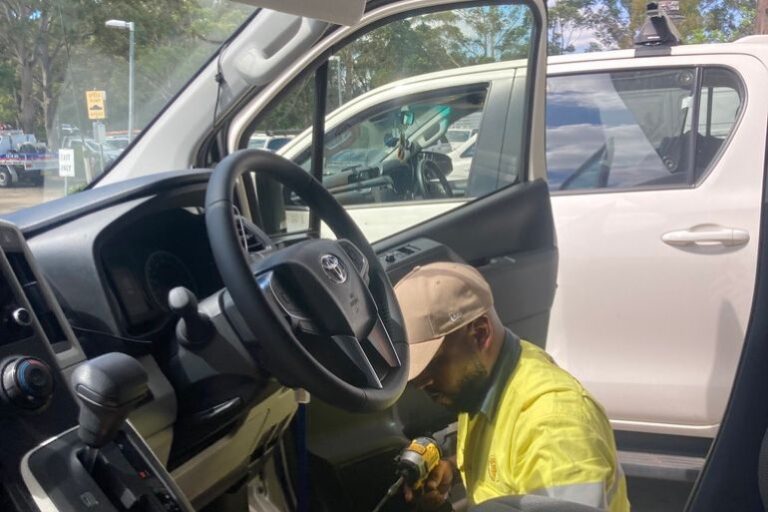
Replacing telematics hardware across a national fleet sounds straightforward until the vehicles are spread across Australia, operating on customer-controlled sites, working in remote locations and rarely available at a convenient time.
That was the challenge facing SRG Global when it needed to migrate approximately 650 vehicles from 3G OBD plug-in telematics devices to new 4G hardwired technology.
The successful rollout, delivered with minimal operational disruption, was one of the reasons Euclidic Systems was nominated as a finalist in the 2026 Fleet News Group Fleet Supplier of the Year Award.
The nomination recognised Euclidic not simply for supplying new technology, but for working with SRG Global and ORIX to manage the logistics, installation scheduling and operational challenges involved in completing a project of this scale.
For Fleet Managers, it is a reminder that deploying technology across a working fleet is often less about the hardware and more about managing what happens around it.

A national fleet creates a national logistics problem
SRG Global operates vehicles across a wide range of locations and operating environments, including sites where vehicle access is tightly controlled.
Some vehicles were in remote areas. Others were operating on client sites where access had to be coordinated. In many cases, simply taking a vehicle out of operation so an installer could work on it required careful planning.
Simone Angelos from Euclidic said the challenge was compounded because some vehicles already had older systems that needed to be removed before the new equipment could be installed.
“They all had different problems,” Angelos said. “Some of them had other old systems in them and needed to be removed. She basically spoke to us, handed the problem to us, and we managed it.”
There were inevitable changes during a project involving hundreds of vehicles, but Angelos said the rollout remained remarkably smooth considering its scale.
That ability to manage the project rather than simply provide the hardware became particularly important as site conditions, access restrictions and scheduling requirements changed.
According to the nomination, Euclidic continually adapted to those changes while keeping the project moving within the required timeframe.
Downtime is more than an installation appointment
Euclidic founder Chris Witt says vehicle downtime needs to be considered as an operational issue, not simply an installation cost.
Taking a vehicle out of service for an hour can mean a technician, field worker or operational team is unable to perform their normal work during that period.
“You’re going to take a truck off the road? Well, what’s the guy going to do? Have a coffee for an hour?” Witt said during an interview with Fleet News Group.
His point is that technology projects need to account for the operational interference created by an installation, service visit or upgrade.
For the SRG Global project, that meant coordinating the installation program around vehicle availability instead of expecting the fleet to reorganise its operations around the technology rollout.
Euclidic worked collaboratively with SRG Global and Orix to schedule installations, respond to changing circumstances and minimise the amount of time vehicles were unavailable.
The migration was ultimately completed across approximately 650 vehicles with minimal operational disruption.
The service behind the technology
Witt believes one of the biggest challenges with modern fleet technology is that sophisticated platforms can still leave customers responsible for much of the implementation and ongoing administration.
His concern is particularly relevant when the employee who originally introduced a system changes roles or leaves the organisation.
Fleet teams can then inherit technology without retaining the knowledge required to configure, administer or extract value from it.
Euclidic has deliberately positioned itself differently.
Rather than treating telematics as a self-service technology purchase, the company aims to provide expertise through implementation and ongoing operation.
“Our hope, our ambition, is to be a one-stop shop,” Witt said. “You bring the problem to us, and we’ll help shepherd you to a landing spot.”
For Witt, the test is whether the final implementation actually delivers the outcome originally promised to the customer.
That approach can be seen in the SRG Global migration. The job was not finished when the hardware arrived. Euclidic took responsibility for helping organise how hundreds of installations could actually happen within a functioning national fleet.
Moving from 3G to a platform built around 4G
The SRG project also reflects the technology strategy Euclidic has followed since establishing the business in 2018.
After initially working with technology from Intelematics, Euclidic developed its own Fleet Gate platform.
Witt said it gave the company an opportunity to avoid some of the legacy technology constraints faced by older telematics platforms.
Fleet Gate was designed around cloud architecture and 4G communications from the outset, with a strong focus on light commercial vehicles rather than building primarily around heavy vehicles.
That foundation has since expanded into fleet operations and work health and safety applications, including driver behaviour reporting, benchmarking, fatigue monitoring, duress alerts, accident reporting and other safety-related functions.
Euclidic’s 2026 Journey To Safer Roads research draws on more than 33 million trips, 379 million kilometres and 12 million driving hours collected across Australia and New Zealand between 2019 and 2025.
The company uses that data to benchmark driver behaviour and identify risk based on factors including operating region and vehicle mass.
Fleet Supplier of the Year finalist
The Fleet News Group Fleet Supplier of the Year Award recognises suppliers that make a practical contribution to the organisations operating Australia’s fleets.
In Euclidic’s case, the SRG Global project provides a clear example of what that can look like.
The technology migration involved hundreds of vehicles, numerous operating environments, multiple stakeholders and significant logistical constraints. Yet the upgrade was completed while maintaining operational continuity and minimising disruption to the fleet.
For Fleet Managers planning their own technology upgrade, the lesson is that selecting the platform is only part of the project.
Installation, stakeholder management, scheduling, driver communication and downtime all have to be managed before the benefits promised by the technology can be realised.
For Euclidic, successfully managing those details across approximately 650 SRG Global vehicles is what turned a telematics upgrade into a Fleet Supplier of the Year nomination.