

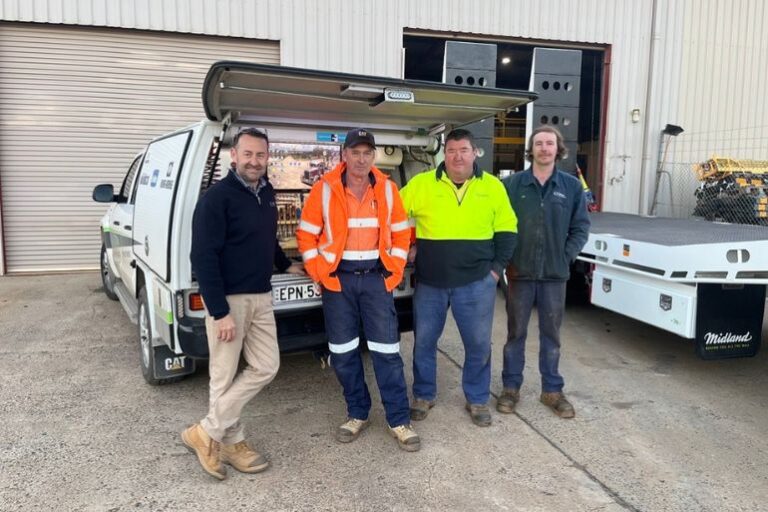
Parkes Shire Council is a finalist in the Fleet of the Year category in the 2026 Fleet News Group Awards.
Its safety program shows why, using telematics, driver scorecards, trailer braking data and near-miss reporting to identify risk early and change behaviour before incidents occur.

The final story in our Parkes Fleet of the Year series
Over the past five articles we have looked at Parkes Shire Council’s regional fleet strategy, pothole detection, idling reduction, workshop planning and whole-of-life cost management. The final story focuses on the issue that sits above every fleet KPI: keeping employees and the community safe.
Weekly visibility of driver behaviour
Parkes uses GPS and telematics data to monitor speeding, harsh braking, harsh acceleration and out-of-hours vehicle use. Driver scorecards are automatically emailed to managers every Monday morning, creating a regular rhythm for reviewing behaviour.
The council’s first response is often a conversation rather than immediate disciplinary action. O’Shannessy described it as the ‘hallway conversation’ – raising the issue quickly so the driver understands what the data is showing. If the behaviour continues, the council has a staged positive-behaviour process that can be escalated.
When visibility changes behaviour
One example discussed during the interview involved seatbelt-related events. An employee was generating approximately 750 events a week. After the issue was raised, that figure reportedly fell to around 15.
The fleet team has found that simply publishing performance information and making people aware that it is being reviewed can lead to a rapid reduction in undesirable behaviour.
That is important because the objective is not to collect a large database of safety events. It is to reduce the number of events before they result in an incident.
Using machine data to see risks drivers may not report
Parkes is also examining information generated by heavy-vehicle braking systems. During maintenance, electronic braking system data can reveal ABS activations, wheel-lift events and other operating conditions that may indicate a need for coaching or further investigation.
This gives the fleet team another opportunity to intervene before a crash or equipment failure. If the data suggests a driver would benefit from additional support, the council can discuss the event and arrange further instruction.
The principle is the same as the driver scorecard: use leading indicators rather than waiting for the lagging indicator of an accident.
Retrofitting safety into existing equipment
The council has invested in training and diagnostic capability for electronic braking systems on trailers. Its technicians developed the skills to diagnose, repair and install EBS equipment and have retrofitted the technology to an existing tri-axle plant trailer.
For Parkes, that meant a safety improvement did not need to wait until the trailer reached the end of its replacement cycle. Existing equipment could be upgraded where there was a clear benefit.
The upgraded braking system also provides data that can be reviewed by the workshop, creating another connection between maintenance, driver behaviour and safety management.
Near misses are changing the depot
Safety data is also influencing the physical layout of the fleet operation. Parkes records near misses and uses the information to identify recurring risks.
The council has reviewed vehicle movements through its depot after identifying a pinch point and is changing traffic flow so vehicles can enter and leave through different routes. Reverse-in parking is also being considered to reduce the risks associated with multiple vehicles reversing out at the beginning of the day.
This is a useful reminder that fleet safety is broader than the technology fitted to a vehicle. Road rules, driver behaviour, equipment design, workshop processes and depot layout all affect the risk profile.
A Fleet of the Year case built on evidence
Parkes Shire Council’s Fleet of the Year case is not based on one spectacular project. It is the accumulation of many improvements: a 10-year replacement program, whole-of-life cost analysis, a highly organised workshop, telematics, idling reduction, road-condition data, specialist heavy-vehicle capability and a willingness to learn from audits and near misses.
The common thread is evidence. The team wants to know what an asset costs, whether it is being used, whether maintenance is being completed, whether a driver is creating risk and whether a new idea is actually delivering a benefit.
O’Shannessy told the judges that the team tries new approaches and changes direction when they do not work. That continuous-improvement mindset is why Parkes Shire Council has earned a place among the 2026 Fleet News Group Fleet of the Year finalists.
Now it’s your turn to decide
The six-part series has shown different sides of the same fleet operation. If you believe Parkes Shire Council’s combination of regional ingenuity, strong governance, practical technology and continuous improvement deserves recognition, cast your vote in the Fleet of the Year Award.
Vote for Parkes Shire Council
Vote for Parkes Shire Council in the 2026 Fleet News Group Fleet of the Year Award
Industry voting is now open. Visit the Fleet News Group Awards voting page to cast your vote.
Awards Night – 14 October 2026, Sydney
The winner of the Fleet of the Year Award will be announced at the Fleet News Group Awards Night in Sydney on 14 October 2026. Register your interest to attend the Awards Night.