When buying a light commercial van, Fleet Managers often focus on payload, powertrain, fuel economy and servicing costs. Yet one of the most important decisions can be something far simpler: what type of rear door best suits the job?
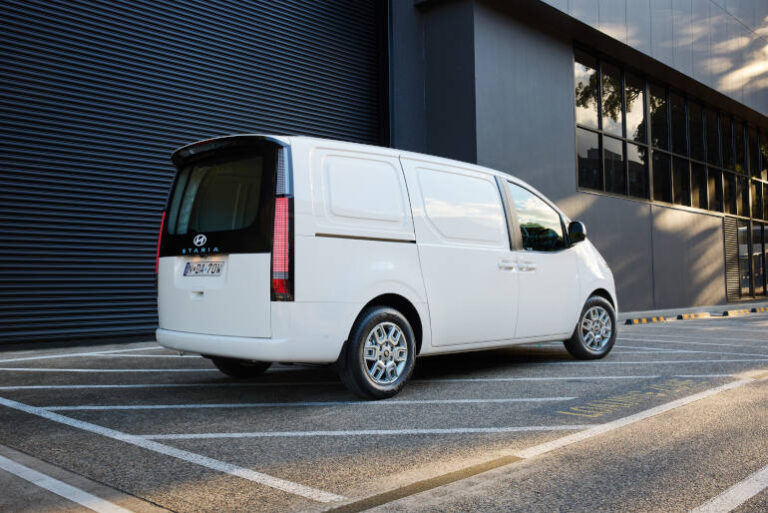
The updated 2026 Hyundai STARIA Load highlights this point perfectly. Hyundai continues to offer customers a choice of either Twin Swing (barn) doors or a Liftback tailgate on the entry-grade STARIA Load, while the Premium model is equipped exclusively with the powered liftback.

According to Hyundai’s Product Planning Assistant Manager Michael Croan, customer research showed there isn’t a single answer.
“Delving into the van segment, we found some notable trends when looking at buyer sentiment. A primary driver of van selection is its capability to be fit for purpose and be able to meet commercial needs.”
He said Hyundai deliberately retained both rear-door configurations.
“The continuation of the liftback and twin swing configuration provides a wider range of versatility for customers.”
During the media launch, Hyundai also revealed its customer research found preferences varied between Australian states, reflecting differences in industries, operating environments and typical loading practices. For fleet buyers operating nationally, that means the “best” door may differ between depots even within the same organisation.
Understanding the application
This is a classic example of why fleet procurement should always start with the application rather than the specification sheet.
A van used by electricians making dozens of city deliveries each day may need something very different from a courier operating from a distribution centre or a council workshop transporting equipment.
The rear door configuration can affect:
- loading efficiency
- workplace safety
- parking access
- weather protection
- loading dock compatibility
- forklift operations
- driver ergonomics.
Barn doors: the practical choice
Twin Swing rear doors remain popular with many commercial operators for good reason.
Advantages
- Doors can be opened independently.
- Easy access when parked close to walls or loading docks.
- Less overhead clearance required than a tailgate.
- Better suited to warehouses with low ceilings.
- Easier to leave partially open while loading.
- Reduced wind loading compared with a large tailgate on windy days.
For operators using forklifts, barn doors also eliminate the overhead obstruction created by an open tailgate.
Disadvantages
- No shelter from rain or sun while unloading.
- Doors require space behind the vehicle to swing open.
- Drivers often need to secure doors in windy conditions.
Liftback tailgate: a mobile shelter
Many service fleets prefer a liftback rear door because it effectively creates a covered workspace.
Advantages
- Provides protection from rain and harsh Australian sun.
- Ideal when accessing tools throughout the day.
- Can improve visibility when working at the rear of the van.
- Power operation on Premium models adds convenience.
Disadvantages
- Requires significant overhead clearance.
- Can be difficult in underground car parks.
- May interfere with forklift loading.
- Large door can catch the wind when open.
Side doors matter too
Rear doors are only part of the loading equation.
Every STARIA Load is equipped with sliding doors on both sides, giving operators flexibility when parked kerbside or when accessing cargo in confined spaces. Hyundai confirmed dual sliding doors are standard across the range during the launch presentation.
For many service trades, the side opening becomes the primary access point because frequently used equipment can be positioned close to the door, reducing unnecessary climbing into the cargo area.
What about pallets?
This is where Australian fleets need to pay particular attention. Australia’s standard pallet measures 1165 × 1165 mm, making it noticeably different from the Euro pallet commonly used in Europe.
Michael Croan said Hyundai designed the STARIA Load around real-world commercial applications.
“The utility of the cargo area is pivotal for vans. For this reason, the STARIA Load cargo area retains a length of 2,607 millimetres, a width of 1,640 millimetres, and a height of 1,436 millimetres.”
“This size accommodates real-world use cases, fitting up to two standard pallets or three Euro pallets in the cargo area.”
While the cargo area is wide enough for Australian pallets, Fleet Managers should also consider the door openings, not just the internal dimensions.
The STARIA Load’s rear opening is designed to accommodate Australian pallet handling, while the dual sliding side doors are intended primarily for accessing equipment and smaller freight rather than forklift loading of full Australian pallets. In practice, forklifts will normally load through the rear opening, regardless of whether the vehicle is fitted with barn doors or a liftback.
Fit for purpose means asking better questions
The STARIA Load demonstrates an important lesson for fleet procurement. Choosing between barn doors and a liftback isn’t about personal preference—it’s about understanding how drivers actually use the vehicle.
Questions fleet managers should ask include:
- Is the vehicle usually loaded by hand or by forklift?
- Will it spend most of its time in CBD parking stations or open work sites?
- Does the driver access tools dozens of times each day?
- Is weather protection important while working from the rear of the van?
- Will the vehicle regularly back onto loading docks?
- Does each depot have different operating requirements?
These are the types of practical considerations that often have a greater impact on productivity than an extra few kilowatts of power or a small improvement in fuel consumption.
Hyundai’s decision to continue offering both rear-door options recognises that Australian commercial vehicle buyers don’t all work the same way. For fleets, it reinforces a simple principle: selecting the right van starts with understanding the job, not simply choosing the vehicle.
- Geely Starray EM-i review: Big on space, strong on value and easy to live with
 The Geely Starray EM-i arrives in Australia with a fairly simple proposition: give buyers the smoothness and convenience of electric driving around town, add a petrol engine for longer journeys, wrap it all in a roomy SUV and keep the price within reach of mainstream buyers. After spending time with the Starray EM-i around Sydney
 - Toyota HiLux BEV off-road review: The quiet achiever goes bushThere is something faintly suspicious about climbing a rocky hill in a HiLux and hearing almost nothing. Normally, a serious off-road climb has a soundtrack. There is diesel revving, tyres scrabbling, a little gravel being aggressively relocated and someone in the passenger seat asking whether that rock was meant to be there. The Toyota HiLux
- Geely Starray EM-i vs EX5: Similar SUVs, similar prices — but novated leasing changes the mathsIf you walked into a Geely showroom and compared the Starray EM-i with the fully electric EX5, the decision might initially look fairly straightforward. Both are five-seat, front-wheel-drive SUVs from the same brand. Both offer generous interior space, modern technology, extensive safety equipment and electrified powertrains. And, importantly, they’re sitting within a few thousand dollars
- Toyota HiLux BEV on-road review: Same work boots, quieter footstepsThe Toyota HiLux BEV does something few HiLux models have ever managed: it leaves the kerb without announcing itself to the entire industrial estate. Your eyes say HiLux. The upright bonnet, broad stance, work-ready tray and familiar cabin all look reassuringly familiar. But your ears are waiting for the diesel clatter that never arrives. Instead,
- Can an electric sedan still earn a place in an SUV world?The medium sedan might not be the dominant fleet vehicle it once was, but Kia believes there’s still room for a practical electric four-door that prioritises efficiency, comfort and everyday usability. Enter the Kia EV4 Air – the brand’s newest battery-electric sedan and one that takes direct aim at the long-standing benchmark in the segment,