

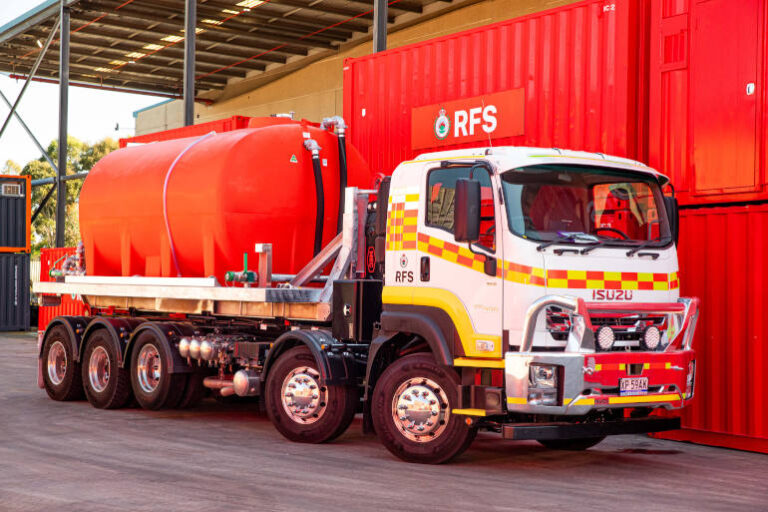
The NSW Government’s decision to transfer ownership and management of the Rural Fire Service fleet from local councils to the RFS is the biggest change in NSW public sector fleet management since StateFleet was disbanded in 2015.
As part of the 2026-27 NSW Budget, the Minns Labor Government will invest $470 million over 10 years to modernise management of the NSW Rural Fire Service fleet. The funding is designed to improve the safety, reliability and lifecycle management of more than 6,000 firefighting vehicles, commonly known as the State’s ‘red fleet’.

The Government will also introduce legislation to transfer ownership of the red fleet from local councils to the RFS from 1 July 2027. The change will consolidate operational responsibility for the fleet under the State Government for the first time since the RFS was established almost 30 years ago.
For fleet practitioners, this is a major structural reform. The RFS fleet is one of the largest and most complex emergency service fleets in Australia, operating in demanding conditions across metropolitan, regional, rural and remote areas. Until now, fleet ownership and accountability have been split, with the RFS operating the assets while councils carried ownership and accounting responsibilities, and played a role in maintenance arrangements.
That structure has created a disjointed approach to fleet management. While the vehicles are critical operational assets for the RFS, they have historically sat across different ownership, accounting, maintenance and management arrangements. This has made it difficult to apply a consistent statewide asset lifecycle approach covering planning, acquisition, maintenance, renewal, disposal, risk and performance.
The reform aims to align ownership with operational responsibility. From a fleet management perspective, that is a major step towards improving accountability, setting consistent standards and building a more mature approach to managing critical emergency service assets.
The funding package includes more than $29 million over two years to establish up to eight RFS regional maintenance hubs and providers. A further $106 million over four years will be invested in critical maintenance and safety upgrades.
These maintenance hubs will be central to the success of the reform. A fleet of more than 6,000 vehicles cannot be managed effectively through ownership transfer alone. It will require investment in people, training, systems, parts supply, technical standards, data, maintenance planning and asset lifecycle capability.
The announcement also has significant implications for regional communities. The Government says the new maintenance hubs will support local jobs and apprenticeships, strengthen local industry and improve the resilience of the RFS fleet into the future.
Emergency Services Minister Jihad Dib said the investment was about planning for the future and strengthening community safety.
“We are planning for the future and investing in our firefighting fleet and facilities to strengthen community safety and the resilience of our emergency response,” Minister Dib said.
“This reform is the next step in making our frontline services fit for the future, giving local communities and our RFS volunteers the support they need to respond to bush fires and other emergencies.”
Minister for Local Government Ron Hoenig said councils had made it clear the existing arrangements no longer reflected the practical reality of how the fleet is operated.
“Local councils have made it clear that the existing arrangements no longer reflect the practical reality that the Rural Fire Service operates the fleet, while councils continue to carry ownership and accounting responsibilities,” Minister Hoenig said.
“The Government has now accepted a pathway that aligns ownership with operational responsibility while recognising the continuing and important role councils play in bushfire prevention, hazard reduction and emergency management.”
For councils, the transfer removes a long-running issue from their balance sheets. Local Government NSW President Darcy Byrne described the change as “a big win for local government”, noting that many councils facing financial constraints would welcome the resolution.
Country Mayors Association Chairman Rick Firman also welcomed the decision, saying rural, remote and regional councils had worked with the Government to remove the RFS assets from council books to reflect the current operating reality.
RFS Commissioner Trent Curtin described the reform as a landmark change for the service.
“This is a landmark and momentous reform for the RFS and one of the most significant investments in our operational capability in recent years,” Commissioner Curtin said.
“Our firefighters rely on these vehicles every day in some of the most demanding and unpredictable conditions, and it is essential we equip them with a fleet that is safe, reliable and fit for purpose.”
He said the reform would establish “for the first time, a consistent and modern approach to fleet management across NSW”.
That statement is important. Fleet management is not only about keeping vehicles on the road. It is about having a structured approach to asset planning, replacement, maintenance, utilisation, safety, compliance, capability and cost over the full life of each vehicle.
For taxpayers, the potential value comes from applying that lifecycle approach at scale. A fleet of this size requires long-term replacement planning, consistent maintenance standards, clear asset data, accurate whole-of-life cost modelling and disciplined decision-making about when vehicles should be upgraded, retained or replaced.
The challenge will be implementation. Moving more than 6,000 vehicles into a centralised ownership and management model will take time, resources and careful engagement with councils, RFS volunteers, maintenance providers and regional communities. The Government says councils will be engaged over the next 12 months to support the transition and identify future maintenance opportunities.
The change also comes alongside broader investment in RFS facilities. More than $34.5 million has been invested this financial year to upgrade 28 rural fire brigade stations and Fire Control Centres, as part of a wider $716.4 million investment in the RFS.
For fleet managers watching from outside the emergency services sector, the NSW RFS announcement is a large-scale example of why governance matters. When ownership, operation, maintenance and lifecycle planning are split across different organisations, fleet maturity can be difficult to achieve.
The disbanding of StateFleet in 2015 changed the way NSW Government agencies accessed and managed fleet services. This reform is different, but just as significant. It brings a large, operationally critical emergency services fleet into a clearer ownership and management structure, with the stated goal of improving safety, reliability and lifecycle management.
By bringing the red fleet under one ownership and management structure, the NSW Government is aiming to create the foundation for a more consistent, transparent and mature fleet management model.
The scale of the reform makes it the biggest NSW public sector fleet management change in more than a decade. Its success will depend not just on the funding, but on the systems, people and capability built around the assets over the next 10 years.