
BYD Australia and New Zealand is ramping up its focus on fleet customers, with the fast-growing automotive brand targeting a significant increase in fleet sales as it works towards becoming one of Australia’s top three vehicle manufacturers.
Speaking at the launch of the Shark 6 Cab Chassis and Shark 6 Performance, BYD Australia and New Zealand Chief Operating Officer Stephen Collins said fleet would play a critical role in the company’s next stage of growth.

While BYD has become Australia’s number one EV brand and the leading Chinese automotive brand, Collins said the business has only begun to scratch the surface of the traditional fleet market.
“Fleet’s about 35 per cent of the market,” Collins said.
“In 2025 it was 10 per cent of our mix, it was nowhere. We’ve invested heavily into fleet through our own fleet department, but also our retail network.”
BYD’s fleet ambitions come as the company continues its rapid rise in the Australian market. After launching locally in 2022 with a single model, the brand finished 2024 ranked 16th overall. By the end of 2025 it had climbed to eighth place with close to a seven per cent market share, and Collins said BYD is currently sitting fifth with around nine per cent market share.
“We’re the number one EV brand, we’re the number one Chinese brand,” Collins said.
“We’re still a growing brand, and we have ambitions to grow further.”
A key part of that growth strategy is increasing penetration into fleet markets that have traditionally been dominated by established automotive brands.
Collins was careful to distinguish between true fleet sales and novated leasing, explaining that BYD tracks the two channels separately.
“I think many of you have heard me talk about this before, so let me just clarify. We don’t classify novated leasing in fleet. This is not fleet, this is pure fleet,” he said.
That distinction is important because BYD has already established a strong presence in the novated leasing sector through its EV and plug-in hybrid range. However, the company now sees significant opportunities in government, council, corporate and commercial fleets.
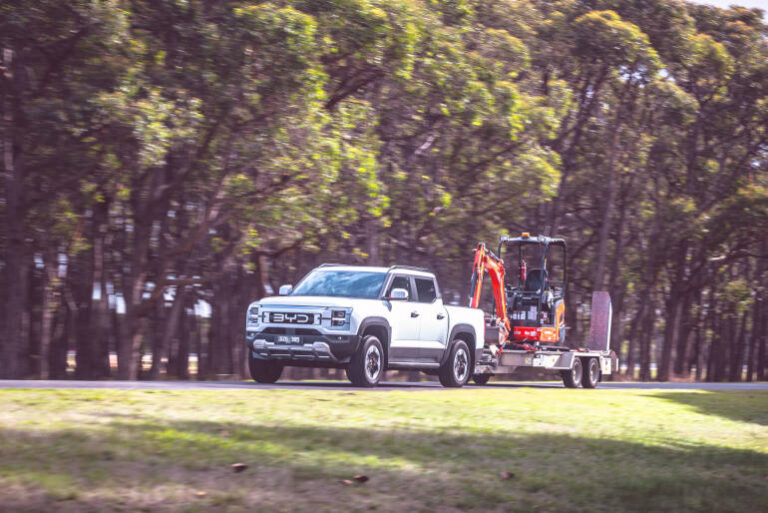
The launch of the Shark 6 Cab Chassis is expected to accelerate that growth by opening new opportunities in trade, service and operational fleets.
“Our target for 2026 is about 20 per cent of the mix,” Collins said.
“You can see in April we were at 18, so we’re well on the way. We’ve still got plenty of work to do in fleet, but this is a big part of our future strategy.”
Collins said the new Cab Chassis variant was already generating interest from organisations that may never have previously considered BYD as a fleet supplier.
“We’ve got orders already, we’ve got much more in the pipe, and we’re selling to councils, we’re selling to a whole host of fleet customers, but never imagined buying a BYD or buying an EV or a PHEV,” he said.
The company believes fleet growth will be supported by continued expansion of its dealer and service network. BYD currently operates around 100 dealerships nationally and expects to increase that number to 150 by the third quarter, with much of the growth occurring in rural and regional locations.
For fleet buyers, Collins said customer support and aftersales capability are becoming just as important as vehicle sales volumes.
“What’s really important for us is that we’re building this brand for the long term,” he said.
“It’s not just about the sales ladder. It’s about how we represent ourselves to customers, fleet customers, retail customers, and do as good a job in the back end as we are doing in the front end.”
Looking ahead, Collins remains optimistic about BYD’s overall market position and believes fleet growth will help drive the company closer to the industry’s front-runners.
“Everyone asks me how much volume we’re going to do for the year,” he said.
“I don’t know because it’s too uncertain, but I would still be disappointed if we didn’t finish somewhere around the top three OEMs.”
For a brand that only entered Australia four years ago, BYD’s fleet ambitions signal that its next battle will not simply be winning EV buyers, but becoming a mainstream fleet supplier across government, business and commercial sectors.