
Delegates at the 2026 IPWEA Fleet Conference in Melbourne heard a consistent message across multiple sessions: fleet management is becoming a strategic discipline that requires balancing competing priorities—not just controlling costs.
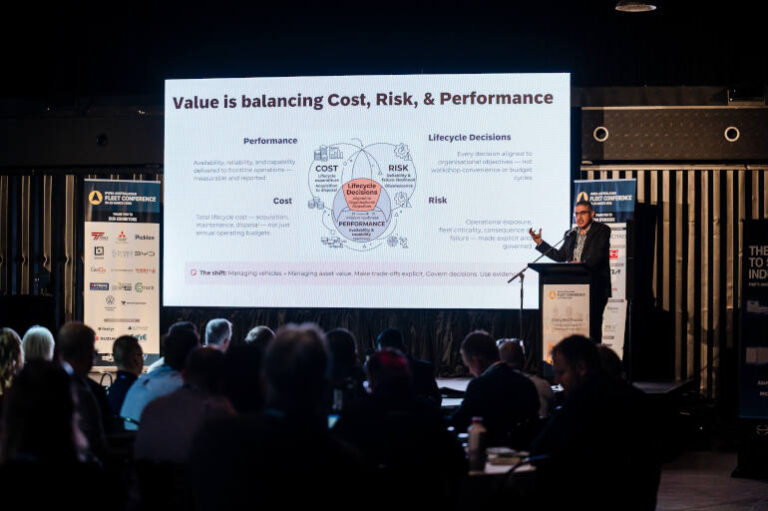
In a practical and thought-provoking presentation, Emad Loka, Director – Fleet Management at Fire and Rescue NSW, challenged fleet leaders to rethink how decisions are made about vehicles, equipment, and infrastructure. His central message was simple but confronting—cost alone is no longer a reliable guide for fleet decision-making.
For those who couldn’t attend the conference, this session highlighted one of the key themes of the event: mature fleet organisations make decisions using a structured balance of cost, risk, and performance.
The Problem With a Cost-Only Mindset
In many organisations, procurement decisions are still dominated by purchase price. Budgets are tight, and pressure to reduce expenditure is constant. But focusing on the lowest upfront cost can create long-term operational risks and higher lifecycle expenses.
Loka explained that this approach often leads to unintended consequences—especially when vehicles are highly specialised or critical to service delivery.
“Cost is predominantly the king at the moment. It’s all about the cost and how much it costs to buy a piece of equipment or a vehicle or a truck.”
The challenge is that acquisition cost represents only a small part of the total investment in a fleet asset. Maintenance, downtime, reliability, and operational performance can have a far greater impact over the life of the vehicle.
This is particularly relevant for public sector and emergency services fleets, where asset failure can directly affect community safety and service continuity.
Introducing the Three-Dimensional Model
Rather than treating cost as the primary decision driver, Loka encouraged fleet leaders to adopt a more balanced framework—one that considers three interconnected factors:
- Cost
- Risk
- Performance
He described this as a three-dimensional model for fleet decision-making, grounded in asset management principles.
“We need to behave accordingly in our decision-making. We look at the three elements of cost, risk and performance—not only focusing on cost.”
This model reflects the growing maturity of fleet management and aligns closely with the broader shift toward whole-of-life asset management.
Understanding Total Cost—Not Just Purchase Price
The first dimension of the model is cost, but not in the traditional sense. The focus is on total lifecycle cost rather than acquisition price.
This includes:
- Maintenance and repair costs
- Downtime and productivity loss
- Replacement timing
- Residual value
- Operational efficiency
Loka emphasised that many long-term costs are determined before the vehicle is even delivered.
“It’s about the total lifecycle cost, not just acquisition, but keeping in mind also how much it’s costing me through the lifecycle of the asset.”
This perspective reinforces a familiar principle in fleet management: the cheapest vehicle to buy is rarely the cheapest vehicle to own.
Risk: The Dimension That Is Often Ignored
While cost is widely measured, risk is often overlooked or underestimated in fleet decision-making.
Risk can take many forms, including:
- Operational downtime
- Safety incidents
- Supply chain dependency
- Skill shortages
- Asset reliability failures
For critical services, the consequences of failure can be significant.
Loka used the example of a specialised aerial appliance in an emergency service fleet to illustrate the point. If that vehicle fails, the impact extends far beyond maintenance costs.
“If it fails, what does that mean? What does it mean to the group, and what does it mean to that community?”
Understanding the criticality of each asset is therefore essential when assessing risk.
Performance: Measuring What Matters
The third dimension of the model—performance—is about ensuring that fleet assets deliver the service outcomes expected by the organisation and the community.
This includes:
- Reliability
- Availability
- Safety
- Productivity
- Service capability
Performance metrics provide the feedback needed to evaluate whether fleet decisions are delivering value.
“We need to have quite transparent performance KPIs to understand how this fleet item is actually operating, not only for a maintenance provider or for a fleet manager, but also for my community of users.”
Without clear performance indicators, organisations risk making decisions based on assumptions rather than evidence.
Balancing the Three Dimensions
The strength of the three-dimensional model lies in its ability to balance competing priorities. No single factor should dominate decision-making.
A vehicle with the lowest purchase price may carry higher operational risk. A highly reliable vehicle may require a higher upfront investment. A specialised vehicle may deliver superior performance but require additional maintenance capability.
The role of the fleet leader is to evaluate these trade-offs deliberately.
“When we balance all these together—cost, risk and performance—we are really governing, and we govern deliberately.”
This is the essence of asset management maturity: making informed decisions that optimise value over the life of the asset.
A Practical Framework for Modern Fleet Leadership
One of the key takeaways from the session was that this model is not theoretical—it is a practical tool that can be applied immediately.
Fleet managers can start by asking three simple questions before making any major decision:
- What will this asset cost over its entire lifecycle?
- What risks does this decision introduce?
- How will this asset perform in real operations?
These questions shift the focus from short-term savings to long-term value.
Why This Matters for the Future of Fleet Management
The transition to more complex vehicles, advanced technology, and tighter regulatory requirements means that fleet decisions are becoming more consequential than ever.
As fleets grow in size and value, the cost of poor decisions increases.
The message from the 2026 IPWEA Fleet Conference was clear: modern fleet management requires structured decision-making frameworks that support reliability, safety, and sustainability.
Cost will always matter—but it cannot be the only factor. Because in today’s fleet environment, the best decision is rarely the cheapest one.
- City of Salisbury modernises pool vehicle access with automated key management
 The City of Salisbury has improved the way staff access pool vehicles by integrating its booking platform with an electronic key cabinet, creating a secure and fully automated system for managing vehicle keys. Previously, while the council already had a reliable booking system for hire and pool vehicles, the physical handling of keys remained a
 - Isaac Regional Council Turns Fleet Data into Actionable InsightsIsaac Regional Council is demonstrating how better data can lead to better fleet decisions. By integrating telematics, fuel card transactions and benchmarking analytics into a single set of dashboards, the council has improved oversight of a fleet of more than 420 assets that support essential services across its geographically dispersed region. The project combines information
- NZ Police redesign canine vehicles to improve safety, welfare and fleet governanceNew Zealand Police have introduced a nationally standardised operating model for police dog vehicles, improving canine welfare, officer safety and fleet lifecycle management while maintaining operational capability. The new Police Dog Vehicle Operating Model, delivered through the Škoda Dog Wagon programme, moves away from the traditional approach of modifying general fleet vehicles at a local level.
- NZ Police transforms fleet replacement planning with risk-based methodologyManaging a national fleet of more than 3,700 vehicles is a complex task, particularly for an organisation such as New Zealand Police where vehicles are mission-critical assets supporting frontline operations. In 2025, NZ Police introduced a new Vehicle Replacement Programme Methodology designed to improve how replacement decisions are made across the fleet. The approach moves
- Cost Alone Is Not Enough: The Three-Dimensional Model of Fleet Decision-MakingDelegates at the 2026 IPWEA Fleet Conference in Melbourne heard a consistent message across multiple sessions: fleet management is becoming a strategic discipline that requires balancing competing priorities—not just controlling costs. In a practical and thought-provoking presentation, Emad Loka, Director – Fleet Management at Fire and Rescue NSW, challenged fleet leaders to rethink how decisions are