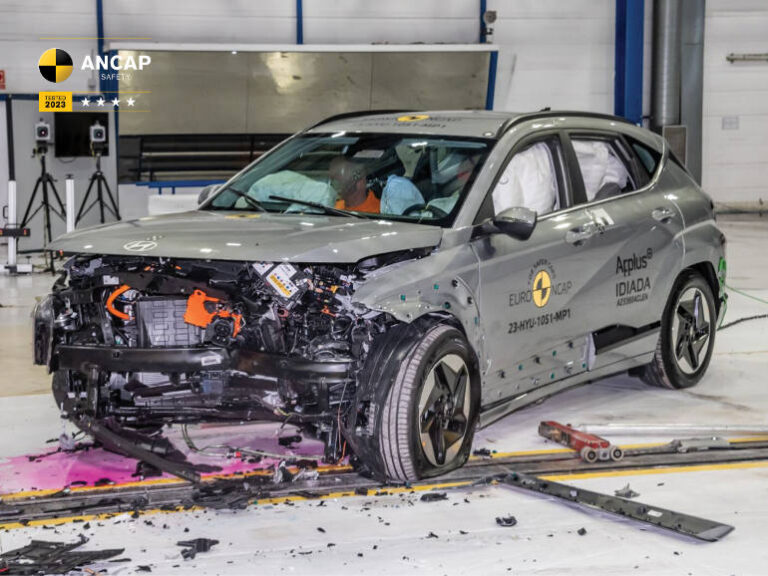
Hyundai Australia has acknowledged that decisions made in recent years around safety ratings have carried real consequences — particularly in fleet channels where procurement standards are clear, consistent and rarely flexible.
During a vehicle launch in late 2025, senior Hyundai executives reflected candidly on how the brand’s approach to ANCAP ratings has evolved, and why five-star safety is now treated as non-negotiable, even as debates continue around driver-assistance systems and real-world intrusiveness.
For fleet buyers, the message was unmistakable: Hyundai has learned from experience, and safety ratings now sit at the centre of product planning.
Learning the hard way
Hyundai executives did not shy away from the fact that launching vehicles without a five-star ANCAP rating created friction — particularly with fleet and government buyers.
One Hyundai spokesperson put it plainly:
“Our preference is to have all our cars five stars. We want to add five star cars when we can, and occasionally we don’t. But in our scenario, every car that we want to launch, we want to try and get to five star.”
That statement reflects a shift in mindset. While four-star vehicles may still meet safety standards, the reality of the Australian market — especially for fleets — is that anything less than five stars can become a barrier to consideration.
Fleet buyers set the benchmark
The importance of fleet channels was explicitly acknowledged during the discussion. When questioned about where pressure for five-star ratings comes from, Hyundai’s response was unambiguous.
“Generally fleet channel.”
For fleet buyers, this is not about marketing or badge value. ANCAP ratings are embedded in procurement policies, tender documents and risk frameworks. A vehicle that does not meet those requirements is often excluded before pricing, specification or whole-of-life cost is even considered.
Hyundai’s leadership conceded that this reality has influenced its product decisions more heavily in recent years.
Reputation matters — especially in fleet
There was also recognition that safety ratings do not exist in isolation. Perceptions formed in the fleet market can have long-lasting impacts on brand reputation, particularly when combined with broader discussions around ADAS intrusiveness and customer acceptance.
Gavin Donaldson, Chief Operating Officer at Hyundai Australia, pushed back on the idea that five-star compliance is merely a box-ticking exercise:
“For us, it’s not just one is ANCAP. We want to meet the standards. We want to make sure we have the safest cars we possibly can.”
Donaldson’s comments suggest Hyundai is now viewing ANCAP not as an external hurdle, but as a baseline expectation — especially for fleets managing safety, liability and driver wellbeing at scale.
Balancing safety and driver acceptance
The discussion also acknowledged an emerging tension: while ANCAP requirements continue to expand, some drivers are increasingly frustrated by intrusive driver-assistance systems.
Hyundai was open about hearing both sides of that feedback.
Tim Rodgers, Product Development Manager, explained:
“We’ve probably heard every type of opinion. We’ve heard ones that parallel yours, but I’ve also heard the flip side where it’s like, ‘Oh wow, I’m so glad it has this, because I don’t speed anymore.’”
Rather than stepping away from five-star targets, Hyundai indicated it is focusing on refining ADAS behaviour, improving menu logic and allowing greater customisation — without compromising safety ratings.
Why five stars now come first
For Hyundai, the conclusion appears settled. In a market crowded with new entrants and increasing regulatory scrutiny, five-star ANCAP ratings are seen as essential to maintaining relevance with fleets.
As Don Romano, Chief Executive Officer of Hyundai Australia, noted during the conversation, the competitive environment has changed:
“It’s a different market… we have to differentiate ourselves in every possible way.”
For fleet buyers, that differentiation increasingly starts with safety compliance — not as a value-add, but as a prerequisite.
What this means for fleet buyers
The late-2025 discussion suggests Hyundai has drawn a clear line from past experience to future strategy:
- Vehicles without five-star ANCAP ratings risk exclusion from fleet programs
- Fleet procurement standards strongly influence product planning
- Reputation in fleet channels can be difficult to rebuild once lost
- ADAS refinement is a focus, but safety ratings will not be compromised
For fleets assessing risk, duty of care and policy compliance, Hyundai’s position offers reassurance that ANCAP alignment is no longer optional — and that lessons from earlier decisions are shaping the next generation of vehicles.
In a market where safety ratings can determine whether a vehicle is even considered, Hyundai appears intent on ensuring that question is no longer asked of its lineup.