
Fleet managers are being encouraged to rethink how they introduce safety technology into vehicles, with warnings that too many screens, alerts and monitoring systems could be creating new distractions rather than reducing risk.
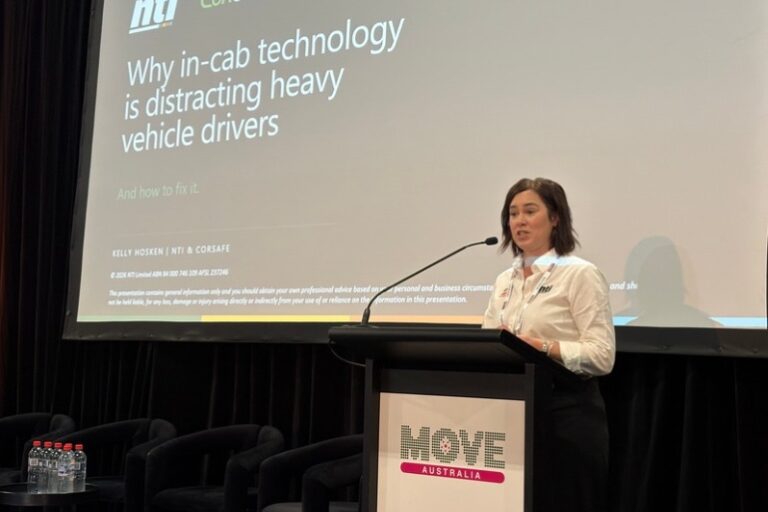
Speaking at MOVE Australia 2026, Kelly Hosken, Manager of Customer Success at NTI, challenged the assumption that adding more technology automatically delivers better safety outcomes.
“I think across the transport and logistics sector, in trying to solve one problem, we’ve accidentally created a completely new one,” Hosken said.
“We’ve ended up with trucks that are smarter, and we’ve ended up with technology that is enabling us to solve a whole bunch of problems. But we’re probably inadvertently making driving harder.”
Although Hosken’s presentation focused on heavy vehicles, the message is equally relevant to passenger car and light commercial vehicle fleets, where increasingly sophisticated driver assistance systems, touchscreens and telematics are becoming standard equipment.

Are we overloading drivers with information?
Modern vehicles can provide drivers with an enormous amount of information. Lane departure warnings, speed alerts, collision avoidance systems, driver monitoring cameras and navigation instructions all compete for attention.
Individually, these technologies are designed to make driving safer. Together, they can create an environment where drivers are constantly responding to notifications.
Hosken referred to a 2026 survey that found 93% of respondents considered using touchscreens while driving distracting, while 49% preferred physical knobs and buttons.
The issue isn’t necessarily the technology itself, but how it interacts with the person behind the wheel.
“The safest operators are not necessarily the ones with the most paperwork, and they’re definitely not necessarily the ones with the most technology,” Hosken said.
For fleet managers, this raises questions when selecting new vehicles or evaluating aftermarket safety equipment. Having the latest technology may look impressive on a specification sheet, but does it improve the driving experience and reduce risk?
The hidden danger of cognitive distraction
One of the key messages from Hosken’s presentation was that distraction isn’t limited to using a mobile phone or taking your eyes off the road.
Drivers can be distracted even when both hands are on the steering wheel.
She shared an insurance claim involving a truck driver who was speaking with his wife through a hands-free system about a broken washing machine and the family’s finances.
The conversation was emotionally demanding. Although the driver was looking ahead and holding the steering wheel, his attention was divided. When he encountered an obstruction, he swerved and rolled the vehicle.
Nobody was injured, but the incident demonstrated how quickly cognitive distraction can become a serious safety issue.
“Distraction is actually a lot more than just having our hands off the wheel. It’s about when our eyes are off the road or our mind is off the driving task,” Hosken explained.
It’s an important distinction for organisations developing driver safety policies that focus heavily on mobile phone use without considering other sources of distraction.
Fleet managers can be part of the problem
Hosken also highlighted how workplace practices can undermine investments in safety technology.
During a review of a large retailer’s fleet, she discovered that one of the biggest causes of driver distraction was the organisation’s own scheduling and dispatch teams.
Staff were repeatedly calling drivers to check their locations and delivery progress, despite having access to telematics systems that already provided the information.
For passenger car and light commercial fleets, similar issues can arise when employees are expected to answer calls, respond to messages or manage appointments while travelling between jobs.
The lesson is that reducing distraction requires changes to workplace processes as well as driver behaviour.
Technology needs trust, training and follow-up
Another challenge is getting drivers to accept new safety systems.
Hosken explained that poorly managed technology rollouts can create resistance, particularly when employees believe monitoring systems are being introduced to watch their behaviour rather than improve safety.
Some drivers even cover or reposition in-cab cameras, potentially removing an important safety benefit.
She encouraged fleet operators to involve drivers early, explain the purpose of new systems and provide practical training.
Importantly, the work doesn’t stop when the equipment is installed.
Fleet managers need to review the data, provide coaching, recognise positive behaviour and listen when drivers report problems.
This is particularly relevant as more organisations adopt connected vehicle technology and driver monitoring systems.
A different approach to fleet safety
Hosken suggested that safer fleets require three things: better driver support, better vehicle design and better work design.
For fleet managers, that means looking beyond vehicle safety ratings and equipment lists to understand how vehicles, technology and organisational processes work together.
It also means being prepared to question whether an additional system is necessary.
As vehicles become more connected and automated, the ability to manage the information presented to drivers will become an increasingly important part of fleet safety management.
Hosken summed up the challenge by reminding delegates that driver attention is a limited resource.
“Attention is a really valuable and limited resource,” she said.
For fleet managers, the takeaway is simple: the goal isn’t to have the most technology in the fleet. It’s to make sure the technology you have is actually making drivers safer.