
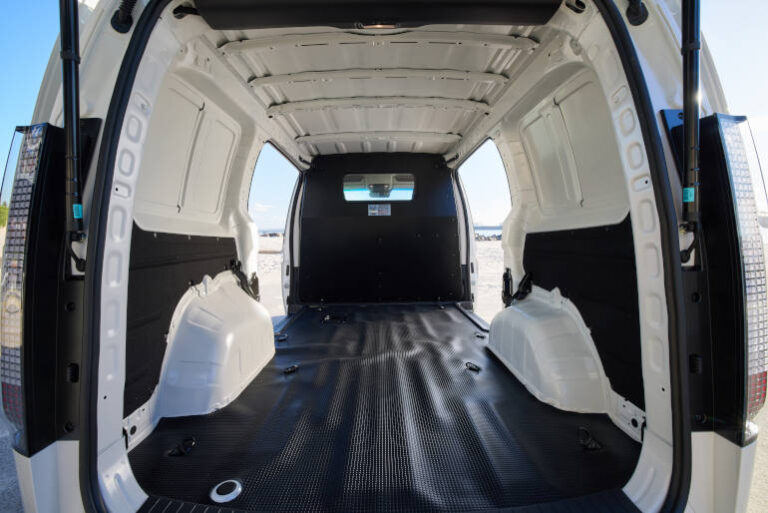
Switching from diesel to electric vehicles doesn’t necessarily mean starting from scratch. Hyundai says the new Staria Load Electric retains the cargo space and interior dimensions of its diesel counterpart, potentially allowing fleets to transfer existing equipment and specialised fit-outs when replacing vehicles.
For fleet managers, the cost of transitioning to electric vehicles involves more than purchasing the vehicle. Shelving, storage systems, cargo barriers, communications equipment and specialised operational equipment can represent a significant investment, particularly for government and service fleets.
At the Australian launch of the Staria Load Electric, Hyundai executives highlighted an advantage of maintaining a consistent vehicle platform across diesel, hybrid and electric powertrains.
Scott Nargar, Senior Manager of Future Mobility & Government Relations, explained that the battery packaging in the electric Staria Load does not compromise the interior cargo space, allowing organisations to retain familiar vehicle configurations when transitioning from diesel.
This could be particularly valuable for police, protective services and other government fleets that operate vehicles with specialised equipment.
Nargar explained that equipment used in these applications is often transferred between vehicles over several replacement cycles rather than being discarded when a vehicle reaches the end of its fleet life.
“Everything fits exactly the same,” Nargar said, referring to the consistency between the diesel and electric versions.
Reducing the hidden costs of fleet electrification
For organisations operating hundreds of commercial vehicles, maintaining consistency across different powertrains could simplify the transition to electric.
Fleet managers already understand the importance of standardising vehicles to reduce operating costs, simplify maintenance and improve driver familiarity.
The Staria Load Electric provides an opportunity to extend that approach to fleet electrification.
Rather than introducing a completely different vehicle to meet emissions reduction targets, organisations could potentially replace diesel Staria Load vehicles with electric versions while retaining existing equipment and operational layouts.
The ability to reuse equipment would depend on the individual fit-out, mounting arrangements and compliance requirements, but the common cargo dimensions provide a useful starting point.
It could also reduce the time required to prepare replacement vehicles for service, particularly where equipment installation and commissioning are significant parts of the replacement process.
Electric power opens up new opportunities
Beyond retaining the existing workspace, Hyundai also highlighted the benefits of vehicle-to-load (V2L) technology.
This allows the Staria Load Electric to supply electricity to external equipment using energy stored in the vehicle’s battery.
For fleet applications, this could reduce the need for separate generators or auxiliary power systems when operating electrical equipment in the field.
Nargar highlighted the opportunity to power equipment directly from the vehicle rather than relying on a second engine or generator.
For maintenance teams, emergency services and mobile service operations, this capability could provide additional flexibility when working away from fixed electrical infrastructure.
The suitability of V2L will depend on the power requirements of the equipment and the impact on available driving range.
One vehicle, three powertrains
The arrival of the Staria Load Electric gives Hyundai three powertrain options within the same light commercial vehicle range.
The diesel, petrol hybrid and battery-electric versions allow fleet managers to select vehicles according to operating requirements, annual kilometres and emissions reduction targets.
During a recent Fleet News Group comparison drive around Sydney, the three versions demonstrated remarkably similar driving characteristics and workspace ergonomics despite differences in their powertrains and rear suspension configurations.
For drivers moving between vehicles, that consistency could reduce the adjustment required when changing from diesel to hybrid or electric.
For fleet managers planning a staged transition to electric vehicles over several years, it also creates an opportunity to maintain vehicle standardisation while gradually changing the powertrain mix.
Fleet management fundamentals still apply
While Hyundai’s approach could make fleet electrification easier, the decision to introduce electric vehicles still needs to be supported by a fit-for-purpose assessment and whole-of-life cost analysis.
Charging infrastructure, daily operating range, payload, towing requirements and vehicle utilisation remain important considerations.
However, the potential to retain existing fit-outs introduces another factor into the financial assessment.
A vehicle that allows equipment to be reused could reduce replacement costs and operational disruption, even if its initial purchase price is higher.
For fleet managers considering how to introduce electric light commercial vehicles without changing established operational processes, the Staria Load Electric demonstrates how a familiar vehicle platform can make the transition more manageable.
Sometimes the biggest advantage of a new electric vehicle is how much of the existing fleet operation can stay the same.