

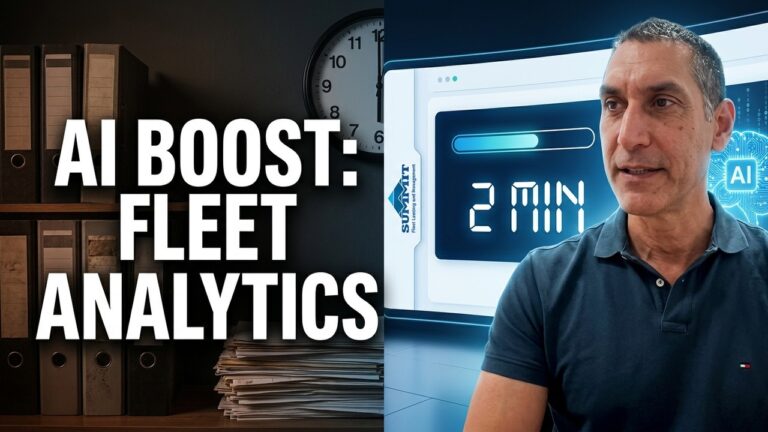
Artificial intelligence is beginning to change how quickly fleet managers can move from data to decisions, but Summit Fleet Leasing and Management Managing Director Darren Gore believes the technology still needs an experienced fleet professional behind it.
Speaking on the Fleet News Group podcast, Gore discussed Summit’s development of AI Fleet Insights and how the latest generation of AI tools is allowing fleet managers to interrogate operational information in ways that were difficult only a few years ago.
For fleet managers accustomed to extracting information from dashboards, spreadsheets and business intelligence platforms, one of the most obvious benefits is speed.
Gore said an analysis that could previously take 20 minutes or half an hour using traditional business intelligence tools could now potentially be completed in minutes.
“It’s more around how do you get the right answer. Sure, getting it fast is unreal because everyone wants to know everything straight away.”
That ability becomes particularly useful when a fleet manager is responding to a senior executive, procurement manager or CFO seeking information for a board paper, budget discussion or operational review.
Instead of manually assembling the same report each time, Gore said a business question can increasingly become a prompt that can be reused or automated.
A request might be narrowed to a particular period, number of vehicles or business unit before the technology analyses the available fleet information.
For fleet managers, this has the potential to shorten the gap between being asked a question and providing decision-ready information.
A foundation built before generative AI
While AI has become one of the dominant technology topics of 2026, Summit’s work in the area began before natural-language AI tools became commonplace.
Gore said an earlier version of AI Fleet Insights was introduced around three years ago as a single-vehicle summary tool. It highlighted key information, exceptions and areas requiring attention.
Summit had also been using AI in back-office applications before that, while investment in business intelligence and structured data provided the foundation for more advanced analysis.
According to Gore, that work has been important because good fleet analysis still relies heavily on the quality and structure of the information available.
The newer generation of AI tools is making that data easier for people to interact with.
Rather than navigating several dashboards to locate an answer, a fleet professional can increasingly ask a question in natural language and allow the technology to help identify patterns or exceptions.

AI doesn’t remove the need for fleet expertise
For organisations considering how AI might affect fleet roles, Gore was clear that technology does not remove the need for the fleet manager.
“The fleet manager, the human, is still the expert.”
The role of the fleet professional becomes particularly important in deciding what question should be asked, understanding whether the response makes operational sense and checking the information before it is used for a business decision.
This distinction is important as organisations increasingly experiment with generative AI.
A fast answer is only useful if the fleet manager understands the operational context behind it.
Gore said this was also a recurring message at the recent Fleet APAC Summit in Bangkok, where AI featured heavily in discussions about the future of fleet management.
The technology may change some of the tools used by fleet professionals, but Gore does not see it removing the need for people who understand vehicles, costs, utilisation, operations and organisational requirements.
Summit is also continuing to recruit as the business grows.
For Gore, the opportunity is to bring people into the industry who are comfortable working with emerging technology and can combine those skills with fleet knowledge.
Turning existing fleet data into useful information
Another implication for fleet managers is that organisations may already possess much of the data needed to improve decisions.
Vehicle transactions, operating costs, maintenance information and other fleet records can contain patterns that are difficult to identify when information is spread across reports and systems.
AI can make exploring that information easier, but Gore said sophisticated technology is not necessarily the starting point.
Even traditional tools such as Excel can help fleet teams begin bringing operational information together and asking what story the data is telling.
The objective should not simply be to deploy AI because it is available.
It should be to make fleet information more useful.
For fleet managers, that could mean faster answers to questions about cost, replacement, utilisation or exceptions. For senior management, it can mean improved access to evidence when making decisions about one of the organisation’s largest asset groups.
Technology supporting fleet management excellence
Summit Fleet Leasing and Management is a sponsor of the inaugural Fleet News Group Awards, which recognise organisations demonstrating excellence across fleet management, technology, safety and sustainability.
Gore said supporting fleet management as a profession was one of the reasons Summit chose to become involved with the program.
The connection between the Awards and Summit’s technology work is also a reminder that technology itself is not the measure of fleet excellence.
Its value comes from what fleet managers are able to do with it.
As AI makes it possible to analyse larger volumes of information more quickly, the next challenge for fleet professionals will be ensuring that faster insights lead to better fleet decisions.
And, as Gore argues, that still requires a knowledgeable person asking the right question.