
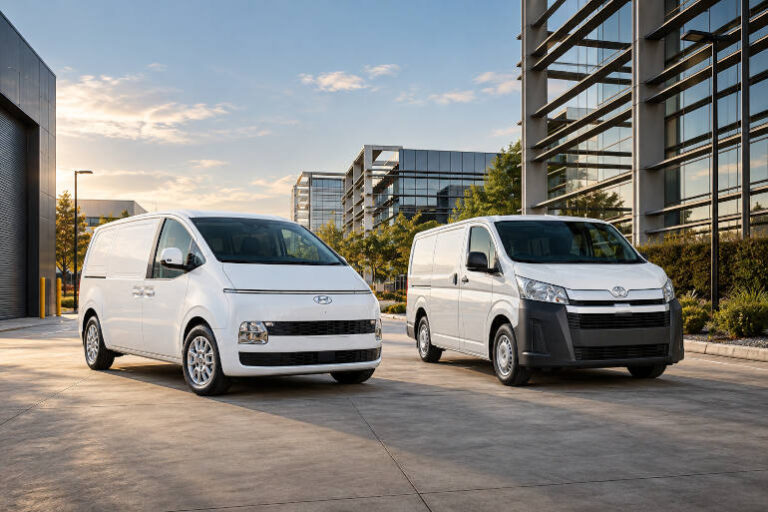
The Hyundai STARIA Load and Toyota HiAce are two established choices for fleets requiring a practical commercial van with close to a one-tonne payload.
The STARIA Load offers diesel and petrol-hybrid powertrains, relatively compact exterior dimensions and car-like driving characteristics. The HiAce provides a larger cargo area, a higher Gross Vehicle Mass and a strong range of commercial accessories.
For fleet buyers, the decision will depend on the type of cargo being carried, annual kilometres, towing requirements and where the vehicle will operate.

Specifications at a glance
| Specification | STARIA Load diesel | STARIA Load hybrid | Toyota HiAce automatic van |
|---|---|---|---|
| Gross Vehicle Mass | 3,060kg | 3,130kg | 3,300kg |
| Payload | 997kg | 1,039kg | Approx. 1,040–1,060kg |
| Cargo volume | 4.935m³ | 4.935m³ | 6.2m³ |
| Cargo floor length | 2,607mm | 2,607mm | 2,530mm |
| Combined fuel consumption | 7.0L/100km | 6.2L/100km | 7.8L/100km |
| Fuel type | Diesel | Petrol-electric hybrid | Diesel |
| Airbags | Seven | Seven | Eight |
| Rear-door choices | Liftback or twin swing doors | Liftback or twin swing doors | Tailgate or optional barn doors |
| Side access | Dual sliding doors | Dual sliding doors | Dual sliding doors |
HiAce has the larger cargo area
The biggest difference between the two vans is cargo volume.
The STARIA Load provides 4.935m³ of load space, with a cargo floor measuring 2,607mm long, 1,640mm wide and 1,436mm high. Hyundai says the cargo area can accommodate two standard Australian pallets or three Euro pallets, depending on the loading method.
The HiAce provides 6.2m³, giving it approximately 26 per cent more cargo volume than the STARIA Load. Its cargo floor is listed at 2,530mm long, which is 77mm shorter than the Hyundai, but the Toyota’s wider and more squared-off body creates more usable cubic capacity.
This difference will matter most to parcel delivery operations, mobile workshops and fleets carrying bulky but relatively light equipment.
For organisations carrying dense tools, parts or machinery, payload may become the limiting factor before the cargo space is completely filled.
Payload is closely matched
The STARIA Load diesel has a listed payload of 997kg, while the hybrid increases this to 1,039kg.
Hyundai has given the hybrid a higher GVM, helping compensate for the additional weight of the battery, electric motor and associated hybrid equipment.
The HiAce automatic van provides an approximate payload of 1,060kg with its standard tailgate or 1,040kg with optional barn doors.
This puts the HiAce and STARIA Load hybrid within around 20kg of each other when both are fitted with barn-style rear doors. The Toyota carries approximately 40kg to 60kg more than the STARIA Load diesel, depending on rear-door configuration.
The small payload difference reinforces the importance of weighing completed vehicles. A shelving system, cargo barrier and roof rack can consume a meaningful proportion of a van’s available carrying capacity.
STARIA Load hybrid leads on fuel consumption
Fuel efficiency is the STARIA Load hybrid’s clearest advantage. Its official combined consumption is 6.2L/100km, compared with 7.0L/100km for the STARIA Load diesel and 7.8L/100km for the automatic HiAce.
Based on the published figures, the STARIA Load hybrid uses approximately 20.5 per cent less fuel than the HiAce. The diesel STARIA Load uses approximately 10.3 per cent less.
For a vehicle travelling 30,000 kilometres each year, the official figures equate to:
| Vehicle | Annual fuel use at 30,000km |
|---|---|
| STARIA Load hybrid | 1,860 litres |
| STARIA Load diesel | 2,100 litres |
| Toyota HiAce automatic | 2,340 litres |
The STARIA Load hybrid would use 480 fewer litres than the HiAce over that distance, before allowing for differences in petrol and diesel pump prices. And the lower CO2 per litre from petrol supports emission targets.
Its petrol-electric drivetrain should be particularly suited to metropolitan work, where regenerative braking and low-speed electric assistance can contribute more frequently.
Actual consumption will depend on payload, traffic, driver behaviour, accessories, weather and operating conditions.
Towing may decide the powertrain choice
The STARIA Load hybrid is not rated to tow, which may rule it out for fleets using trailers or mobile equipment.
The STARIA Load diesel has a braked towing capacity of up to 2,500kg, making it the more suitable Hyundai option for towing applications.
Toyota lists the automatic HiAce with a 1,500kg braked towing capacity.
A fleet that does not tow may be able to take full advantage of the hybrid’s lower fuel consumption. Where towing is part of the operational requirement, the diesel STARIA Load provides the highest capacity of the vehicles compared.
Safety technology is comprehensive
Both vans offer strong active-safety packages designed to reduce driver workload and help prevent common fleet incidents.
The STARIA Load includes seven airbags and Hyundai SmartSense technology, including:
- Forward Collision-Avoidance Assist
- Blind-Spot Collision-Avoidance Assist
- Rear Cross-Traffic Collision-Avoidance Assist
- Lane Keeping Assist
- Lane Following Assist
- Smart Cruise Control
The HiAce is fitted with eight airbags and Toyota Safety Sense. Its standard safety equipment includes a pre-collision system with pedestrian and daytime cyclist detection, Lane Departure Alert, Lane Trace Assist, Road Sign Assist, Automatic High Beam, Safe Exit Assist and an Emergency Driver Support System.
A reversing camera, front and rear parking sensors, Blind Spot Monitor and Rear Cross Traffic Alert are also standard.
The Toyota’s Emergency Driver Support System is a notable fleet feature. It is designed to identify when a driver has become unresponsive and, after issuing warnings, can gradually slow the vehicle and bring it to a controlled stop.
Toyota Connected Services also includes Automatic Collision Notification, SOS Emergency Call and Stolen Vehicle Tracking, with one year of complimentary access. Toyota Halo telematics is available to business customers as a subscription-based fleet management service.
Rear doors and loading access
Both vans provide dual sliding side doors, which can improve access in depots, loading zones and confined parking areas.
The STARIA Load can be ordered with a lift-up tailgate or twin swing doors. The tailgate provides shelter while loading, but requires space above and behind the van. Swing doors are generally more practical near loading docks or when using a forklift.
The HiAce offers a standard tailgate and optional barn doors. Toyota lists the barn-door opening at approximately 1,497mm wide and 1,340mm high.
The barn-door option adds around 20kg to the Toyota’s kerb weight, reducing its calculated payload by the same amount.
Fit-out and fleet support
Toyota offers a broad commercial accessory range for the HiAce, including cargo barriers, solid partitions, panel protection, roof racks, internal ladder storage, cargo liners, technician steps and towing equipment.
This established fit-out ecosystem may be important to fleets operating standardised service-body or mobile-workshop configurations.
The STARIA Load’s lower profile and more compact footprint may be better suited to metropolitan fleets regularly using underground car parks, urban loading areas and residential streets.
Which van is the better fleet choice?
The STARIA Load hybrid makes a strong case for urban fleets that do not require towing. It combines a competitive 1,039kg payload with the lowest official fuel consumption and requires no external charging infrastructure.
The STARIA Load diesel provides similar cargo capacity with the added benefit of a 2,500kg braked towing capacity.
The HiAce is the stronger choice when cargo volume is the priority. Its 6.2m³ load area provides approximately 26 per cent more space than the STARIA Load, while maintaining a payload close to one tonne.
The final decision should be based on the fleet’s actual operating profile. Measuring the intended cargo, weighing a vehicle with the planned fit-out and reviewing real routes will provide a more reliable answer than comparing brochure figures alone.