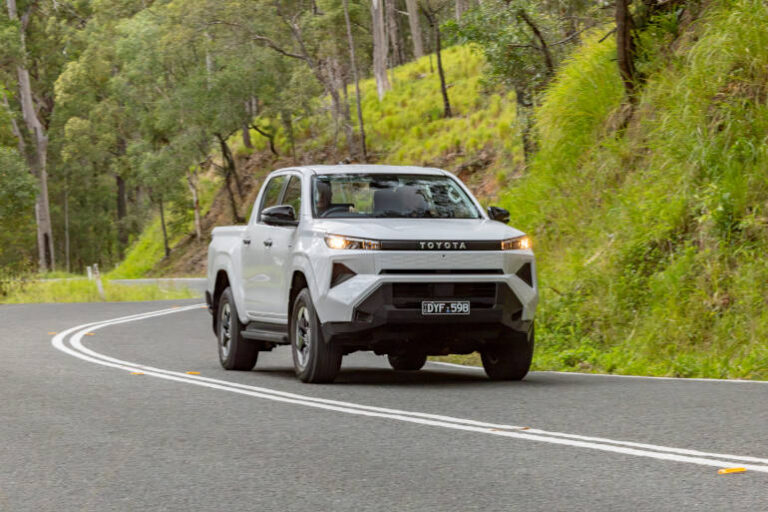
The Toyota HiLux BEV does something few HiLux models have ever managed: it leaves the kerb without announcing itself to the entire industrial estate.
Your eyes say HiLux. The upright bonnet, broad stance, work-ready tray and familiar cabin all look reassuringly familiar. But your ears are waiting for the diesel clatter that never arrives.
Instead, there is a faint electric whirr at low speed, followed by silence. Well, relative silence. There is still tyre noise, wind noise and the occasional reminder that a dual-cab ute is not a Lexus, but the usual diesel soundtrack has been politely removed from the conversation.
That changes the character of the vehicle more than expected.
The HiLux BEV’s dual-motor all-wheel-drive system produces 144kW and delivers its response smoothly rather than with the pause-and-push familiar to diesel ute drivers. In Normal mode it feels relaxed and predictable. Eco mode dulls the response for drivers trying to stretch every available kilometre. Sport mode adds a little more urgency when joining fast traffic or overtaking, although nobody will mistake it for a silent sports ute wearing work boots.
Toyota says the system can shift torque automatically from a 50:50 front-rear split to full rear-drive operation, depending on conditions. The result is a vehicle that feels composed and uncomplicated rather than overly clever. It simply gets on with moving.
The claimed range is 315km under the NEDC test for the pick-up models, while the cab-chassis is rated at 245km. That puts the HiLux BEV squarely into a defined fleet role. It is not aimed at the operator towing a heavy trailer between remote towns every day. Its 2,000kg braked towing limit makes that clear.
But for mining, energy, government and utility fleets with known daily distances, predictable routes and charging at base, the numbers make considerably more sense.
Toyota developed the HiLux BEV around those applications, and says prototypes have been working with major mining customers in Western Australia for more than two years. According to Toyota, the vehicles operated in temperatures of up to 50 degrees Celsius without significant downtime, aside from the occasional flat tyre. That is probably the most Australian validation possible: the battery survived, but the tyres still found nails.
The most significant engineering change is underneath.
The 59.2kWh battery is mounted between the chassis rails, requiring a new rear suspension design. Rather than turning the HiLux into an independent-rear-suspension lifestyle ute, Toyota has retained leaf springs and used a De Dion rear axle arrangement. The rear transaxle is mounted to the chassis rather than moving with the axle, reducing unsprung mass and, Toyota says, improving handling.
It is clever engineering with a very traditional objective: keep the ute tough enough to carry a proper load.
Payload varies by model, from 725kg for the SR5 pick-up to up to 855kg for the SR cab-chassis before a tray is fitted. That is why the HiLux BEV still has a little of the familiar unladen-ute bounce when there is nothing in the rear. The launch vehicle was driven without a significant load, and the rear could feel busy over rougher road surfaces.
It was not uncomfortable, but it was noticeable.
A proper comparison would involve loading the BEV and diesel versions with 300kg or 400kg, then sending them down the same road. That is the test fleet buyers will care about, because few work utes spend their lives carrying nothing except a driver, a water bottle and someone’s lunch.
Inside, the HiLux BEV remains reassuringly close to the diesel model. A 12.3-inch digital instrument cluster provides BEV-specific information, while a shift-by-wire selector replaces the conventional gear lever. It takes a moment to get used to, but so did the first smartphone, and now people panic when their battery falls below 20 per cent.
The SR includes dual-zone climate control, a 12.3-inch multimedia display and a 1,500W inverter in the centre console for powering small appliances or work equipment. SR5 models add leather-accented seats, an eight-way powered driver’s seat with lumbar support, wireless phone charging and an eight-speaker sound system.
The more important upgrade, however, is the quietness.
A HiLux BEV makes early-morning depot departures less intrusive. It makes conversation easier. It removes the constant low-speed diesel rattle from a driver’s day. For fleets trying to reduce emissions without asking drivers to abandon the familiarity of a proper four-wheel-drive ute, that matters.
The HiLux BEV is not a replacement for every diesel HiLux. Toyota is not pretending otherwise.
It is a battery-electric HiLux for fleets that know where their vehicles go, where they park and where they charge. In the right role, it still looks, feels and works like a HiLux.
It just arrives with quieter footsteps.
- Fleet Support Starts With Listening at Daimler Trucks Canberra
 Daimler Trucks Canberra (Tristar Group) has built its ACT fleet relationships around a simple idea: understand the customer’s operation first, then prove the relationship through communication, follow-up and action. Daimler Trucks Canberra is a finalist in the 2026 Fleet News Group Fleet Supplier of the Year Award. Industry voting is open until 22 September 2026.
 - Why FleetGuru.ai Is Backing Recognition of Fleet Best PracticeFleetGuru.ai did not wait for the Fleet News Group Awards to become an established industry event before deciding to support it. The fleet technology company joined the inaugural program as a Foundation Sponsor because CEO and Co-Founder Eden Shirley believes recognising best practice is an important part of moving the fleet industry forward. “For us,
- How Euclidic upgraded 650 vehicles without disrupting the fleetReplacing telematics hardware across a national fleet sounds straightforward until the vehicles are spread across Australia, operating on customer-controlled sites, working in remote locations and rarely available at a convenient time. That was the challenge facing SRG Global when it needed to migrate approximately 650 vehicles from 3G OBD plug-in telematics devices to new 4G
- How Blacktown plans to serve a growing city without endlessly growing the fleetBlacktown City Council is a finalist in the Fleet of the Year category in the 2026 Fleet News Group Awards. In the final article in our six-part series, we look at how the fleet team is planning for population growth and higher service demand without assuming the answer is simply more vehicles. Blacktown is a
- From 750 events to 15: how Parkes is using fleet data to change behaviourParkes Shire Council is a finalist in the Fleet of the Year category in the 2026 Fleet News Group Awards. Its safety program shows why, using telematics, driver scorecards, trailer braking data and near-miss reporting to identify risk early and change behaviour before incidents occur. The final story in our Parkes Fleet of the Year