

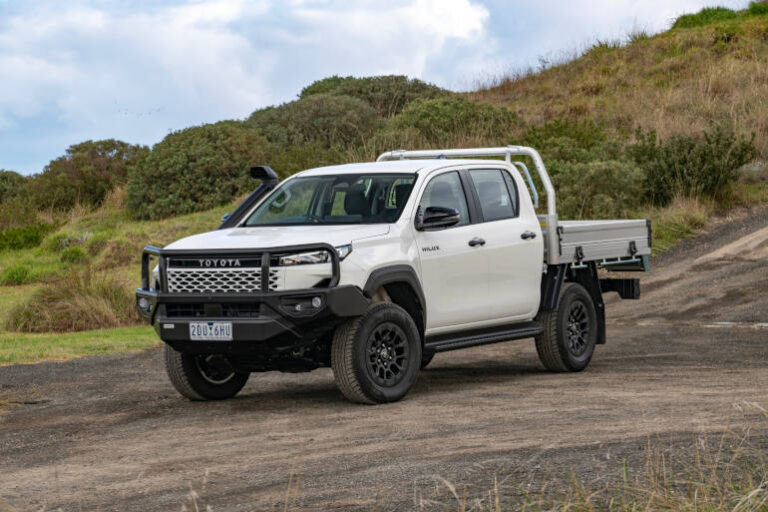
Toyota’s decision to offer a factory-fitted GVM upgrade on selected HiLux 4×4 grades could deliver more than extra payload. For fleets, leasing companies, Fleet Management Organisations (FMOs) and dealerships, the bigger gain may come from the reduction in delivery delays, supplier coordination and compliance administration that often comes with aftermarket modifications.

The Australian-developed GVM upgrade will be available from August 2026 on selected work-focused HiLux grades. Toyota says the factory option increases payload by between 372kg and 435kg, depending on the variant, allowing for a maximum payload of up to approximately 1525kg. The upgrade also increases vehicle ride height by up to 10mm, with longer monotube shock absorbers fitted to the rear, while axle capacities increase by 100kg at the front and 280kg at the rear.
On paper, that makes the HiLux more capable for buyers that need to carry tools, canopies, service bodies, racking, communications equipment, towing gear and safety equipment. In practice, the factory-fitted approach may be just as important as the extra capacity.
For many fleets, the delivery of a new ute is not simply a handover from dealer to driver. Vehicles often move through several suppliers before entering service. A standard ute may need accessories, signage, telematics, internal fit-out, a GVM upgrade, registration changes, engineering documentation and final inspection before it can be deployed.
Each extra supplier introduces time, paperwork and coordination. Purchase orders need to be raised, invoices checked, payments processed, delivery dates aligned and vehicle movements managed between dealerships, body builders, accessory suppliers and aftermarket upgrade providers. When something is delayed, the whole delivery chain can stall.
A factory-designed and fitted GVM upgrade has the potential to remove one of those steps. For fleet buyers and FMOs managing large orders, this could reduce vehicle downtime before first use from days or weeks to a more predictable delivery schedule. For leasing companies, it may simplify order processing, asset records and documentation. For dealerships, it can reduce the need to coordinate third-party upgrades before delivery.
The safety benefit is also significant. Toyota says its factory-fitted option retains the Toyota five-year warranty and remains compatible with all safety systems. This matters because modern utes are now highly integrated vehicles, with driver assistance systems, braking technology and stability control all designed to work within specific engineering parameters.
Toyota Australia Vice President Sales, Marketing and Franchise Operations, John Pappas, said the option would give buyers additional load-carrying capability while retaining manufacturer support.
“Introducing a GVM upgrade option for the new HiLux will allow customers to maximise the vehicle’s already-excellent load-carrying capabilities, providing benefits to both fleet and private buyers,” Mr Pappas said.
“Being Toyota’s very own factory-fitted option, it ensures the HiLux retains its Toyota five-year warranty and is compatible with all safety systems giving it a real advantage over its aftermarket competition.”
That final point is where the market impact becomes more complex. Aftermarket GVM upgrade suppliers have filled an important gap for many years, particularly for fleets operating utes near their payload limits. They have supported mining, construction, utilities, councils, emergency services and field service operations where standard payloads are quickly consumed by operational fit-outs.
Some of those suppliers may miss out on sales if more fleet buyers choose the Toyota factory option. The impact will depend on the final HiLux grade coverage, fleet adoption, pricing, availability, and whether buyers still require more specialised upgrades beyond the Toyota specification.
However, for the broader fleet community, the shift is likely to be viewed as a game changer. A factory option reduces complexity at the start of the vehicle lifecycle, where many fleet delays occur. It may also provide greater confidence for Procurement Managers, Fleet Managers and Fleet Coordinators who need to demonstrate that vehicles are fit for purpose, safe, compliant and supported by the manufacturer.
It also gives dealerships a stronger role in delivering a more complete work vehicle solution. Instead of passing the customer through several external steps, dealers can supply a HiLux with the GVM upgrade already integrated into the factory order process. This could make quoting simpler and improve delivery transparency for fleet customers.
Some may see the move as Toyota’s response to the Ford Ranger Super Duty. However, Fleet News Group was advised that the factory-fitted GVM upgrade had been in the product plan for the new HiLux well before the Ranger Super Duty was launched.
The comparison will still be made because both vehicles speak to a clear trend in the fleet market. Many buyers want more capability from a ute without immediately moving to a larger truck. Payload, towing, warranty, safety systems and ease of delivery are becoming more important as fleets carry heavier equipment and face greater scrutiny around compliance.
For Fleet Managers, the decision will still require careful assessment. The factory GVM upgrade may reduce administration and improve delivery efficiency, but buyers will still need to calculate real operating payload, accessory weight, axle loads, towing requirements, driver comfort, maintenance impacts and whole-of-life cost.
The difference is that Toyota is now giving fleets a factory-backed pathway to do that, rather than leaving them to solve the payload problem after the vehicle has already left the production pipeline.