
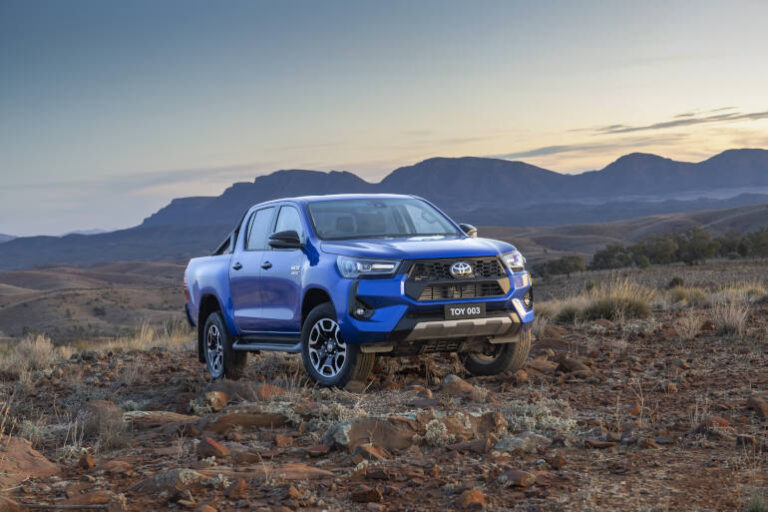
Toyota Australia has partnered with global transport company Transurban to test new Cooperative Intelligent Transport Systems (C-ITS) designed to improve road safety and traffic flow on some of Melbourne’s busiest routes.
The trial, which began in August, uses Toyota HiLux vehicles equipped with next-generation vehicle-to-everything (V2X) communication technology. The focus is on one of the riskiest driving scenarios—merging onto motorways—where accidents and congestion are common.
Using Transurban’s proprietary traffic management system, which employs AI-powered cameras to measure density, location, and speed, the C-ITS hardware in the vehicles receives real-time updates. These updates alert drivers about speed mismatches with surrounding traffic and warn them of vehicles in their blind spots.
Toyota Australia Vice President Sales, Marketing and Franchise Operations, Sean Hanley, said the partnership demonstrates Toyota’s commitment to testing future-ready technologies in real-world driving conditions.
“Partnering with Transurban allows Toyota Australia to test exciting new technologies in real-world situations on some of our most frequently travelled roads,” Mr Hanley said.
“Technologies like the Merge Assist feature being trialled will help in the development of future automated driving capabilities, which will help improve safety outcomes for all, in particular on motorways.”
For Transurban, the trial reflects a broader focus on innovation and safety across its toll road network.
“We’re always looking at ways to make journeys safer and more reliable for the communities who use our roads,” said Transurban Group Executive of Operations, Dave Clements.
“This partnership allows us to explore how connected vehicle technologies can complement our existing traffic management systems to reduce crash risk and improve traffic flow.”
The test site is the inbound Cook Street on-ramp in Port Melbourne, with trials scheduled through September.
Toyota Motor Corporation Australia has previously run C-ITS pilots through Lexus, testing features such as early warnings for unseen vehicles and pedestrians, notifications of roadworks, and communication with emergency services and traffic lights.
As connected and automated vehicle technologies continue to evolve, this collaboration provides an opportunity to assess how innovations can be integrated into both current fleets and future transport systems, with the shared goal of improving safety outcomes for all road users.
- Why Hyundai is getting serious about novated leasing for electric cars
 Novated leasing is becoming an increasingly important part of the Australian electric vehicle market, and Hyundai Australia is adjusting its fleet strategy to reflect the change. The company has launched its own Hyundai Novated Lease product, powered by Smart, while also introducing specific offers designed for customers acquiring selected EVs through novated leasing. Akshat Ahuja,
 - Finalists announced for 2026 Novated Lease Car of the YearFleet News Group has announced the three finalists for the 2026 Novated Lease Car of the Year, presented in partnership with the National Automotive Leasing and Salary Packaging Association (NALSPA). The finalists are: Unlike the other Fleet Car of the Year categories, the Novated Lease Car of the Year finalists are selected using real-world market data from
- Novated leasing growth pushes Smartgroup past 91,000 vehiclesSmartgroup has reported continued growth in its novated leasing business, with the number of leases under management reaching 91,600 at the end of June 2026. The total was up 11,600 vehicles, or 15%, compared with the same period a year earlier. Smartgroup had 80,000 novated leases under management at June 2025 and 64,600 at June
- Geely Starray EM-i vs EX5: Similar SUVs, similar prices — but novated leasing changes the mathsIf you walked into a Geely showroom and compared the Starray EM-i with the fully electric EX5, the decision might initially look fairly straightforward. Both are five-seat, front-wheel-drive SUVs from the same brand. Both offer generous interior space, modern technology, extensive safety equipment and electrified powertrains. And, importantly, they’re sitting within a few thousand dollars
- Why the $15,000 Kia EV4 GT-Line price gap becomes just $39 a weekThe Kia EV4 range provides a useful example of why new-car buyers should look beyond the driveaway price when comparing electric vehicles for a novated lease. At first glance, the difference between the EV4 Air and the EV4 GT-Line is substantial. The Air has a quoted on-road price of $53,000, while the GT-Line is $68,000