

The shift to electric trucks is often framed around emissions and fuel costs, but a project being developed by Fleet Plant Hire and Vertu Group shows the technology may also help address two of the construction sector’s most persistent challenges: driver shortages and vehicle safety.
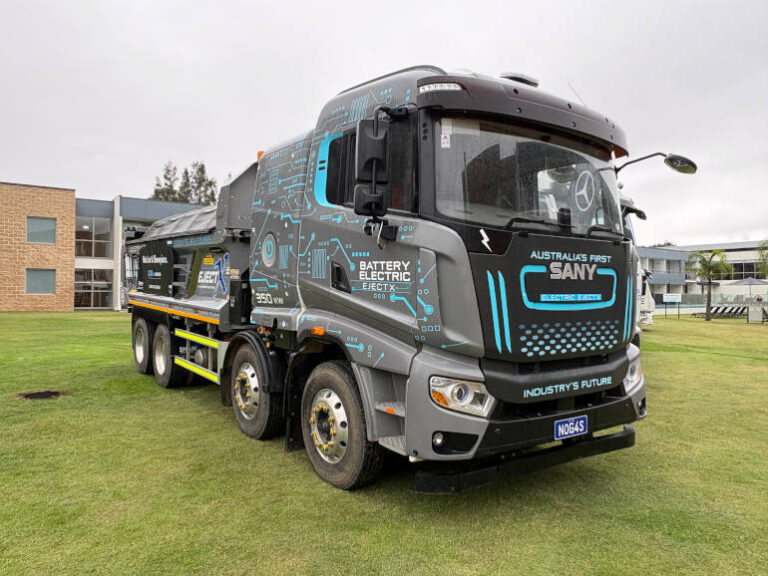
At TruckShowX 2026 in the Hunter Valley, Fleet Plant Hire showcased a Sany battery-electric tipper fitted with an EjectX body designed and manufactured in Queensland by Surex. The combination brings together a quieter, automatic electric truck with a body system that removes the need to raise the truck body when unloading.

For Chris West, Managing Director at Fleet Plant Hire, the opportunity is about more than introducing a new powertrain. He said the electric truck is delivering a better experience for drivers, particularly in an industry where long days, vibration, noise and fatigue are part of the operating environment.
“We’re finding more so that they are better for driver fatigue,” West said. “Obviously, your running costs after a period of time are much cheaper, and most drivers are looking at it as being an alternative to what has been around.”
West said the appeal was not limited to the environmental benefits normally associated with battery-electric trucks.
“It’s not just the fact that it’s new energy and that it’s green,” West said. “The main driver has been they’re a better outcome for the driver themselves.”
That driver-focused argument is important in construction, where many trucks operate in busy, high-risk environments and must complete repetitive work across civil, infrastructure and disposal sites. Fleet Plant Hire has been using the Sany truck in normal construction operations since January, rather than placing it in a controlled demonstration route.
“We have used that truck since basically January on normal construction sites,” West said. “We don’t ask the client who’s using it to put it on particular parts of a job, so it doesn’t sit on site all day.”
The truck is a Gen One 8×4 model with a 350kW battery. West said it has generally been completing around 250 to 300 kilometres a day and charging back overnight, which aligns with the duty cycle of many tipper applications. These trucks are not typically covering linehaul distances, making construction one of the more practical early applications for heavy electric vehicles.
Jonathon Griffiths, Managing Director at Vertu Group, said the project had been developed around proving the technology in real operating conditions.
“Our whole mandate from Fleet, or the whole mandate working together, has been making sure these things work in the real world,” Griffiths said.
The other major part of the safety story is the EjectX body (built by ShawX in Queensland). Unlike a conventional tipper, which raises the body to unload material, the EjectX system pushes the load out the back while the truck remains flat. That design is intended to reduce rollover risk, particularly when loads become stuck or when unloading on uneven ground.
West said rollover risk remains a serious issue in traditional tipping operations.
“There’s been a lot of rollovers, which have caused deaths, where a load has either become stuck at the top or down at the tailgate or on uneven ground when their body’s raised to tip,” West said. “They developed this EjectX body, so the body, the truck stays flat all the time. Centre of gravity is low.”
For fleet and safety managers, that is a significant change in the risk profile. A truck that does not need to lift its body to discharge a load can avoid one of the most dangerous moments in tipper operation. It also reduces the likelihood of people being exposed to hazards around a raised body.
The simpler operating environment also has implications for workforce development. West said the industry is dealing with a driver shortage, and the combination of an electric automatic truck and push-button body operation could make it easier to introduce new drivers safely.
“There’s a driver shortage in Australia,” West said. “Having the electric automatic truck with the system for the body, where the driver doesn’t need to engage anything other than press one button on a screen, it means that we can bring in effectively new drivers to the industry.”
West said those drivers could gain experience before progressing to more complex combinations.
“We can actually run them through a training module for a year, and it’s completely safe to everyone around them,” he said.
Fleet Plant Hire is also developing an EjectX trailer, with West noting that trailers are often where rollover risk is most pronounced in traditional operations. The next-generation vehicle is expected to operate at around 52 to 54 tonnes, giving the company a pathway to expand the application beyond the single rigid truck.
For Griffiths, the project demonstrates how electrification can flow beyond large fleet purchases and into a more traditional sector of the heavy vehicle market.
“I think one of the great things as well about this project is we’re sort of revolutionising one of the most traditional industries being construction,” Griffiths said. “Construction is sort of the last mile when it comes to actually transitioning.”
The message for construction fleets is that electric trucks should not be assessed only through emissions reduction. In the right application, they may also support safer work practices, reduce fatigue, simplify driver training and help attract new people into the industry.
For operators managing cost, compliance and labour pressures, that broader value proposition could be just as important as replacing diesel.