

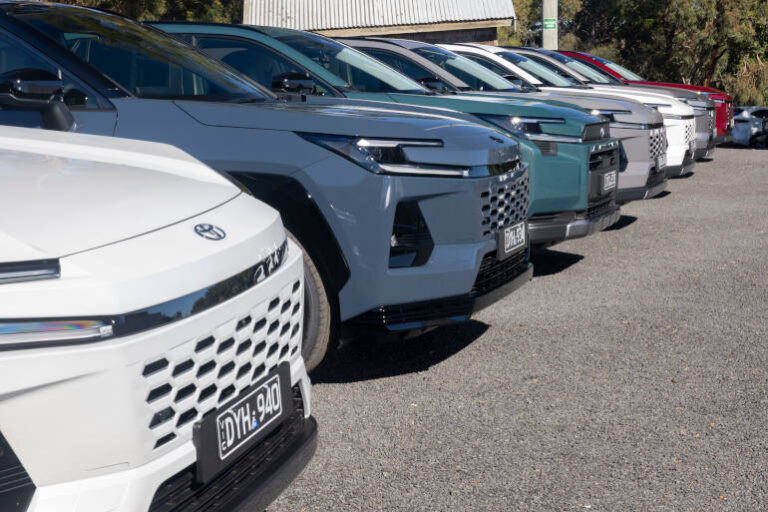
The launch of the sixth-generation Toyota RAV4 should have been a straightforward story about Australia’s most popular medium SUV getting a new model update.
Instead, it has raised a question that many Fleet Managers are quietly asking: Why doesn’t it have a five-star ANCAP safety rating at launch?
That missing stars are not just a technical detail. It challenges one of the most entrenched assumptions in fleet procurement — that a five-star rating is the single defining measure of safety.
And it forces us to confront a more uncomfortable possibility. Are manufacturers starting to push back against the escalating cost of meeting ever-changing safety requirements?
This Isn’t the First Time — And Fleets Already Know That
Let’s be honest about history. The industry has seen this situation before.
The Toyota Corolla continues to sell into fleets long after its ANCAP rating expired. Smaller fleets keep buying it. Larger fleets in banking and insurance keep buying it. They understand the operational reality of the vehicle — reliability, running costs, and resale value — and made a pragmatic decision.
Before that, the Toyota LandCruiser Prado spent a period in the market without a current rating. Mining and regional fleets continued to operate it because it was the right tool for the job.
Those decisions were not reckless. They were practical. And they reveal something important. Fleet Managers already know that safety is more complicated than a star rating.
Let’s Address the Obvious Question
Could the missing rating simply be a timing issue? Possibly.
But Toyota is not known for poor timing. The company plans product launches years in advance. It manages supply chains with military precision. It aligns marketing campaigns with market conditions — sometimes uncannily well.
That makes the timing explanation feel thin.
A more realistic explanation is that the vehicle may not yet meet the latest ANCAP 2026 protocol — or that meeting it requires additional engineering work, additional technology, and additional cost.
And that leads directly to the real issue.
The Cost of Safety Is Rising — And Fleets Are Paying for It
ANCAP standards have become progressively tougher. Each new revision adds requirements:
- More advanced driver monitoring systems
- More sophisticated collision avoidance technology
- More sensors and cameras
- More software and computing power
- More testing and validation
All of that improves safety. But all of it costs money. And those costs show up directly in fleet budgets.
Over the past few years, vehicle prices have increased sharply. Safety technology is one of the biggest contributors to that increase. The industry rarely says this out loud, but Fleet Managers see it every time they sign a purchase order.
So it is reasonable to ask: At what point does the cost of incremental safety features start to undermine affordability for fleets?
That question is not anti-safety. It is pro-sustainability — operational sustainability. Because a fleet that cannot afford to replace vehicles on time is not a safe fleet.
The Counterargument — And It’s a Strong One
There is also a clear case against the idea that this is a deliberate pushback. A five-star rating still matters.
It provides:
- Independent verification of safety performance
- Confidence for executives and boards
- Protection in the event of an incident
- A consistent procurement benchmark
From a governance perspective, it is difficult to ignore. And in many organisations, workplace safety obligations make it risky to purchase vehicles without a current rating — even if the vehicle itself is technically safe.
That is the reality of modern risk management.
The Bigger Problem — We’ve Turned a Rating Into a Strategy
Here is the uncomfortable truth. Too many organisations treat the five-star ANCAP rating as a complete safety policy. It isn’t. It is the first step. And sometimes it becomes the last step.
Buying a five-star vehicle does not guarantee safety. Real fleet safety comes from:
- Driver behaviour
- Maintenance discipline
- Vehicle utilisation management
- Fatigue management
- Training and supervision
- Telematics and monitoring
- Leadership accountability
Those factors prevent incidents. Star ratings do not.
Toyota May Be Sending a Message — Whether Intentionally or Not
Toyota recently ran an advertising campaign that emphasised real-world testing on roads rather than laboratory testing environments. That messaging matters. It suggests a subtle shift in thinking — not away from safety, but toward practicality.
Manufacturers are starting to question whether laboratory-based testing fully reflects real-world fleet operations. And fleets should be asking the same question.
What This Means for Fleet Buyers in 2026
The absence of a five-star rating at launch is not a crisis. But it is a signal.
A signal that:
- Safety requirements are becoming more complex
- Vehicle costs are rising
- Procurement decisions are getting harder
Fleet Managers are already balancing competing pressures:
- Budget constraints
- Emissions targets
- Vehicle availability
- Driver safety
- Operational reliability
Adding more mandatory technology without considering cost consequences creates risk in another form — delayed vehicle replacement. And delayed replacement is one of the biggest safety risks in any fleet.
The Challenge to Fleet Leaders
If your fleet safety policy is built entirely around a five-star ANCAP rating, it is time to rethink the approach. Because safety is not a badge. It is a system. The launch of the new Toyota RAV4 simply gives us a timely reminder of that reality.
And perhaps the most important question is not: Why doesn’t it have a five-star rating yet?
But rather: What are we doing beyond that rating to keep people safe?
A Toyota spokesperson has confirmed that the all-new RAV4 has received a significant upgrade to passive and active safety features compared to the outgoing model.
An official ANCAP rating is expected to be confirmed following a product update in the second half of 2026, designed to meet the latest 2026 protocol requirements. This is expected to be aligned to the Euro NCAP testing program which will be conducted later in 2026.




