

Australia does not have a diesel engine problem—it has a fuel confidence problem.
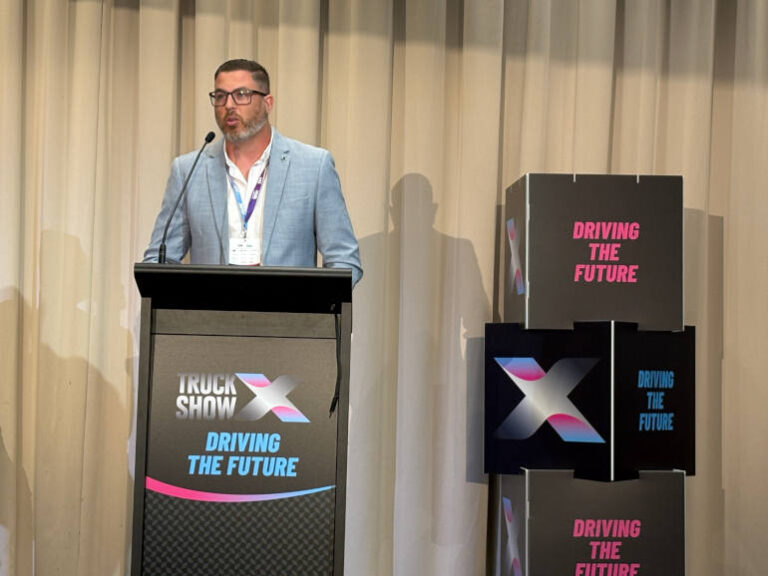
That was the central message from Shayne Commons, Director of Product Strategy at Volvo Group Australia, during his presentation at TruckShowX, where he addressed concerns about diesel supply, fuel quality and the future energy mix for heavy transport.
Commons said recent disruption had been driven by global supply pressures, geopolitical tensions, shipping interruptions and panic buying, rather than a collapse in the quality of diesel available to Australian operators.
“We’re seeing supply-driven disruption. We’re not seeing fuel quality collapse,” Commons said.
Temporary changes to Australia’s diesel standard had created confusion within the transport industry, particularly around a reduction in the minimum flash point permitted for diesel.
Commons stressed that the change did not reduce the energy content or combustion quality of the fuel and would not affect vehicle power, fuel economy or engine durability.
“Flash point does not affect the energy quality,” he said. “The power output and the economy or the fuel burn is not affected by this flash point change.”
Modern diesel engines remain protected
According to Commons, diesel meeting the temporarily amended standard would not damage modern truck engines, fuel-injection equipment or exhaust after-treatment systems.
He also confirmed that Volvo Group Australia’s warranty position had not changed.
“There’s no impact to warranty, and it remains valid with no exceptions to that,” Commons said.
Fleet operators were not required to change their maintenance programs or refuelling procedures because of the revised standard.
Instead, Commons encouraged operators to continue following established fuel-management practices, including purchasing from reputable suppliers, draining water separators and maintaining good fuel hygiene.
“Use today’s diesel confidently. Your engines are safe,” he said.
While the current disruption did not create an engine compatibility problem, Commons said it demonstrated the risks associated with relying heavily on one imported energy source.
The more important question for fleets was therefore how they could reduce their exposure when the next disruption occurred.
Renewable diesel provides a practical alternative
Hydrotreated vegetable oil—commonly known as HVO or renewable diesel—was identified as one of the most practical alternatives available to the heavy vehicle industry.
HVO is chemically similar to conventional diesel and can be used as a drop-in fuel without major vehicle modifications or new refuelling infrastructure.
“It’s a drop-in fuel with no new infrastructure and no changes required, which really matters in a fuel crisis,” Commons said.
However, Australia currently has little meaningful domestic HVO production. Limited supply increases costs and restricts the number of fleets able to use it at scale.
Commons said growing local production could reduce lifecycle emissions, improve energy security and create another pathway for operations that could not yet transition to battery-electric vehicles.
Volvo Group Australia has already gained practical experience with the fuel. Since late 2024, new Volvo and Mack trucks produced at the company’s Wacol manufacturing facility in Queensland have received their first engine start using 100 per cent HVO.
“Any vehicles that you’ve purchased or operated since 2024, the first engine startup has been done on 100 per cent HVO,” Commons said.
Electric trucks are already doing real work
Commons also challenged the view that battery-electric trucks remained experimental or unsuitable for Australian conditions.
He said electric trucks were already operating successfully in urban distribution, waste, ports and mining-support applications.
“These trucks are earning money,” Commons said. “They’re doing real work, performing real tasks and doing it effectively—and also cost-effectively—for those operators.”
For fleets, the case for battery-electric trucks was not based solely on emissions reduction. It could also include more predictable energy costs, lower maintenance requirements and reduced vehicle noise.
However, Commons rejected the assumption that battery-electric technology would replace diesel in every application.
Volvo Group Australia instead expects the transport sector to adopt multiple energy sources, with each selected according to the operational task.
Diesel would continue where it remained the most practical option. HVO could provide a lower-carbon replacement in compatible operations, while battery-electric trucks would be deployed where duty cycles and charging arrangements made them commercially viable.
Gas, hydrogen and other developing energy sources could also play a role over the longer term.
“The only wrong answer is pretending there’s one solution that fits all problems,” Commons said.
Diversification is the best defence
The recent diesel disruption provided a reminder that the industry’s transition should not be treated solely as an emissions exercise.
A broader mix of fuels and powertrains could also help fleets manage supply risk, energy costs and future market volatility.
Commons urged operators to remain focused on verified information, understand the suitability of different technologies and begin planning before the next fuel crisis emerged.
“The fuel crisis is about fuel volatility. It’s not about energy compatibility,” he said.
For fleet operators, the practical response is not to abandon diesel prematurely, but to understand where diesel, renewable fuels and electric trucks can each deliver the strongest operational result.
“Plan your transition pathway now,” Commons said. “Don’t plan it when we’re in a crisis.”