
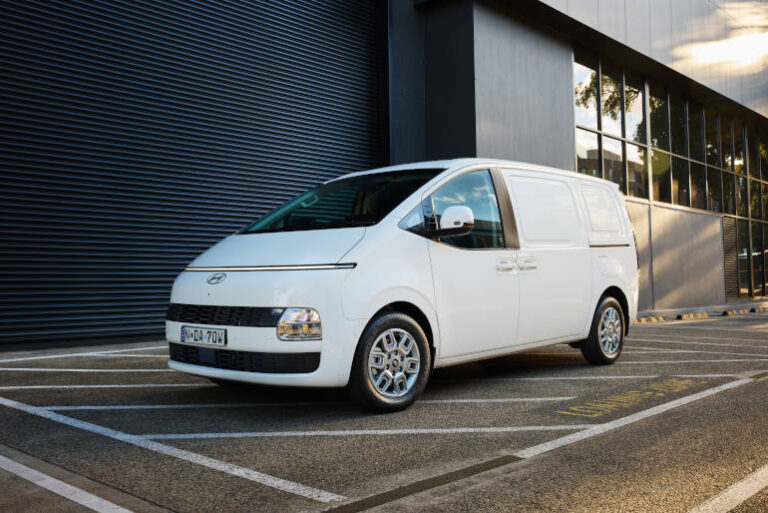
The headline feature of the updated Hyundai STARIA Load is undoubtedly the introduction of a hybrid powertrain. As Australia’s first full hybrid van in this segment, it will attract plenty of attention from fleet buyers looking to reduce fuel consumption without moving to a battery-electric vehicle.
After spending time behind the wheel at the Australian media launch, however, it’s the improvements to the driver’s workplace that left the stronger impression.
Commercial vehicles are mobile offices. Drivers can spend eight or more hours each day in them, so comfort, visibility and ergonomics have a direct impact on fatigue, productivity and job satisfaction. Hyundai appears to have recognised this, because almost every change inside the cabin makes the STARIA Load a better place to work.

The dashboard finally feels modern
The most obvious improvement is the new dashboard.
The previous STARIA Load never felt outdated, but the facelift brings it into line with Hyundai’s latest passenger vehicles. The new digital instrument cluster and larger multimedia display are easier to read and present information more clearly, while the redesigned dashboard creates a much cleaner, more organised workspace.
Importantly, the larger screens remained easy to read even when driving directly into bright sunlight. That’s a practical improvement that matters far more to fleet drivers than impressive-looking graphics in a showroom.
The new steering wheel is another subtle but worthwhile upgrade. It’s comfortable to hold and contributes to a driving position that feels more passenger car than commercial van.
Storage is better—but not perfect
Hyundai has also improved cabin storage.
Additional shelves, overhead compartments and larger storage trays make it easier to organise the equipment that inevitably accumulates in a working vehicle—phones, paperwork, folders, tools and charging cables.
The one decision that raises questions is the open centre console.
There’s no lid, meaning it can’t double as a writing surface or support a laptop when completing paperwork between jobs. For service technicians, inspectors or anyone who regularly works from their vehicle, that’s a missed opportunity.
The open design certainly makes it easy to throw equipment into the console, but it also leaves anything stored there on display. A closable console would have provided greater flexibility without compromising storage capacity.
The hybrid suits urban fleets
The hybrid powertrain feels well suited to metropolitan fleet work.
It’s noticeably quieter than the diesel, particularly around town where electric assistance reduces engine noise during low-speed operation. For drivers spending all day making deliveries or travelling between service calls, the quieter cabin should reduce fatigue over a full shift.
The only characteristic that stood out during the launch drive was the way the petrol engine occasionally held higher revs while climbing the steep hills around Sydney’s Northern Beaches. It’s not unusual behaviour for a hybrid working hard, but it’s more noticeable than in the diesel.
That said, most urban fleet applications are unlikely to spend much time climbing long grades while fully loaded. In everyday suburban driving, the hybrid feels smooth, refined and entirely appropriate for the role.
The lack of towing capacity compared with the diesel will inevitably limit its appeal for some operators, but most STARIA Load customers don’t spend their day towing trailers. For many businesses, improved fuel efficiency and refinement will be the more valuable trade-off.
Suspension changes are difficult to judge
Hyundai invested considerable engineering effort in revising the suspension. Retuned shock absorbers, revised bushings and additional structural components were all designed to improve ride quality and refinement.
On paper, it’s a comprehensive list of changes.
In practice, during the relatively short launch drive carrying approximately 350kg of ballast, there wasn’t a dramatic difference compared with the outgoing model.
That shouldn’t necessarily be interpreted as a negative. The previous STARIA Load was already one of the more comfortable vans in the segment. The facelift simply continues that standard rather than transforming it.
The vehicle remained composed, predictable and comfortable throughout the drive, but the suspension never demanded attention—which, arguably, is exactly what good suspension should do.
Still one of the most practical vans
Practicality remains one of the STARIA Load’s biggest strengths.
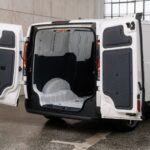
Dual sliding side doors continue to make loading easy in tight parking spaces, while the generous cargo area remains unchanged. Features such as the genuine cargo barrier and durable rubber flooring reinforce that Hyundai understands the requirements of fleet customers.
Small details also demonstrate thoughtful design. The warning light integrated into the raised tailgate is one of those simple ideas that can improve safety for operators working at the rear of the van after dark.
A better workplace
Fleet Managers often focus on payload, purchase price and whole-of-life costs—and rightly so. But driver comfort deserves just as much attention.
A well-designed workspace reduces fatigue, improves productivity and makes a vehicle easier to live with over hundreds of kilometres each week.
That’s where the updated STARIA Load succeeds.
The hybrid powertrain will undoubtedly generate the headlines, but the more meaningful improvements are found in the cabin. The new dashboard, improved technology, quieter driving experience and better ergonomics combine to create a van that feels more refined and more enjoyable to spend time in.
For fleet operators trying to attract and retain skilled drivers, those improvements may ultimately prove more valuable than the addition of another powertrain option.
- Kia is back in the van business — and it is starting with an EV
 Kia has returned to the Australian van market after a long absence, but rather than easing its way back in with a conventional petrol or diesel model, it has chosen to start with a dedicated electric commercial vehicle. The PV5 arrived in Australia in earlier this year as Kia’s first dedicated battery-electric light commercial vehicle
 - Pajero Is Back: Mitsubishi Revives an Australian 4WD IconMitsubishi has confirmed the Australian range and specifications for the all-new Pajero, with the returning nameplate bringing a 2.4-litre turbo-diesel engine, seven drive modes, a 3.5-tonne towing capacity and a choice of five- and seven-seat configurations. The Mitsubishi Pajero will return to Australian showrooms in December 2026, reviving one of the brand’s best-known nameplates after
- Jaecoo Strengthens the J7 Line-UpJaecoo Australia is rolling out its MY27 J7 range, with the midsize SUV continuing to offer both petrol and plug-in hybrid powertrains as the brand broadens its appeal to Australian buyers. The updated line-up includes the petrol-powered Ridge AWD alongside three Super Hybrid System – PHEV variants: the Track SHS-P, Summit SHS-P 2WD and Summit
- Nissan Patrol Enters a New EraNissan has confirmed key Australian specifications for the new-generation Y63 Patrol, with the large SUV gaining a new twin-turbo V6, increased towing capacity, a revised chassis and a broader six-grade line-up. The new Patrol will arrive in Australia in early 2027, replacing the long-serving Y62 and introducing significant changes to the powertrain, suspension, cabin technology
- Hyundai Gives Palisade More Off-Road BiteHyundai will add a new Palisade XRT Pro variant to its Australian range from September, giving the large SUV more ground clearance, all-terrain tyres and a locally developed suspension tune. The XRT Pro is Hyundai Australia’s first model to use the XRT Pro designation. It sits alongside the existing Palisade Elite and Calligraphy variants, but differs through