

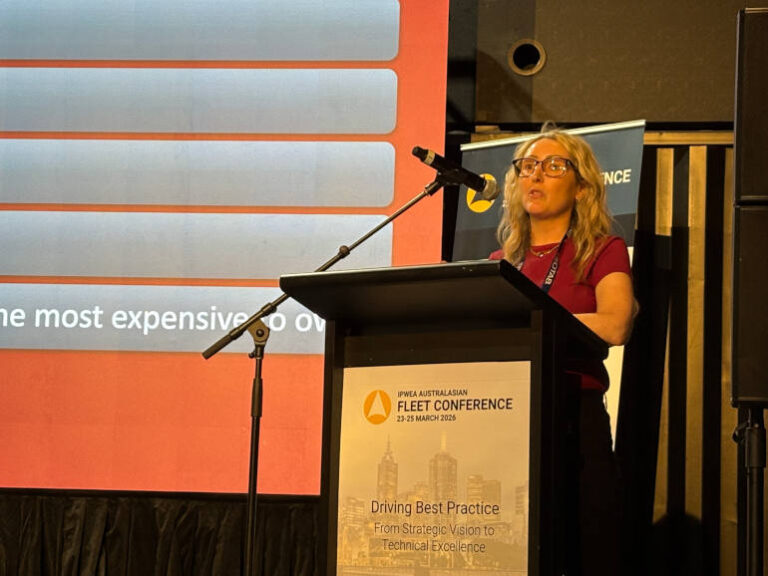
Shannyn Garrett, Procurement Manager – Corporate Services at Serco, delivered a practical session on procurement strategy and whole-of-life cost management at the 2026 IPWEA Fleet Conference in Melbourne. Speaking to a room of fleet professionals facing increasing operational complexity, Garrett challenged the traditional focus on purchase price and explained why procurement decisions made today can create operational problems years into the future.
Her presentation focused on a simple but often overlooked principle: fleet assets should be managed across their entire lifecycle, not just at the point of purchase.
Seeing Fleet and Property as the Same Type of Asset
Garrett opened with a personal story from her recruitment into Serco, explaining how her understanding of asset management shaped her approach to procurement.
“The one thing I did know about property was that it’s an asset, and each asset follows a life cycle. One moves and the other one doesn’t.”
That perspective resonated with senior leadership because it demonstrated a commitment to long-term value rather than short-term savings.
“He knew that I wasn’t just going to be shopping on price when it came to the vehicles for the fleet. He knew that I would be looking at the entire asset life cycle before I made any decisions.”
This lifecycle mindset became the foundation of her message to Fleet Managers throughout the session.
The Procurement Trap: Focusing on Price Alone
Garrett acknowledged that cost pressures are real, particularly in environments where budgets are tight and operational demands are growing. However, she warned that decisions based solely on purchase price often lead to long-term operational consequences.
“Price does matter, but if we’re just using price alone, it’s a blunt tool.”
She explained that these short-term decisions can result in years of avoidable costs through downtime, maintenance issues and supplier performance problems.
“When only focusing on the purchase price, we’re not thinking about any of the operational complexities that go along the way.”
Rather than blaming procurement teams, Garrett argued that the real issue is how and when procurement is engaged in the decision-making process.
Procurement Should Be a Strategic Partner
A key theme of the presentation was redefining the relationship between fleet and procurement teams.
Garrett encouraged Fleet Managers to involve procurement earlier in the planning process and to treat them as collaborators rather than gatekeepers.
“Stop seeing procurement as your price checkers, and start seeing procurement as your strategic partners.”
She explained that early collaboration allows organisations to consider operational requirements, maintenance strategies and supplier capability before contracts are signed.
This message resonated strongly in the conference context, where many sessions highlighted the growing need for cross-functional leadership in fleet management.
Hidden Costs That Appear Years Later
Garrett identified several hidden costs that commonly emerge when fleet decisions are made without proper lifecycle planning. These costs are often invisible during procurement but become significant operational challenges over time.
Among the most common issues she highlighted were:
- Poor standardisation
- Over- or under-specification of vehicles
- Low utilisation of assets
- Inefficient maintenance strategies
- Weak supplier performance
- Limited data for decision-making
She illustrated how small specification changes can quickly escalate costs across the fleet.
“We just think, you know what, we’re just ordering a ute. How hard can it be? And then Jimmy over here wants this, Bob over here wants that, Jill over here wants this, and all of a sudden we end up adding 10,000 different bits and pieces.”
Her advice was to standardise wherever possible and ensure operational requirements are clearly defined before procurement begins.
Planning Disposal from Day One
Another practical takeaway from the session was the importance of planning for asset disposal at the start of the lifecycle.
Garrett noted that many organisations focus heavily on acquisition but give little attention to residual value until the asset reaches the end of its life.
“If you invested properly at the start and you realised that asset at the end of life has another life somewhere else, the value is so much more.”
This approach not only improves financial outcomes but also supports better conversations with finance teams about long-term asset value.
“When we start talking to the financial teams, we don’t often think about that resale value at the end. Now, that’s music to our finance people’s ears.”
Data Turns Whole-of-Life Cost into Practical Decision-Making
Garrett emphasised that data is the foundation for effective lifecycle management, particularly as fleet operations become more complex.
She highlighted the growing role of utilisation, maintenance and financial data in supporting procurement decisions.
“Data is what makes whole of life costs practical, rather than theoretical.”
However, she cautioned against relying solely on data without professional judgement.
“Data doesn’t replace judgment. It just supports better decisions.”
This balanced view reflected the broader theme of the conference — that technology and analytics are tools to support leadership, not substitutes for it.
Whole-of-Life Thinking Is a Leadership Responsibility
Garrett concluded by framing whole-of-life cost management as a leadership issue that requires collaboration across multiple departments.
“Whole of life is ultimately a leadership issue. We all know it starts at the top.”
She emphasised that successful fleet outcomes depend on coordinated decision-making between procurement, operations, finance and suppliers.
“It’s procurement, it’s the operators, it’s finance. It’s any of those experts that are going to touch or have an impact on that vehicle through its life.”
For Fleet Managers attending the IPWEA conference — and those who could not be there — her message was a clear reminder that the most expensive fleet problems are rarely caused by the vehicle itself.
They are created by decisions made long before the keys are handed over.




