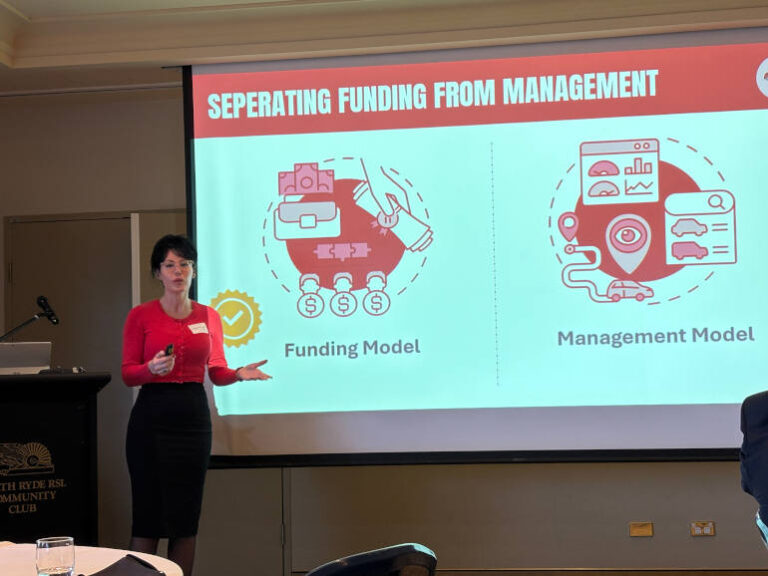
Sarah Johnson, Head Consultant at WLC Fleet Consulting, brought years of hands-on experience to the stage at the July AfMA Forum in Sydney, sharing pragmatic advice on fleet funding strategies. Her session, “Leasing vs Owning: What to Consider Before You Decide,” cut through industry assumptions to explore the nuanced financial and operational impacts of both approaches — all delivered with real-world examples tailored to the unique demands of fleet buyers and Fleet Managers.
It’s Not About Leasing or Owning — It’s About Fit
Sarah opened by making one thing clear: “I’m not going to be encouraging anybody to do either or. Every fleet is different, every problem is different, every use case is different.” This theme underpinned her entire presentation. Rather than pitching one model over another, she urged Fleet Managers to ask better questions and start with discovery.
“Before you do anything, don’t just go in with blinkers on. Taking time to do discovery in any kind of review is incredibly important,” she said. “You need to get into the detail.”
Understanding Flexibility and Use Case
Sarah illustrated how flexibility is often the determining factor in choosing a funding model. “If you own a vehicle and no longer need it, you can sell it. But if it’s leased, there may be early termination costs or damage fees.”
She described how organisations with constantly changing needs — like projects ramping up or winding down — must account for flexibility in their funding strategy. “If your use case is always short-term, maybe subscription, GoGet, or pool vehicles make more sense than traditional lease or ownership models.”
She also noted that fleets can (and should) mix models: “If you have a heavy commercial vehicle (HCV) fleet but also tools-of-trade vehicles, you might own the HCVs and lease the lighter ones.”
Transparency Depends on Systems and Maturity
Whether a fleet is leased or owned, the key to smart decision-making is transparency — something Sarah emphasised repeatedly.
“If you own your fleet and manage it in-house, transparency is critical. But remember, you’re responsible for creating it, and it’s only ever going to be as good as your reporting maturity.”
She cautioned that many asset management systems are not fit-for-purpose for fleets: “An asset management system is not a fleet management system. They are very different things.”
Risk Appetite and Residuals
Sarah explored how an organisation’s appetite for risk — especially around resale value — should guide funding choices. She pointed to COVID-19 as a real-world example: “If you owned your fleet and sold at the peak of COVID, you did great. If you had to sell during a downturn, it was a very bad day.”
With leasing, the risk of residual value is passed on — but for a fee. “You’re paying for convenience and to de-risk the operation. At the end of the lease, you hand the keys back and walk away.”
However, she warned Fleet Managers not to be naive about the trade-offs: “There are end-of-lease damage charges, inertia costs, and early termination fees. Not to be scared of — just to understand. These things need to go into your whole-of-life calculations.”
How to Compare the Models
Sarah outlined a straightforward but effective benchmark for fleet cost comparison: total vehicle cost over whole-of-life divided by kilometres travelled. “That’s your KPI — cents per kilometre. It gives you a line in the sand to come back to 6, 12, or 24 months later to validate assumptions.”
She encouraged Fleet Managers not to be constrained by tradition: “Don’t just assume 3-year, 60,000 km cycles. Put more options on the table.”
She also warned against over-optimising for a single scenario: “Don’t build a business case around the perfect lease term if you can’t actually meet that term in real life.”
The Hidden Cost of Transition
One of Sarah’s key messages was that the cost of change is often underestimated — whether moving from leasing to owning, or vice versa.
Transitioning from lease to own can mean a sudden capital outlay. “If you’ve got a 200-car fleet at $70,000 a car, that’s a big cash requirement. And what if the business stops performing and CapEx is cut? What happens to your ability to maintain the fleet?”
Transitioning the other way isn’t free either. “There’s the loss of equity, ongoing lease payments, and operational disruption. You’ll also need a different team — managing leases is a completely different skill set to managing owned assets.”
Don’t Be Surprised by End-of-Lease Costs
Sarah said end-of-lease damage costs continue to catch fleets off guard — often amounting to millions across large fleets.
“Some of the more mature organisations are now budgeting for it — putting in $1,200 or $1,500 per vehicle. But for some reason, it still comes as a surprise.”
She advised including realistic assumptions in total vehicle cost modelling — whether for refurbishment before sale (for owned vehicles) or damage allowances (for leased vehicles).
Four Takeaways for Fleet Buyers
Sarah closed with four key reminders for Fleet Managers and Procurement teams:
- Resource Your Team Appropriately: “Leased and owned fleets require different skills. Make sure you have the right people in the right roles.”
- Build Flexibility Into Commercial Models: “Even if you plan for a standard lease term, the reality on the ground will vary. Your model needs room to adjust.”
- Mix Programs Where It Makes Sense: “Use leasing where it fits, own where it doesn’t. You don’t have to pick one model for everything.”
- Review Regularly: “What worked three years ago may not work today. Keep reviewing your total cost of ownership, market products, and internal needs.”
Final Thought: Purpose First, Funding Second
For Sarah Johnson, the conversation always comes back to fit for purpose. “There’s always a use case for leasing, and there’s always a use case for owning,” she said. “It depends on why you need to move your people, your boxes, your tools. Start with that — and build your program around it.”