

Parkes Shire Council is a finalist in the Fleet of the Year category in the 2026 Fleet News Group Awards.
Behind that recognition is a highly organised maintenance operation that combines digital work orders with simple visual planning to help keep a large regional fleet available, productive and ready for work.

The fourth story in our Parkes Fleet of the Year series
So far in this series we have looked at regional fleet strategy, pothole detection and the council’s work to reduce idling. The fourth article moves into the workshop, where Parkes Shire Council has developed a maintenance process that mixes sophisticated asset data with very practical visual management.
Plan the work before the machine stops
Parkes owns its fleet and completes maintenance in-house. Service requirements are established for individual asset types rather than relying on a single generic interval. Some work is date-based, while other services are triggered by kilometres or machine hours. Heavy vehicles can have three-month inspection cycles, and specialist plant can carry its own test points and maintenance instructions.
The fleet team prints or generates upcoming service work about a month in advance. That planning window allows maintenance to be coordinated around operational requirements, rostered days off, weather and other periods when an asset may already be unavailable.
It also gives the stores function time to order parts before the vehicle reaches the workshop.
Parts in tubs, jobs on the board
One of the most memorable parts of the finalist interview was the workshop planning system. Parts for scheduled work are prepared in tubs labelled with the relevant work order and week. Jobs are then placed on visual boards covering the days ahead.
Different coloured frames and markers distinguish council work, contractor work, high-priority jobs and tasks that must be completed in the field.
It is a simple Lean-style approach that means technicians and supervisors can quickly see what is planned and what requires immediate attention. The digital system provides the detailed record; the physical board makes the workload visible to the people doing the work.
The work order travels with the technician
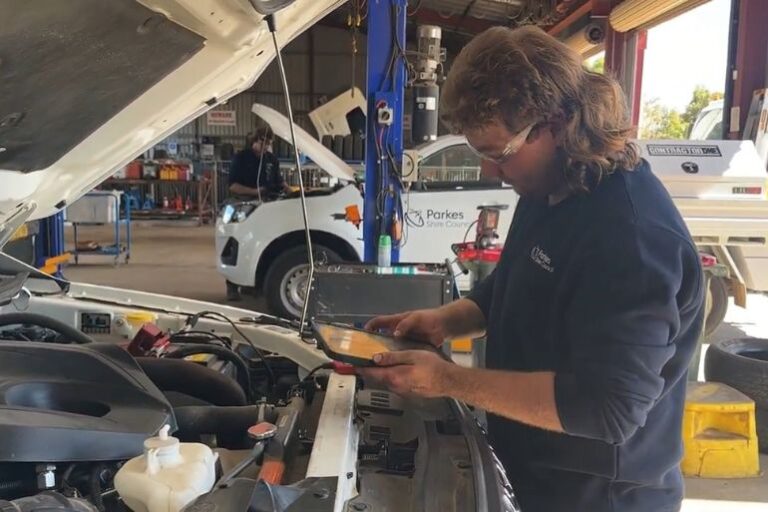
Technicians use tablets to access electronic work orders. Asset-specific instructions can include isolation requirements, safety checks and test points. The technician can add photographs, record comments and create follow-up work directly from the job.
Every action can carry a date and time stamp, providing a stronger audit trail than a paper form completed later. If further repairs are identified during a service, they can be scheduled while the issue is in front of the technician.
That matters because one of the biggest risks in maintenance is the gap between identifying a defect and making sure someone actually returns to fix it.
Maintenance data starts during procurement
Parkes tries to understand the maintenance implications of an asset before it enters the fleet. During procurement, the team requests risk assessments, special service operations and other technical information so the correct schedules can be attached to the asset from the beginning.
This is particularly important for specialist plant. A grader, truck, trailer and mower do not have the same operating environment or failure risks, so their maintenance programs should not be identical.
The result is a more structured relationship between procurement, maintenance and lifecycle planning.
Keeping reactive work under control
The council monitors work orders that move beyond their expected completion time and follows up jobs that have not been activated or closed. O’Shannessy told the judges that the structured scheduling process is helping reduce reactive maintenance because services are less likely to be missed and emerging problems are identified earlier.
Parkes targets 96 per cent fleet availability. Achieving that in a rural operation is not simply a workshop metric. When plant is unavailable, road crews, parks teams and other operational areas can lose productive time. Preventing an avoidable breakdown can therefore protect both maintenance costs and service delivery.
Digital where it helps, visual where it works
The Parkes workshop is a useful example of technology supporting people rather than replacing practical management. TechnologyOne generates the work, records costs and preserves the maintenance history. Tablets give technicians live access to instructions and evidence. The planning board provides an immediate view of the week.
There is no requirement that every part of the system be digital simply for the sake of it. The team uses the tool that makes the work easier to understand and control. That pragmatic approach runs through the wider Parkes fleet program and is one of the reasons it is a finalist for Fleet of the Year.
Next week: why the cheapest truck may not be the cheapest truck
In article five, we’ll look at how Parkes takes purchasing down to whole-of-life cost and dollars per kilometre – including a grader repair decision that the council says created a turnaround of around $30,000.
Vote for Parkes Shire Council
Vote for Parkes Shire Council in the 2026 Fleet News Group Fleet of the Year Award
Industry voting is now open. Visit the Fleet News Group Awards voting page to cast your vote.
Awards Night – 14 October 2026, Sydney
The winner of the Fleet of the Year Award will be announced at the Fleet News Group Awards Night in Sydney on 14 October 2026. Register your interest to attend the Awards Night.