

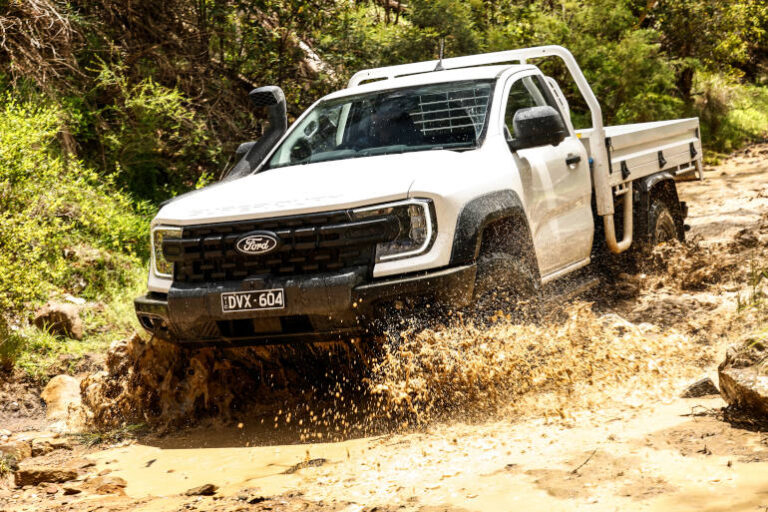
When a new vehicle launches, it can feel like it appeared overnight. In reality, the Ford Ranger Super Duty is the result of years of internal debate, engineering work, testing and fleet engagement — a development timeline that stretches back to 2018, long before the phrase “Super Duty Ranger” was ever public.
What makes this story particularly relevant for fleet buyers is not just how long it took, but why it took that long. The Ranger Super Duty wasn’t rushed to market. It had to earn internal approval, earn the Super Duty badge, and earn the confidence of fleet customers who would rely on it every day.
This is the story of how it happened.
2018: The First Spark
The origins of the Ranger Super Duty trace back to a conversation, not a product plan.
Andrew Birkic, President and CEO of Ford Australia, has described the moment clearly: it started with listening to a fleet customer explain what wasn’t working.
“The genesis of the story is sitting with a fleet customer and talking about what was frustrating them,” Birkic said. “What inhibited productivity, what drove cost into the system, and what drove waste.”
At that point, there was no commitment to build a new model. But there was a realisation that fleets were consistently pushing vehicles beyond their intended design limits, because there simply wasn’t a factory-built alternative that sat between a standard ute and a light truck.
By the end of that conversation, something had changed.
“By the end of it, we both walked out and went, ‘There’s something here. There’s a spark,’” Birkic said.
2019–2020: Turning an Idea Into a Business Case
An idea alone doesn’t get a vehicle approved inside a global OEM. The next phase was about determining whether the concept could stack up technically and commercially.
Steve Crosby, Director of Product Development at Ford IMG, explained that the challenge was bigger than simply “making Ranger tougher”.
“Super Duty is an iconic name in the Ford world,” Crosby said. “You don’t just get it — you have to earn it.”
Internally, that meant proving that:
- the platform could be re-engineered safely
- the use cases were broad enough to justify investment
- and the vehicle could deliver genuine capability, not just incremental improvement
This period involved early concept work, feasibility studies and internal reviews — all before the program was formally locked in.
2020–2021: Engineering Begins in Earnest
Once the program moved forward, engineering teams began rethinking Ranger from the ground up. Justin Capicchiano, Chief Program Engineer for Ranger Super Duty, said this phase was defined by realism.
“We realised pretty quickly this wasn’t about peak numbers,” Capicchiano said. “It was about what the vehicle could do every day, repeatedly, without falling over.”
Key systems — chassis, axles, suspension, mounts and electronics — were redesigned as an integrated package. Importantly, the goal wasn’t to create a niche product, but one that could operate across a wide band of fleet applications.
“It’s tricky to provide value across the whole band,” Birkic said. “From people doing a lap of Australia, to farmers, to forestry, to emergency services.”
2021–2022: Real-World Testing and Fleet Immersion
As prototypes emerged, Ford moved beyond lab testing and into the environments that matter most to fleets. Jeremy Welch, Conversion Development Manager at Ford IMG, described how deeply Ford embedded itself into customer operations.
“It was about going on the journey with the customer,” Welch said. “Not talking to them once and disappearing — talking to them multiple times, riding along with them, understanding what actually happens when they do their jobs.”
Some fleet customers even allowed Ford to collect operational data.
“We got loads of data,” Welch said. “What they do, how they do it, where the stress is. That changed everything.”
This feedback loop directly influenced decisions around payload management, safety systems, durability and conversion compatibility.
2022–2023: Challenging Assumptions
One of the most important phases in the program came when Ford’s assumptions were challenged by fleet reality. Welch admitted Ford initially believed fleets would prioritise simplicity and low cost over technology.
“We thought fleets wanted the cheapest thing,” he said. “What we found was they wanted the safest thing they could get — because that’s what gives them the most uptime.”
Features such as cameras, sensors and onboard systems were reassessed not as “nice-to-haves”, but as tools to reduce incidents and downtime.
“If you’ve got sensors, there’s less chance of someone backing into something,” Welch said. “That means the vehicle stays on the road working — and that’s what they want.”
This period marked a shift from designing for fleets to designing with them.
2023–2024: Proving It Was Truly ‘Super Duty’
As the vehicle neared production readiness, the final hurdle was internal: proving it deserved the Super Duty badge. Steve Crosby explained that every component needed to stand up to scrutiny.
“You have to demonstrate proof points at every step,” Crosby said. “Right from concept all the way through to the customer.”
Testing focused on sustained load, repeatability and long-term durability — the attributes fleet buyers care about but rarely see highlighted at launch events.
2025: Launch, With Confidence
By the time the Ranger Super Duty was ready to be revealed, it was no longer just a concept shaped by fleet feedback — it was a vehicle validated by it. Andrew Birkic summed up the philosophy behind the finished product.
“Everything we’ve done is very intentional,” he said. “It’s about optimising the outputs based on what customers value.”
Why This Timeline Matters to Fleet Buyers
For fleet practitioners, the Ranger Super Duty development story is more than a history lesson.
It shows:
- why OEM-grade solutions can replace aftermarket compromise
- why delivery timelines and uptime were prioritised
- and why the vehicle aligns with the growing maturity of fleet management
As fleets head into 2026 with tighter budgets and higher expectations, vehicles developed this way — patiently, collaboratively and deliberately — are likely to play a bigger role in long-term fleet strategies.
The Ranger Super Duty may be new to the market, but its thinking has been nearly a decade in the making.