

Since 1955, Bendix has been a cornerstone of Australian automotive manufacturing, earning its reputation as a leader in brake component design and production. From its roots in Ballarat, Victoria, Bendix has evolved into a trusted name in both the OE (Original Equipment) and aftermarket sectors, renowned for its commitment to safety, performance, and local manufacturing excellence.
A Proud Australian Heritage
“Bendix has been in Australia since 1955, manufacturing in Ballarat, Victoria—so regional Victoria—predominantly from an OE perspective back in those days,” said Ian Campbell, Head of Product Management at Bendix. During Australia’s golden era of automotive manufacturing, Bendix supplied brake components to some of the biggest names in the industry, including Ford, GM, Toyota, Mitsubishi, and Nissan. “Bendix was OE to Ford, GM, then more recently, Toyota, Nissan, Mitsubishi,” Campbell noted, underlining the company’s long-standing relationships with major manufacturers.
Bendix’s role extended beyond passenger vehicles, supplying brake solutions for light and heavy commercial vehicles and even the rail industry. “In the day they were even doing rail… when Australia used to make lots of things, including trains,” Campbell reflected. Today, despite the decline in local automotive manufacturing, Bendix continues to innovate and adapt, recently developing brake pads for Light Rail – a great local manufacturing story,” as Campbell described it.
The Birth of a Brake Pad: Innovation at Every Step
Bendix’s approach to brake pad development is meticulous and rooted in engineering excellence. “When we develop a brake pad, we undertake a thorough audit of the OE vehicle, 3D scanning of critical components, leading to perfect dimensions, clearances and edges, and a flawless fit in the finished product,” explained Campbell. This process ensures Bendix pads meet or exceed OE standards, offering consumers reliable, high-performance alternatives.
One of the most critical aspects of the development process is the formulation of the friction material. Using advanced techniques like electron microscopy, Bendix engineers analyse the compounds used to create superior friction materials tailored to specific driving conditions. “We develop our own versions with a view to surpassing the performance of what was originally provided by the manufacturer,” Campbell said.
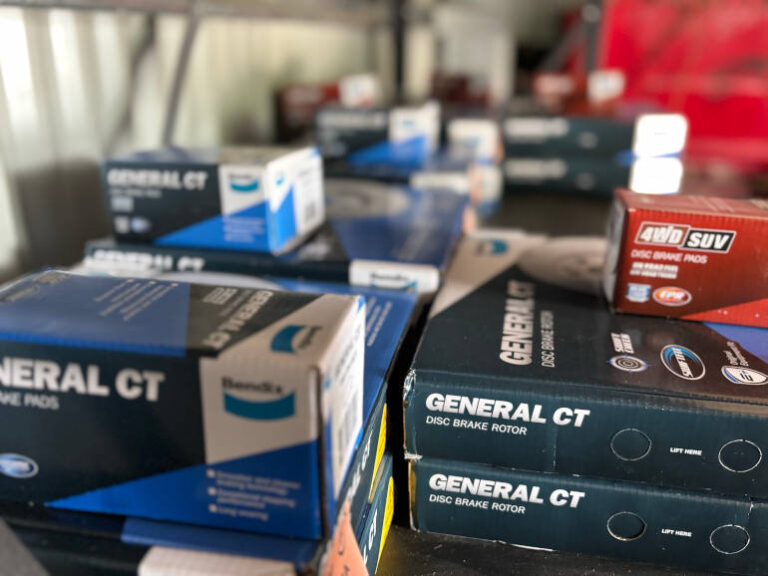
Bendix offers tailored solutions to suit diverse driving styles and applications. For instance, the General CT™ range is designed for everyday commuting with a focus on low noise and minimal dust, while the Ultimate+ range caters to enthusiasts seeking enhanced stopping power and reduced brake fade.
Extensive Testing: Simulating Real-World Conditions
At the heart of Bendix’s product development is its state-of-the-art testing facility in Ballarat, home to the only brake dynamometers in the Southern Hemisphere. “We’ve got eight brake dynos at the moment… we can do anything from a pushbike brake disc through to a heavy truck or a tram brake,” Campbell proudly noted.
These dynamometers allow Bendix to simulate real-world driving conditions with precision. “The best thing about the dyno is that you can repeatedly simulate lots of the same thing. So, if you wanted to simulate a car, a four-wheel drive towing a caravan down Mount Hotham, you could simulate that and repeat it over and over again,” Campbell explained. This rigorous testing process helps Bendix collect valuable data on wear, noise, and performance under various conditions.
Bendix also places a strong emphasis on noise testing, utilizing dedicated noise dynos and real-world vehicle tests. “We have vehicles in our test fleet wired up with microphones… and they just get driven around. We monitor what noises come out of them,” Campbell said. This attention to detail ensures Bendix pads meet strict low-noise benchmarks while maintaining optimal performance.
Design features like slots, chamfers, and shims play a crucial role in noise reduction and performance. “All those little lines and chamfers and everything you see on a brake pad—they’re all there for a reason,” Campbell emphasised. “We spot it straight away when we see an OE pad with multiple slots and double shims—that vehicle had a noise problem from the start,” he added.
Unrivalled Quality Assurance Processes
Bendix’s commitment to quality is evident in its rigorous Quality Assurance (QA) protocols, which ensure every brake pad meets exacting standards. “We boast an impressive—and extremely low—eight parts per million in manufacturing defects,” Campbell highlighted.
The QA process begins with shear testing to evaluate the bond between the friction material and backing plate. “A shear strength test machine applies hydraulic pressure against the edge of the friction material to a specified level to determine the quality of adhesion. We test at both ambient temperature and 300°C to replicate real-world conditions,” Campbell explained.
Compression tests further assess how brake pads perform under pressure, simulating the force applied by caliper pistons during braking. “We use compression testing to simulate brake applications and check pad displacement under ambient and elevated temperatures of up to 400°C,” Campbell noted.
Dimensional accuracy is also paramount. Using Coordinate Measuring Machines, Bendix ensures every pad meets precise engineering specifications. Even the smallest components undergo scrutiny using shadow graph technology.
The friction material itself undergoes extensive analysis. “We run XRF (X-ray Fluorescence) tests to check the composition and ensure there are no unwanted inorganic elements,” Campbell said. Additional tests, including acetone testing, resin analysis, and specific gravity tests, ensure the raw materials meet the exacting standards required for Bendix’s high-performance pads.
Celebrating 70 Years of Australian Manufacturing
As Bendix marks its 70th anniversary in Australia, the company remains steadfast in its commitment to local manufacturing and innovation. “It’s our 70th year in operation within Australia—quite the milestone,” Campbell proudly shared.
Bendix’s dedication to excellence, combined with its extensive design, testing, and quality assurance processes, ensures it remains a leader in the industry. Whether supplying brake pads for passenger vehicles, commercial fleets, or public transport systems, Bendix continues to deliver products that allow drivers to “put their foot down with confidence.”
This article highlights Bendix’s history, commitment to local manufacturing, and the extensive design, testing, and quality assurance processes that go into every brake pad and disc, using verbatim quotes from Ian Campbell, Head of Product Management at Bendix.