

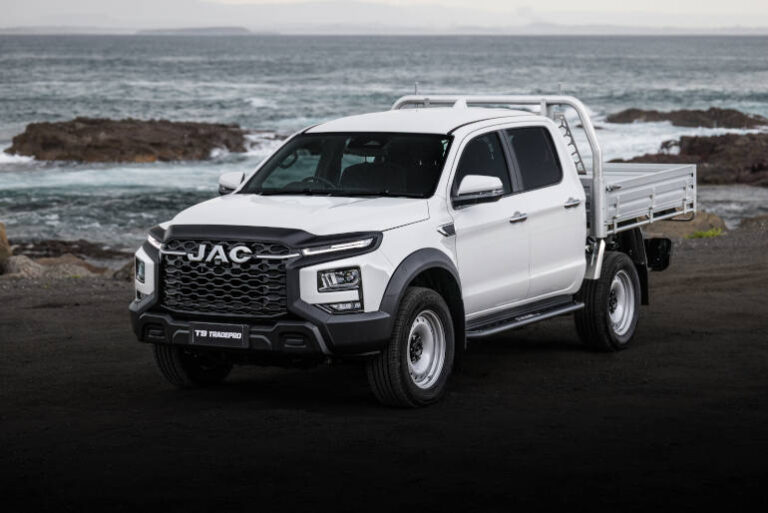
JAC Motors Australia has officially expanded its ute line-up with the introduction of the new Tradepro Cab-Chassis, a back-to-basics workhorse designed to give tradies and fleet buyers a lower-cost entry point into the growing T9 range.
The new variant arrives with a sharp opening offer aimed squarely at business users, reinforcing the brand’s positioning around value and practicality in the light commercial segment.

A new entry point focused on value and flexibility
The new model has been positioned as the most accessible configuration in the T9 family, with pricing starting from $38,990 plus on-road costs. Eligible ABN holders can secure a drive-away package from $40,990, including a genuine alloy tray fitted through participating dealers.
That price point is significant in a market where utes have steadily moved upmarket in both specification and cost. For many fleet buyers and small businesses, a simple, capable platform that can be customised for specific tasks still represents the most practical solution.
The open cab-chassis format allows operators to tailor the vehicle with trays, service bodies, or specialist equipment depending on the application—whether that’s construction, maintenance, agriculture, or local government operations.
Built for the core jobs fleets actually do
Under the skin, the Tradepro focuses on capability rather than lifestyle features. It’s a straightforward work vehicle designed to handle towing, payload, and off-road conditions without unnecessary complexity.
Key operational specifications include:
- 1,165kg payload capacity (excluding tray)
- 3.2-tonne braked towing capacity
- 4×4 system with rear differential lock
- Dual-range transfer case supplied by BorgWarner
- Combined fuel consumption of 7.6L/100km (NEDC)
For Fleet Managers and procurement teams, those numbers place the Tradepro squarely in the mainstream one-tonne ute category, competing directly with established models on core capability rather than brand heritage.
Importantly, the specification also reflects the realities of modern fleet operations—balancing performance with efficiency as fuel costs, emissions reporting, and utilisation targets continue to tighten under policies such as the New Vehicle Efficiency Standard (NVES).
Safety and ownership support remain central to the proposition
Despite its positioning as an entry-level variant, the Tradepro retains the same ownership support package as the rest of the T9 range.
Every model is backed by the JAC All Roads Assurance (JARA) program, which includes:
- Seven-year unlimited kilometre warranty
- Up to seven years of roadside assistance
- Capped price servicing
- Warranty loan vehicle program to minimise downtime
That last point is particularly relevant for fleets where vehicle availability directly affects productivity and service delivery.
The broader T9 platform has also earned recognition for safety performance, having been named Australia’s safest ute in 2024 based on aggregated ANCAP protocol results.
A strategic move in a highly competitive segment
The launch of the Tradepro Cab-Chassis reflects a clear strategy from JAC to compete on value in a segment traditionally dominated by well-established brands.
For fleets and novated lease buyers, the timing is notable. Rising acquisition costs, tighter emissions requirements, and ongoing pressure on operating budgets are forcing organisations to reassess vehicle specifications and total cost assumptions.
A lower-priced, fit-for-purpose ute that arrives ready to work—rather than loaded with lifestyle features—can change the economics of fleet replacement decisions, particularly for high-utilisation roles.
As Ahmed Mahmoud, Managing Director at JAC Motors Australia, explained in the announcement:
The vehicle was designed to deliver a serious work platform without requiring buyers to pay for unnecessary extras, while still maintaining essential capability and value.
The bottom line for fleet buyers
The Tradepro Cab-Chassis is less about innovation and more about practicality. It targets the part of the market where reliability, payload, and purchase price still drive decisions.
For organisations reviewing their light commercial fleet mix—particularly those moving away from higher-spec lifestyle utes—the new variant provides another option worth evaluating through a whole-of-life cost lens.
In a segment where price increases have become the norm, a new entrant focused on affordability and operational capability is likely to attract attention.




