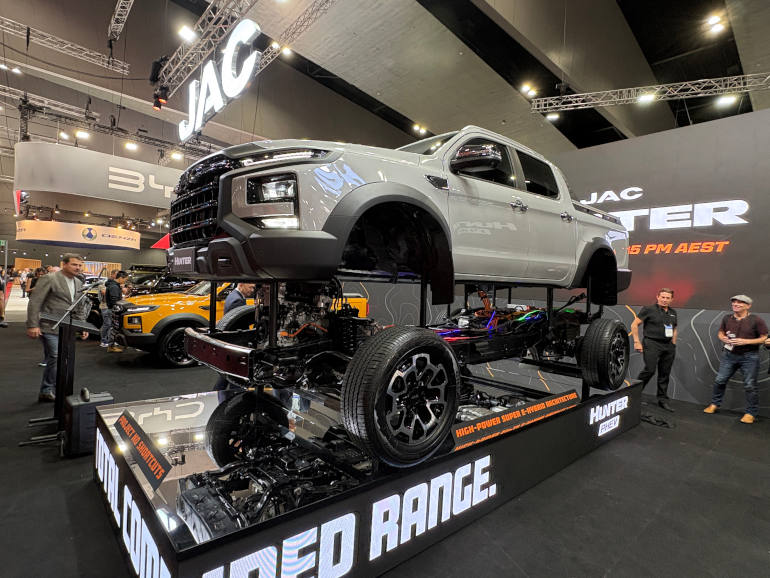

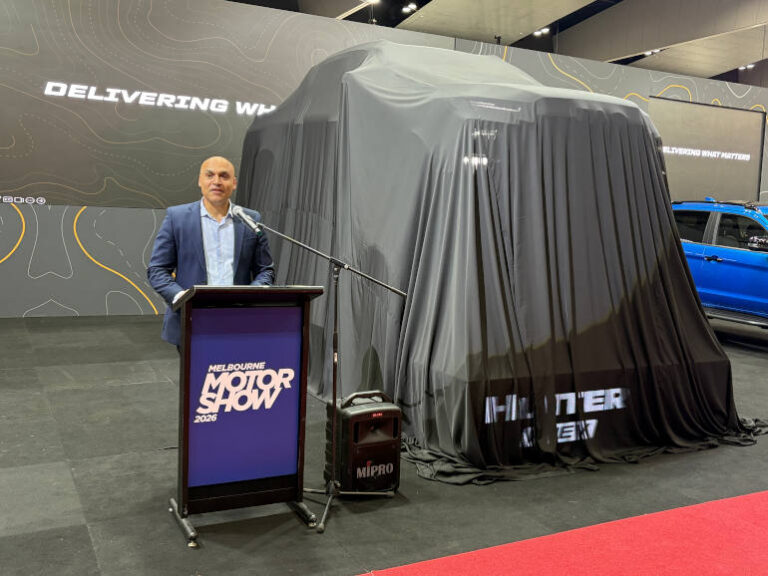
At the Melbourne Motor Show, Ahmed Mahmoud, Managing Director at JAC Motors Australia, used the stage to reinforce the brand’s commitment to the Australian market, highlight local engineering investment, and formally announce key details of the upcoming Hunter plug-in hybrid ute.
The message was clear: JAC Motors is positioning itself as a long-term player in the fleet and light commercial vehicle market, with a focus on capability, safety, and affordability rather than simply introducing another new model.
Mahmoud reminded the audience that Australia has played a central role in the global rollout of the Hunter program.
“It was at this show (last year) that Australia was the first in the world to reveal the JAC Hunter, plug-in hybrid electric vehicle. A clear signal of where JAC focus lies.”
He explained that since that first reveal, the company has expanded its diesel T9 range and continued development work to ensure the Hunter meets the expectations of Australian drivers and fleet buyers.
Local testing and engineering for Australian conditions
A significant part of the announcement centred on local engineering and validation work, an area that fleet buyers often scrutinise when assessing new brands entering the market.
Mahmoud stressed that the Hunter has undergone extensive development in Australia, including collaboration with independent engineers and testing under real operating conditions.
“We’re not simply importing a vehicle, ticking a compliance box and calling it done, absolutely not. We’re doing at least 50,000 kilometres of local testing.”
He also confirmed that vehicle dynamics tuning for the Hunter has been completed locally.
“Today, I’m proud to announce that the Hunter will launch with vehicle dynamics tuning by Michael Barber from Multimatic tuned specifically for Australian conditions.”
For fleet operators, this focus on local validation is intended to address concerns around durability, ride quality, and suitability for regional and heavy-duty use.
Five-star safety rating and ownership support package
Safety and aftersales support were also highlighted as core elements of the Hunter’s market positioning.
Mahmoud confirmed that the new plug-in hybrid ute has achieved a top safety rating.
“I’m here and proud to announce that Hunter has earned a five star ANCAP safety rating, proof that exceptional safety and accessible pricing are not mutually exclusive.”
He also outlined a comprehensive ownership support package designed to build confidence among private and fleet buyers.
“An unlimited kilometre, seven year warranty for all drivers, including commercial use, seven years of servicing, and, of course, seven years of roadside assistance.”
For Fleet Managers evaluating new suppliers, warranty coverage and predictable maintenance costs remain key components of Whole-of-Life Cost (WOLC) analysis and risk management.
Performance and efficiency claims position Hunter as a new contender
The Hunter plug-in hybrid has been positioned as a high-performance alternative in the ute segment, combining power with lower emissions and fuel consumption.
Mahmoud highlighted headline figures intended to differentiate the model from traditional diesel competitors.
“Hunter is the most powerful plug in hybrid ute in Australia.”
He also pointed to the vehicle’s efficiency credentials.
“Hunter delivers class leading 1.6 litres per 100 kilometres fuel consumption and class leading CO₂ emissions of just 38 grams per kilometre.”
For fleets facing increasing pressure from fuel costs, emissions reporting requirements, and the New Vehicle Efficiency Standard (NVES), these performance and efficiency claims will likely be examined closely during procurement evaluations.
Two variants confirmed ahead of mid-year arrival
The Hunter will launch locally in two variants, offering different specification levels to suit a range of fleet and private use cases.
Mahmoud outlined the initial model lineup.
“The Hunter will launch with two variants, the Hunter Pro our base specification and a Hunter X. Our top specification will feature the diff lock, an optional sunroof and black detail.”
This two-variant strategy reflects a common fleet approach—providing a fit-for-purpose base model for operational roles while offering a higher-specification option for executive or specialised applications.
A long-term commitment to the Australian market
Beyond the vehicle launch itself, Mahmoud used the event to emphasise JAC’s broader strategy and long-term intentions in Australia.
He acknowledged that trust in the fleet and commercial vehicle market is built over time through consistent product performance and customer support.
“We are committed to Australia for the long term, and we know that in the market, trust is not given. It is earned through the vehicles you build and how they perform when it matters.”
For fleet buyers, that commitment will ultimately be measured through reliability, dealer capability, parts availability, and resale performance—factors that typically take several years to establish.
What this means for fleet buyers
The announcements at the Melbourne Motor Show signal that JAC is moving beyond market entry and into the next phase of brand development in Australia.
Key watchpoints for Fleet Managers include:
- Real-world fuel and energy performance
- Service network capability and parts supply
- Residual value stability
- Suitability for heavy-duty and regional operations
- Integration of electrified powertrains into existing fleet policies
The Hunter plug-in hybrid enters a competitive segment at a time when fleets are balancing cost pressures, emissions targets, and operational reliability.
Whether it becomes a mainstream fleet option will depend less on launch specifications and more on how the vehicle performs in service over the next three to five years.