

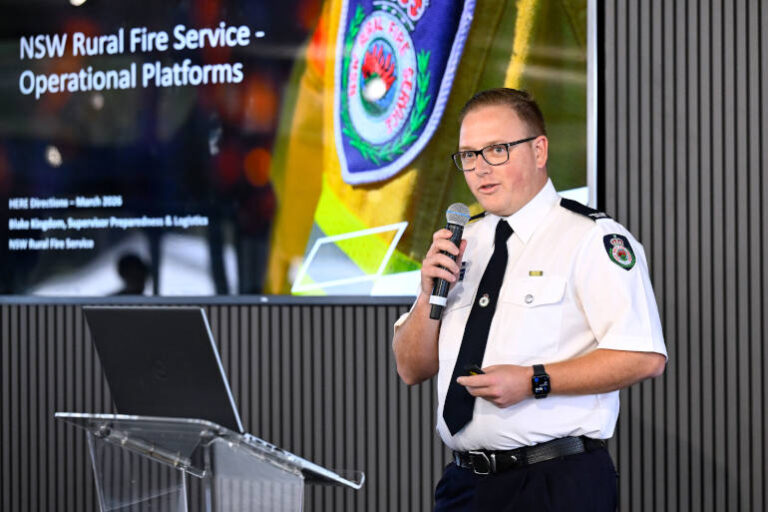
At the recent HERE Directions event in Melbourne, a presentation from the New South Wales Rural Fire Service (NSW RFS) provided a compelling case study on how modern fleet technology can serve more than one purpose.
While emergency response fleets are traditionally viewed as tools for operational deployment, the NSW RFS example shows how connected vehicles can also become mobile communication hubs, data collection platforms, and community support assets. By integrating mapping, connectivity, and real-time intelligence, organisations can use their fleets to improve both operational effectiveness and service delivery to the communities they support.

From fire trucks to connected service platforms
The NSW RFS manages one of the largest emergency service fleets in Australia. The organisation has more than 70,000 members across 2,000 brigades, responsible for protecting around 700,000 square kilometres of New South Wales. Each year the service responds to more than 32,000 incidents, ranging from bushfires and grass fires to vehicle accidents, storms and search-and-rescue operations.
Managing resources across such a vast area creates a major logistical challenge. Dispatch centres must determine which appliance is closest to an incident while considering road closures, weather, terrain and other operational risks.
In the past, this process relied heavily on radio communications and manual reporting from crews. Today, connected vehicle technologies are transforming how this information is collected, shared and acted upon.
The vehicle as a connectivity hub
One of the most innovative concepts presented at the event was the idea of “vehicle as a node.”
The NSW RFS is currently installing satellite connectivity across thousands of its operational vehicles using low-earth-orbit satellite technology. This initiative aims to equip the fleet with always-on connectivity, even in remote areas where traditional mobile networks are unavailable.
Each vehicle effectively becomes a mobile communications hub capable of supporting multiple functions:
- Real-time mapping and navigation for crews
- Data sharing between field teams and command centres
- Connectivity for other emergency services
- Temporary community internet access in isolated locations
This approach transforms the fleet from simply a transport resource into part of the organisation’s digital infrastructure.
Supporting communities during emergencies
The value of connected fleets becomes particularly clear during emergencies when communications infrastructure is damaged or unavailable.
In one example shared during the presentation, the rural community of Menindee lost connectivity after local infrastructure failed. An RFS rescue vehicle equipped with satellite connectivity was deployed to the area and activated a temporary Wi-Fi network.
This allowed the local medical centre to communicate with the Royal Flying Doctor Service and coordinate patient transfers.
In this case, the fire appliance was not only responding to an incident but also restoring critical communications for the community.
For organisations managing fleets in regional or remote areas, this demonstrates how vehicles can provide valuable community resilience during disruptions.
Faster response through real-time data
Connectivity also improves operational decision-making.
Modern dispatch systems combine road routing data, mapping platforms and operational rules to determine the closest and most appropriate resource to respond to an incident. This process must also account for hazards such as damaged roads, fallen trees or traffic conditions that may delay a response.
Real-time connectivity allows these decisions to be updated dynamically as new information becomes available.
The NSW RFS has also deployed digital tools that enable crews to upload photos and maps from the field. These updates can be shared quickly with command centres and public information platforms, giving communities faster access to situational updates during emergencies.
For fleet operators in other sectors, the same principle applies: connected vehicles can provide continuous feedback to central systems, improving both operational visibility and response times.
Turning fleet data into intelligence
As fleets become connected, the amount of available operational data grows rapidly.
The NSW RFS expects thousands of vehicles to transmit location, operational and communications data continuously once the connectivity rollout is complete. This creates new opportunities to analyse fleet activity, improve planning and optimise resource deployment.
However, it also introduces new challenges around managing and analysing large volumes of data.
For many organisations adopting connected vehicle technologies, the next step after connectivity is developing the analytics capability to convert raw data into operational intelligence.
Expanding the role of fleet assets
The NSW RFS case study highlights a broader trend in fleet management: vehicles are no longer just assets used to move people or equipment.
With modern connectivity and mapping platforms, fleets can support a wide range of functions, including:
- emergency response coordination
- infrastructure monitoring
- community communications
- environmental data collection
- operational analytics
This multi-purpose approach increases the value organisations receive from their fleet investments.
A blueprint for other organisations
Although the example comes from emergency services, the lessons are relevant for many industries.
Local governments, utilities, logistics providers and infrastructure operators all manage fleets that travel widely across the communities they serve. By integrating mapping platforms, connectivity and data analytics, these fleets can deliver benefits beyond their primary operational role.
The NSW RFS experience demonstrates how connected vehicles can become critical tools for both operational efficiency and community support.
As fleet technology continues to evolve, organisations that view their vehicles as connected service platforms rather than simply transport assets will unlock the greatest value for both their operations and the communities they serve.