

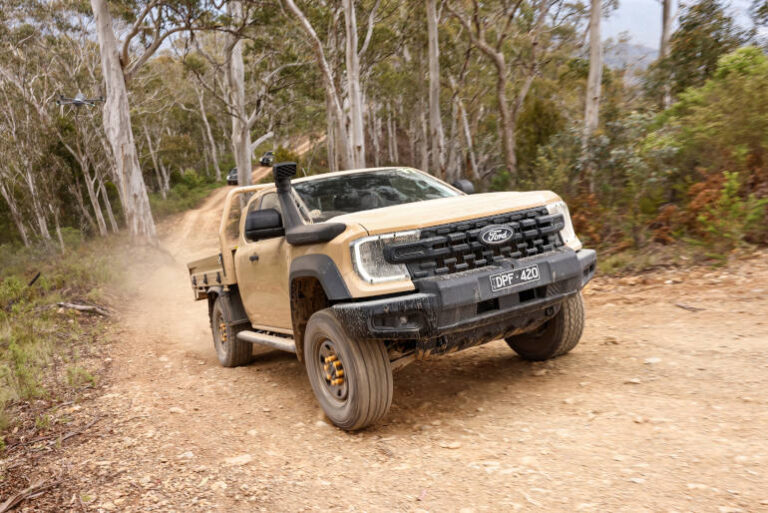
An ambitious collaboration between Ford Australia and six Australian universities is aiming to position Australia as a global leader in automated vehicles designed for the harshest and most remote operating environments.
Announced in Melbourne on 11 February 2026, the partnership brings together industry and academia under the ARC Training Centre for Automated Vehicles in Rural and Remote Regions (AVR3), an $11 million program focused on automation beyond the city fringe .
Moving automation beyond the city
Globally, most automated vehicle development has centred on urban use cases such as last-mile delivery. The AVR3 program is deliberately targeting more complex environments — bushfire zones, flood-affected regions, farms and remote roads — where lane markings may be absent and conditions unpredictable.
“Australia has unique uses for autonomous vehicles. What we want to do is develop autonomous vehicle technology that helps remove risk to human life in situations like bushfires, makes roads safer by automating monotonous driving tasks like those on farms, and frees up humans so they can do other work, like freeing up paramedics to deliver patient care rather than driving,” said Professor Sebastian Glaser, Centre Director of AVR3 at Queensland University of Technology .
The program involves researchers from Queensland University of Technology, Swinburne University of Technology, Deakin University, the University of Sydney, the University of Technology Sydney and the University of Western Australia, alongside industry partners .
Professor Glaser added: “The opportunities are endless – there are so many uses that we can test for in Australia and that could benefit people outside urban areas.”
Built on Ranger and Ranger Super Duty
The automation work will be developed on the Australian-led Ford Ranger and Ranger Super Duty platforms — vehicles already widely used in heavy industry sectors including mining, agriculture, forestry and emergency services.
Jeremy Welch, Special Projects Engineer at Ford Australia, said the vehicles were designed with demanding customers in mind.
“When our Aussie team was working on Ranger and Ranger Superduty, we spoke to customers across heavy industry – mining, agriculture, forestry, emergency services – to really understand their day-to-day work and the exposure they have to harsh conditions,” Welch said .
“It was clear to us that these customers needed extremely heavy-duty vehicles, but we also saw that they could benefit from automation for risk management, productivity, and cost.
“We knew that developing a smart truck would make it easier to integrate autonomous technology for the next phase of Ranger’s evolution, which is automation,” he added .
The Ford Ranger is already used in automated applications by some mining companies, and AVR3 aims to expand these capabilities — particularly in exploring how automation can be safely deployed on public roads .
Industry–university collaboration
Swinburne University of Technology is also a key partner in the centre. Distinguished Professor Saeid Nahavandi said the collaboration highlights the role of research partnerships in advancing practical innovation.
“We are delighted to work with our industry partners through the ARC Training Centre for Automated Vehicles in Rural and Remote Regions (AVR3),” he said .
“This collaboration exemplifies the impact of strong industry-academic partnerships in advancing research and innovation, pushing the frontiers of science, and delivering meaningful benefits for society.”
Implications for fleet operators
For fleet buyers operating in regional and remote Australia — particularly in emergency services, utilities, agriculture and mining — the initiative signals a shift in how automation is being framed.
Rather than focusing solely on convenience or urban efficiency, the AVR3 program is targeting risk reduction, operational resilience and productivity in environments where driver fatigue, isolation and hazardous conditions are ongoing challenges.
If successful, the collaboration could establish Australia as a proving ground for extreme-case vehicle automation, with export potential for technologies developed and validated under some of the world’s toughest operating conditions .