

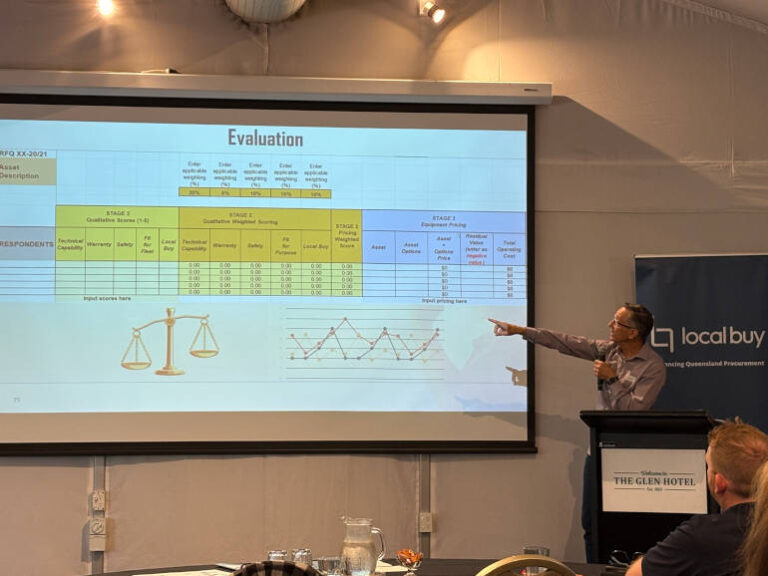
Richard Schuster, Principal Consultant at TheFleetSource, brought four decades of fleet experience to the table when he addressed an audience of council fleet professionals, challenging them to rethink how they approach vehicle and equipment procurement. With a career spanning from managing 180-vehicle operations to overseeing Telstra’s national fleet of over 40,000 assets, Schuster has developed what he calls the “Schuster Sourcing Funnel” — a practical five-part model designed to improve fleet acquisition outcomes and reduce duplication across councils.
Why a Council Fleet is the Ultimate Challenge
“I like council fleets,” Schuster told the room early in his presentation. “I like complex fleet management. I like the fact that you guys don’t just have car fleets. You’ve got trucks, specialist plant, the crazy dump compactors, auto drinkers – everything.”
That complexity, he argued, is both the challenge and the opportunity. Unlike corporate fleets, councils deal with more moving parts – literally and figuratively – and that requires a more sophisticated approach to sourcing.
Introducing the Schuster Sourcing Funnel
The core of Schuster’s message was a five-layer funnel designed to take fleet teams beyond the spec sheet. His sourcing model includes:
- Alignment
- Ecosystem
- Sourcing
- Specifications
- Evaluation
Each stage builds on the last, and Schuster emphasised that skipping any of them risks poor procurement outcomes.
1. Alignment – “Are You Aligned With the Organisation’s DNA?”
Schuster warned against the common trap of repeating last year’s order without reassessing the organisation’s current needs. He recalled his time growing a not-for-profit fleet from 180 to 800 vehicles while still reducing costs year-on-year.
“If the organisational requirement is growth, downsizing the fleet is failure,” he said. “The fleet must align with the strategic plan, not just operate in a silo.”
He encouraged councils to use the PESTEL framework — Political, Economic, Social, Technological, Environmental, Legal — when planning replacements. “You need to think bigger than the spec to replace that grader,” he warned. “Otherwise, fleet will always be seen as a cost centre.”
2. Ecosystem – “Your Neighbours Are Not the Enemy”
A key part of the sourcing funnel, according to Schuster, is understanding and collaborating within the broader council ecosystem. Too often, councils repeat work done by their neighbours — writing separate specs, issuing individual RFQs, and evaluating in isolation.
“There’s an 80/20 rule at play,” he argued. “80% of the fleet and procurement needs across councils are similar. Why aren’t we sharing specs, RFQs, and evaluation tools?”
Schuster called for the creation of shared knowledge hubs, similar to what mining companies use, where best practices are harvested and replicated. “Why make the same mistake your neighbouring council made last year?”
3. Sourcing – Robust, but at What Cost?
While acknowledging that most councils have robust sourcing processes in place — particularly through prequalified supplier panels like Local Buy — Schuster cautioned against internal policy constraints and rushed timeframes.
“I’ve seen RFQs issued with a one-week response window,” he said. “Guess what we got? A substandard response.”
He also flagged potential biases that creep in. “Why are we ordering a CAT? Because we’ve always ordered a CAT. That doesn’t cut it anymore.”
And while local supplier preference is important, Schuster noted it can become problematic when there are no suitable local options — particularly for highly customised assets.
4. Specifications – The Customisation Trap
When it comes to writing specs, Schuster encouraged balance. He shared an example of a detailed tipper truck specification that fit on seven pages – “and it wasn’t in 8-point font.”
Excessive customisation, he warned, leads to longer delivery times and limits opportunities for inter-council collaboration.
“The more you customise, the less likely you can share assets across councils. And the longer your delivery lead times.”
Another tip: structure supplier response templates to make evaluation easier. “I spent an incredible amount of time dealing with suppliers who didn’t follow the data format I asked for. Lock down your spreadsheets – it saves hours later.”
5. Evaluation – Align Your Rubik’s Cube
The final step in the Schuster Sourcing Funnel is evaluation – and getting it wrong can throw off the whole process.
“You need clear categories like safety, cost, environment, and fit for purpose,” Schuster explained. “But also define how each is scored, how much it’s weighted, and who’s doing the scoring.”
He emphasised the importance of a well-documented, transparent process, not just for audit trails but also for fairness and consistency. “You need to be able to pull all that data together into a coherent, concise report that management can sign off.”
And don’t forget the unsuccessful bidders: “Advising them properly is part of the process too.”
Smarter, Not Harder
Schuster closed with a challenge to council fleet teams: stop thinking in isolation. “This is like a Rubik’s cube – if even one line is out of alignment, nothing fits.”
By focusing on alignment, working collaboratively, and treating suppliers as partners rather than adversaries, councils can achieve better outcomes — for their own organisations, and the sector as a whole.
Fleet Tip: Stop reinventing the wheel
If another council has already specified, sourced, and evaluated a piece of plant or equipment, learn from their experience. Start sharing specs, templates, and evaluation frameworks — and create a knowledge hub that benefits the whole sector.