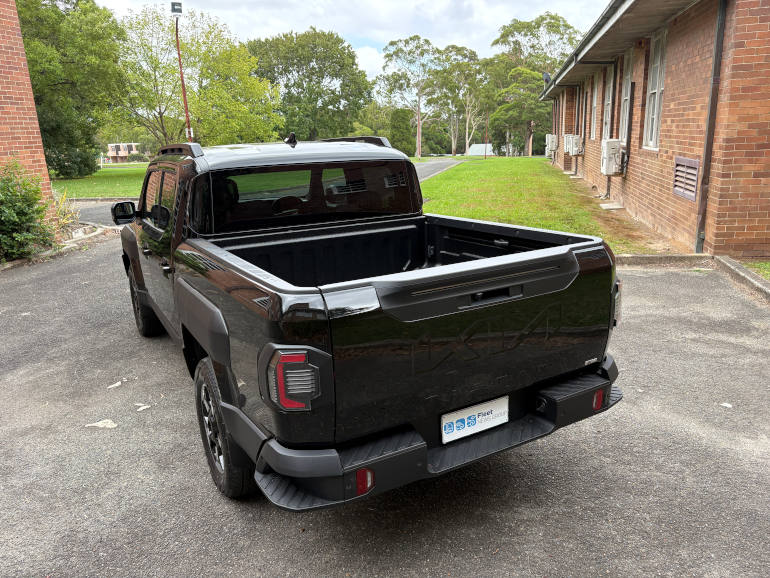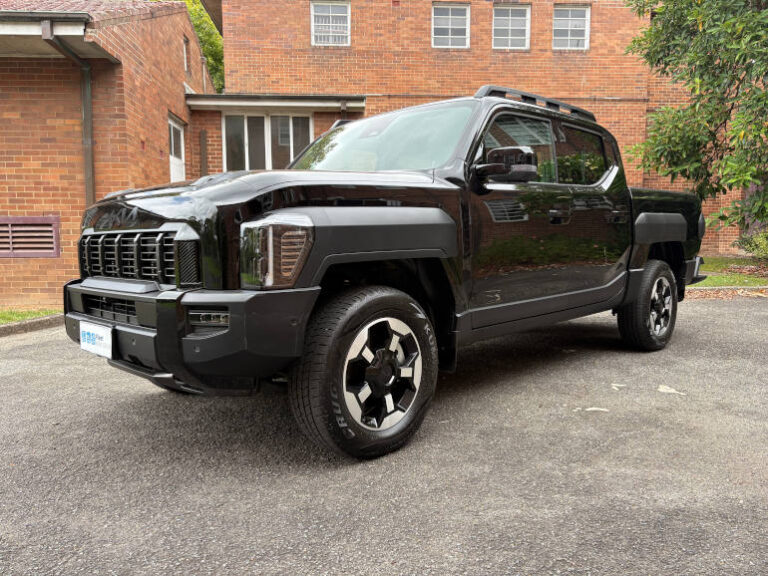
The Kia Tasman has arrived in Australia with plenty of noise, plenty of opinion, and no shortage of scrutiny. In a dual-cab ute market dominated by household names like HiLux and Ranger, simply turning up isn’t enough. Kia knows that — and the Tasman X-Line is its statement that it’s prepared to do things differently.
I’ve considered where the Tasman X-Line really fits, through a fleet and novated leasing lens, rather than the usual lifestyle hype.
Where the Tasman Sits in the Market
The Tasman enters a three-way split ute market. At the top sit the incumbents — Ranger, HiLux and D-MAX — with rock-solid reputations and proven resale. Below that is the value-led challenger segment, where buyers chase size and capability without the price premium. And emerging alongside both is the low-emissions ute conversation, driven recently by the BYD Shark.
Kia’s Tasman doesn’t neatly fit into just one of those boxes. On specification alone, it competes comfortably with the segment leaders. On pricing and positioning, it aims to attract buyers prepared to trust the Kia brand rather than defaulting to tradition. The X-Line variant in particular leans away from traditional fleet fit-outs and more towards novated lease and lifestyle buyers.
Powertrain and Capability
Under the bonnet, the Tasman X-Line runs Kia’s 2.2-litre Smartstream turbo-diesel four-cylinder, producing 154kW and 440Nm, paired with an eight-speed automatic transmission kia-tasman-brochure. Peak torque arrives low in the rev range, making it well suited to towing and loaded driving.
On paper, the numbers stack up. The Tasman offers a 3,500kg braked towing capacity, 350kg towball download, and a GVM of 3,250kg, with payload just over 1,020kg in X-Line specification. For most fleet and trade applications, that’s more than adequate.
Fuel consumption is competitive rather than class-leading, with the X-Line rated at 7.8L/100km combined and 206g/km CO₂. Upcoming NVES pressures will affect all diesel dual-cabs. Importantly, this is a segment-wide issue rather than a Tasman problem.
Off-Road and Driving Systems
The X-Line sits above the SX+ in Kia’s range and brings meaningful hardware upgrades. Ground clearance increases to 224mm, approach angle improves to 28.9 degrees, and the standard terrain mode select system covers snow, mud and sand.
Electric power steering, selectable drive modes (including Tow), and a mechanical rear differential lock support genuine off-road use. For fleets that operate on unsealed roads, construction sites or regional routes, the Tasman doesn’t feel like a soft lifestyle ute pretending to be tough — it has real capability baked in.
Interior: A Genuine Strength
Inside is where the Tasman X-Line starts to make its strongest case.
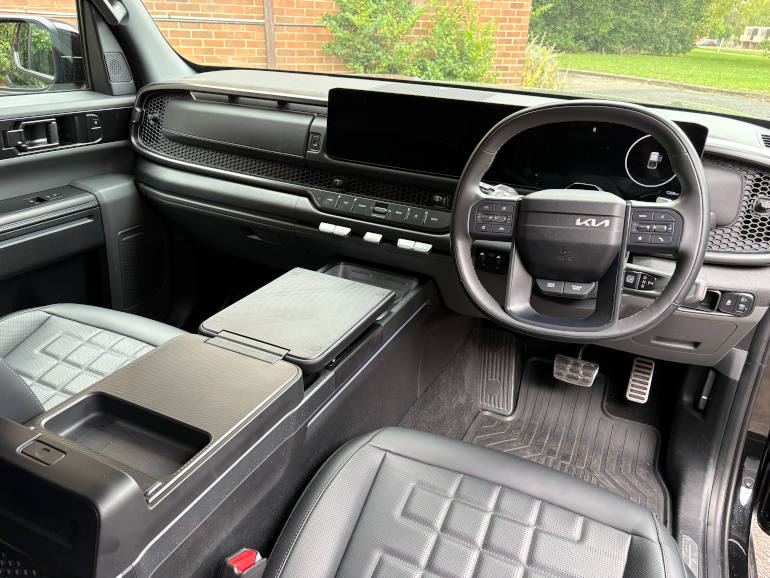
The cabin is dominated by Kia’s panoramic display, combining a 12.3-inch digital instrument cluster, 5-inch climate interface, and 12.3-inch infotainment screen kia-tasman-brochure. Unlike some competitors, Kia has resisted going fully touch-only, retaining physical buttons and textured controls that are easier to use on the move.
Seat comfort is excellent, particularly the headrests — a small detail, but noticeable on longer drives. The X-Line adds artificial leather trim, power-adjustable front seats, dual wireless phone charging, and extensive USB-C charging across both rows kia-tasman-brochure.
One standout feature is the fold-down centre console table, which effectively creates a mobile workspace. For fleet drivers, supervisors and anyone working from their vehicle, this is one of the most practical interior features in the segment — and one Kia should seriously consider making standard across the range.
Rear-seat practicality is also strong, with under-seat storage, zippered seat-back pockets, rear air vents and even a 240-volt power outlet capable of charging tools, laptops or batteries on site kia-tasman-brochure.
Styling and Future Value
Styling is where opinions split — loudly.
The Tasman’s blocky, unapologetic design has copped criticism since launch, and that matters more than some will admit. For fleet managers and novated lease providers, residual value is king, and styling plays a role in used-market acceptance.
The upside? The Tasman is early in its model cycle, which usually supports resale. The risk? Kia is likely to refresh the design sooner rather than later, potentially branding early examples as “the original” — or less kindly, “the ugly one”. That could soften early residuals compared to Ranger or HiLux, which enjoy decades of buyer trust.
Whole-of-Life Costs and Fleet Considerations
Right now, the Tasman doesn’t win the whole-of-life cost battle. That’s not a criticism so much as a reality of entering a mature segment. Resale data is limited, and competitors have long-established used-market demand.
That said, servicing, maintenance, tyres and repairs are broadly in line with the rest of the dual-cab field. Fuel use is competitive. And Kia’s long-standing commitment to fleet customers — across passenger cars, SUVs and EVs — shouldn’t be overlooked.
For novated lease buyers in particular, the Tasman X-Line makes sense as an emotional purchase that still delivers genuine capability, comfort and practicality.
Verdict
The Kia Tasman X-Line isn’t trying to be another HiLux or Ranger clone — and that’s both its risk and its appeal.
It offers strong mechanical fundamentals, excellent interior execution, and thoughtful features that genuinely support people who work from their vehicle. It may not deliver class-leading resale today, but it provides a solid foundation for buyers willing to back the Kia brand and stand out from the crowd.
For fleets, the lower-grade variants will make more sense. For novated lease and lifestyle buyers who want capability without conformity, the Tasman X-Line is a credible — and very usable — alternative.