

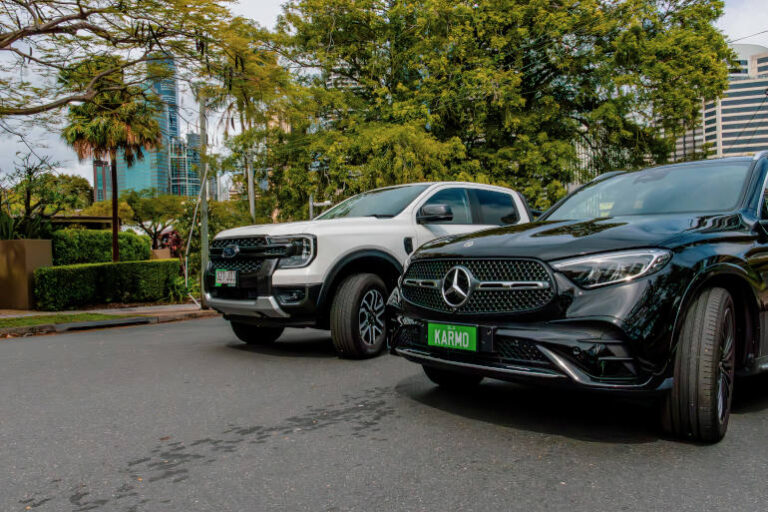
For much of the past decade, car subscription sat on the fringes of Australia’s vehicle market. Often compared with short-term rental or car share, it was viewed as a consumer convenience rather than a serious fleet solution. That perception is now changing, as subscription providers mature their business models and fleets look for more flexibility in an increasingly uncertain operating environment.
According to Nick Boucher, CEO of Karmo, 2025 marked a turning point in how subscription is being evaluated by fleet decision-makers.
“When you look at the overall market itself, I think it’s (fleet) just under half the market. So it’s a huge space, and one that we knew we had to get into.”
The move into fleet has not been opportunistic. Boucher says the business waited until the fundamentals were in place.
“We just wanted to make sure that we were comfortable in our business model, availability of stock, and also our technology was ready to go. And you know, those three things are ticked.”
Scale, utilisation and fleet discipline
One of the challenges facing larger fleets is managing utilisation as vehicle numbers grow. Boucher argues that scale quickly exposes weaknesses in fleet controls.
“I think it’s a lot easier to do things when you’re running 6, 7, 8, 100 vehicles, but when you start getting over 2,000 vehicles, scale becomes a bit more of a problem if you’re not managing those things well.”
Accident management, insurance, repairs and downtime all become more complex as fleets grow. Subscription, he suggests, can act as a pressure-release valve rather than a replacement for core fleet assets.
“Why would I not do this for 15 per cent of my fleet or 20 per cent of my fleet? Because then I do have the ability of dropping these cars pretty quickly where I don’t require them.”
This flexibility becomes particularly relevant when contracts are won—or lost—at short notice.
“The beauty of the subscription is you’ve got the ability to then return those cars within the 30-day period… rather than having dead stock sitting there doing nothing.”
Government and council fleets: slow, but interested
Government fleets are rarely early adopters, but Boucher says local councils in particular are starting to engage.
“We’ve had really good uptake from local council, because it’s not actually falling into a category where they’ve already got suppliers or panels as such, because there’s no subscription.”
Subscription requires education, but once understood, it opens different conversations around balance sheets and debt.
“Once they understand the subscription benefits to them again, being off balance sheet… it could still be a big win to reduce overall debt.”
Electric vehicles as a low-risk trial pathway
Electric vehicles remain one of the biggest transition challenges for fleets. Subscription, Boucher says, has found traction as a low-risk entry point.
“The beauty of our model is that they can generally try to see it’s going to work for them, because it’s a big shift, right?”
As operational concerns are replaced by real-world experience, attitudes shift quickly.
“Once people are overcoming the fears with reality, they’re saying that with most vehicles, it makes a hell of a lot of sense.”
Residual value uncertainty also plays into subscription’s appeal.
“No one really has a genuine understanding of residuals yet on EVs… The beauty of the model is you don’t have that risk.”
Novated leasing, FBT and policy uncertainty
The FBT exemption for electric vehicles has accelerated EV uptake, particularly through novated leasing. Boucher supports the intent, while acknowledging the uncertainty.
“Anything that helps accelerate the take up of electric vehicle… is a good thing.”
However, he notes that subscription products designed to work beyond incentives may prove more resilient.
“We want to make sure that we’ve got a product for consumers, not just now, but also in 2035, or 2040.”
What Fleet Managers should be focusing on now
For fleets heading into 2026, Boucher’s advice centres on fundamentals rather than new technology.
“It doesn’t matter if you’ve got three or if you’ve got 20,000 vehicles in your fleet. Are you getting efficiency out of it? And are you getting the utilisation you require?”
In tighter economic conditions, under-utilised vehicles quickly become a cost burden.
“Every dollar saved is 100 per cent gross margin.”
Subscription may not suit every fleet or every vehicle, but its growing role is clear: a flexible tool to manage uncertainty, utilisation and transition—particularly as fleets balance emissions targets with operational realities.
As Boucher puts it, subscription is not about replacing everything that came before, but offering fleets another option in a market that is becoming more complex by the year.
- Who Should Attend TruckShowX 2026
 TruckShowX 2026 is designed to bring together a wide cross-section of the heavy vehicle and transport industry, but its relevance extends well beyond traditional trucking operators. As fleets across multiple sectors face rising costs, increasing compliance requirements, and pressure to improve productivity, the event is positioned as a practical forum for anyone responsible for moving
 - A Quiet Force in Fleet: Bryce Grove’s Enduring Impact on an Industry in MotionAwards nights are often filled with big personalities and bigger speeches. But when Bryce Grove, National Operations Manager at SG Fleet, stepped forward to accept the Experian Workplace Champion Award, the moment felt different. Not because the recognition wasn’t deserved — quite the opposite — but because it shone a spotlight on a style of leadership that often
- The New Challenge: Finding Enough Used EVs to SellThe used electric vehicle market has shifted quickly in 2026, creating an unexpected challenge for dealers and fleet sellers — supply is now struggling to keep up with demand. For Fleet Managers and Leasing Companies, this change is significant. After several years of uncertainty around resale values and buyer appetite, the secondary EV market is
- March Sets New Benchmark for EV Sales as Fuel Prices and Policy Drive DemandMarch 2026 will be remembered as a turning point for Australia’s new vehicle market, with electric vehicle (EV) sales reaching record levels and reshaping buying behaviour across the industry. Australia recorded 15,839 battery electric vehicle (BEV) sales in March, representing 14.6% of total new car sales—the highest monthly result on record. The surge reflects a convergence of
- The Day a Loaded Ute Met a Loaded TruckIt started as a straightforward comparison. Same load. Same conditions. Same job. But this wasn’t a random test. It was part of a deliberately staged demonstration run by Isuzu Trucks in March, where a group of motoring journalists were invited to put light trucks and utes through identical tasks. The objective was clear enough: show —