

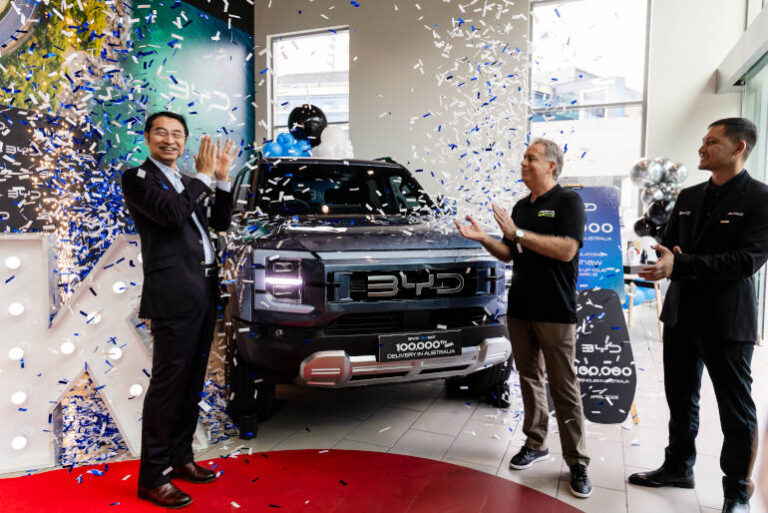
Chinese automotive brand BYD has delivered its 100,000th vehicle in Australia, marking a significant milestone less than four years after entering the local market.
The landmark vehicle was a Shark 6 Premium ute handed over to Brisbane customer Tim Shaw during a presentation led by BYD General Manager Asia Pacific, Liu Xueliang. The achievement reflects the rapid expansion of the brand’s product line-up and dealer network since its Australian launch in November 2022.
For fleet buyers and procurement teams, the milestone is another indicator of how quickly new entrants can establish scale in the Australian market when pricing, technology and availability align with customer demand.
Rapid growth in a short time
BYD entered the Australian market with a single model—the Atto 3 mid-size SUV—and has since expanded its range to ten vehicles across multiple segments. This growth has been supported by a national sales and service network now exceeding 100 locations.
The company attributes its success to strong demand for electrified vehicles that offer competitive pricing and modern technology, particularly as organisations balance cost pressures with sustainability targets.
Stephen Collins, Chief Operating Officer at BYD Australia, highlighted the pace of development in the local market.
“The growth of BYD Australia over the last three and a half years has been remarkable. Australian motorists want stylish, practical and affordable new energy vehicles, now more than ever. It’s our pleasure to hand over our 100,000th vehicle today,” said Collins.
For fleet managers, this level of growth often signals improved parts availability, service coverage and resale confidence—factors that are typically considered in whole-of-life cost assessments.
Expanding product mix across segments
While early adoption focused on passenger vehicles, BYD has progressively broadened its offering to include SUVs and commercial-focused models. The Sealion 7 SUV is currently the brand’s most popular all-electric vehicle in Australia, while newer entries such as the Atto 2 are targeting value-focused buyers entering the EV market.
More recently, attention has shifted to the utility segment with the introduction of the Shark 6 plug-in hybrid ute. According to the company, the model has gained traction with private buyers and is set to expand with additional variants, including a cab-chassis configuration designed for trade and fleet applications.
That move aligns with a broader trend across the industry, where electrified utes and light commercial vehicles are emerging as a key battleground for fleet adoption over the next five years.
What the milestone means for fleets
From a fleet procurement perspective, reaching 100,000 vehicles in service is less about marketing and more about operational maturity.
Scale typically brings:
- Greater confidence in dealer and service network capability
- Improved supply chain stability
- Better access to parts and technical support
- More reliable resale value forecasting
- Increased availability of fleet-specific programs
These factors are particularly relevant as organisations evaluate newer brands alongside established manufacturers. Many Fleet Managers are now applying a structured procurement lens—looking beyond purchase price to consider lifecycle support, network coverage and long-term product continuity.
The continued expansion of BYD’s local footprint suggests the brand is transitioning from early-adopter status to mainstream consideration in fleet replacement cycles.
A signal of market change rather than a finish line
The delivery of the 100,000th vehicle is a symbolic milestone, but it also reflects a broader shift in the Australian vehicle market. New entrants are gaining traction more quickly than in previous decades, supported by electrification policies, competitive pricing and changing customer expectations.
For fleet decision-makers, the key question is not whether new brands will grow, but how quickly they can demonstrate long-term reliability, service capability and consistent product updates.
Those fundamentals—rather than sales milestones alone—will ultimately determine whether emerging brands secure a permanent place in fleet procurement strategies.