

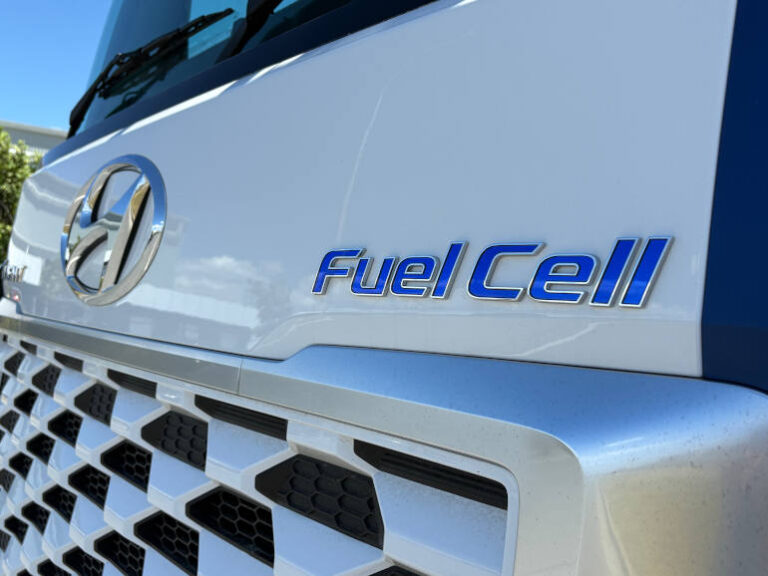
In the heavy vehicle sector, new technology is rarely rejected outright — but it is always tested cautiously. Fleet operators carry the responsibility of safety, uptime, compliance and productivity, and any change to fuel or driveline technology must earn trust through evidence rather than ambition.
That reality explains Hyundai’s approach to launching the XCIENT Fuel Cell truck in Australia. Rather than pushing hydrogen as a rapid replacement for diesel, the company has deliberately structured its rollout to reduce operational risk for fleets.
For Hyundai Australia, the XCIENT program is less about speed to market and more about readiness.
Hydrogen is not new — but expectations are higher
Hydrogen has been discussed in Australia’s transport sector for more than a decade, often positioned as a future solution rather than a present one. What has changed is the maturity of the technology and the expectations of fleet customers.
Hyundai’s involvement with hydrogen in Australia dates back to 2015, when it introduced the ix35 Fuel Cell passenger vehicle. While volumes were limited, that program gave Hyundai early exposure to hydrogen regulations, infrastructure constraints and safety frameworks.
That experience has influenced how the company now approaches hydrogen in the heavy vehicle space.
Martin Him, Head of CV and Fleet at Hyundai Australia, says the company is acutely aware that heavy vehicle operators will not tolerate uncertainty.
“Truck fleets operate under very different conditions to passenger vehicles. The tolerance for downtime or inconsistency simply isn’t there, so we’ve taken the time to make sure the foundations are right before expanding.”
Global learning reduces local risk
A key reason Hyundai can take a structured approach is its global operating history with the XCIENT Fuel Cell truck.
In Europe, nearly 200 XCIENT trucks are operating in commercial freight applications, covering more than 15 million kilometres. These vehicles work in cold climates, mountainous terrain and high-utilisation duty cycles. In New Zealand, fleets have provided insight into hydrogen supply logistics and driver training. In the United States, hydrogen trucks have been evaluated in port and logistics environments where turnaround time is critical.
Rather than treating Australia as a pilot market, Hyundai has drawn directly on those learnings.
“We’re not asking Australian fleets to be guinea pigs. These trucks are already working elsewhere, and we’ve been able to bring that knowledge into how we support customers here.”
Martin Him, Head of CV and Fleet at Hyundai Australia
A truck designed around operational continuity
From a technical perspective, the XCIENT Fuel Cell is designed to minimise disruption to existing operating models.
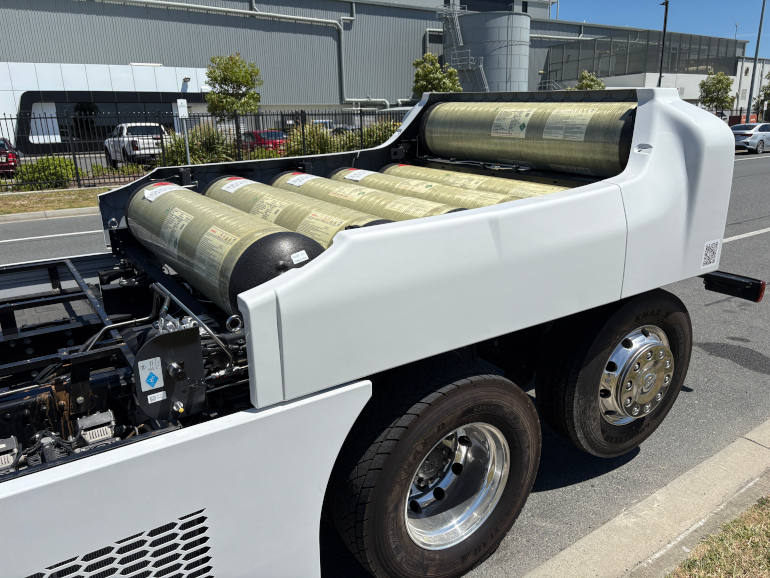
The truck uses a twin hydrogen fuel cell system producing 220 kW, supported by a 72 kWh battery that manages peak demand and regenerative braking. Power is delivered through a 350 kW electric motor producing up to 2,237 Nm of torque, paired with a five-speed automatic transmission.
For fleet managers, the key points are practical rather than theoretical:
- Refuelling times comparable to diesel
- Around 400 km of driving range depending on load and conditions
- No tailpipe emissions without sacrificing payload or utilisation
In day-to-day operation, the truck behaves like a conventional heavy vehicle in terms of scheduling and refuelling cycles, reducing the behavioural change required from drivers and dispatch teams.
Early adopters chosen carefully
Hyundai’s decision to begin with three customer fleets in Western Australia reflects a deliberate strategy rather than limited demand.
Western Australia presents a combination of long-distance freight tasks, emerging hydrogen supply opportunities and customers with strong internal capability to manage change.
Him says the selection of early customers was critical.
“These fleets know exactly how their trucks are used. They understand payload, range, utilisation and maintenance costs in detail, which makes them the right partners for this stage.”
By limiting the initial rollout, Hyundai can closely monitor performance, maintenance requirements and real-world operating costs before broader deployment.
Local right-hand drive conversion builds confidence
Another risk-mitigation decision was Hyundai’s choice to localise the left-hand-drive to right-hand-drive conversion process in Australia.
That work is being undertaken by Advanced Manufacturing Queensland at its Brisbane facility. The conversion involves detailed engineering validation to ensure compliance with Australian Design Rules while maintaining Hyundai’s global quality standards.
Local conversion capability provides confidence for fleets concerned about long-term support and parts availability, while also reinforcing that XCIENT is not a short-term trial vehicle.
It also ensures Australian conditions — from road surfaces to operating temperatures — are considered during the build process.
Training and infrastructure come first
Hydrogen introduces new safety and procedural considerations, and Hyundai has prioritised internal readiness ahead of volume sales.
At its head office in Macquarie Park, Hyundai has invested in staff training and installed a hydrogen refuelling station to support demonstration vehicles, technical development and emergency response planning.
This investment ensures sales, technical and aftersales teams are equipped to support fleet customers with accurate, practical guidance rather than theory.
Martin Him, Head of CV and Fleet at Hyundai Australia, says this groundwork is essential.
“If we’re going to ask fleets to consider hydrogen, we need to be confident that our own people are trained and our processes are proven.”
Hydrogen as part of a mixed-fuel future
Hyundai is careful not to position hydrogen as a universal solution for all heavy vehicle tasks. Battery electric trucks, renewable fuels and efficiency improvements will all play roles in reducing emissions across fleets.
Hydrogen fuel cell trucks, however, offer a pathway for zero-emission operation where battery-only solutions struggle with range, charging time or payload constraints.
For Fleet HV News readers, the significance of the XCIENT Fuel Cell is not that it replaces diesel overnight, but that it gives fleets another viable option — one that aligns with existing operating patterns while reducing emissions.
With global operating data, committed Australian customers and local manufacturing capability in place, Hyundai’s hydrogen strategy is built on caution, evidence and long-term intent rather than hype.
In the heavy vehicle world, that may be the strongest signal of all.