
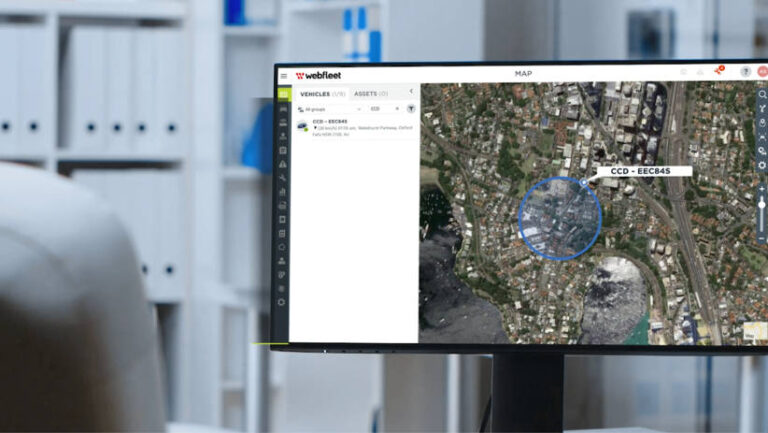
Telematics has long been associated with track-and-trace, driver behaviour monitoring and compliance reporting. But as fleet operations become more complex and margin pressure intensifies, the value proposition is shifting.
According to Jonny Clarke, Director of Webfleet Australia and New Zealand, which is part of Bridgestone Mobility Solutions, the focus is moving beyond simply reporting what happened on the road.
“Previously, telematics told you what the vehicle was doing based on driver behaviour, but we know that there’s a lot more to do with it than just driver behaviour,” Clarke said.
For heavy vehicle fleets in particular, the operational picture is broader. Load distribution, mass compliance, tyre performance, fuel usage and asset utilisation all interact to affect profitability and risk.
“We’re looking at the full ecosystem for the vehicles, from tyre management right way through to fuel and data analytics,” Clarke said.
With the integration of Smart OBM capability for heavier trucks, Clarke said fleets can now access deeper insight into how vehicles are being operated.
“With this smart OBM capability for the heavier trucks, now we can give them a full analytics, a full process of analytics all the way through,” he said.
Drilling Into the ‘Why’
The evolution from tracking to advisory hinges on analysis rather than data collection alone. Clarke illustrated the point with a practical example.
“If you’re driving the truck today and I’m driving the truck today, the same truck, the same model, the same load, but at the end of the day there’s a discrepancy in the fuel level between us, why is that?” he said.
Rather than simply identifying fuel variance, advisory services focus on uncovering root causes.
“We can actually really analyse that,” Clarke said. “We can see from the scales, from the weights, what’s actually been happening with the vehicle.”
That includes understanding the impact of harsh braking, cornering speeds and load placement on fuel performance and tyre wear. For Fleet Managers, that level of insight supports operational decisions rather than just compliance reporting.
From Provider to Advisor
Marcelo Godinho, Vice President Fleet Management System – LATAM, Middle East, Africa, Australia and New Zealand, said the shift is deliberate and strategic.
“It is moved towards become a fleet advisor,” Godinho said. The intention is to help fleets extract value from their own operational data.
“It is, how can we help with the fleet own data, with the data we acquired in the knowledge, and bring more value to the customer and become really a fleet advisor in bringing value for them,” he said.
That broader advisory approach aligns with Bridgestone’s mobility strategy, where tyres, fleet systems and analytics are viewed as part of one ecosystem.
“If you want to bring value for the mobility, it’s not just the tyre, it is the ecosystem,” Godinho said.
Maturity Is the Next Step
Godinho noted that in more mature markets, particularly parts of Europe, fleet customers already use telematics at a deeper operational level.
“They really go in depth in how to make our drivers to become the best in class usage for the efficiency, fuel consumption, CO2 emission,” he said.
In those markets, telematics platforms are integrated into work management, performance optimisation and environmental reporting, rather than operating as standalone tracking tools.
Clarke believes Australian fleets are moving in that direction, particularly as economic pressure increases.
“The only way they can do that is by getting data and analytics,” he said.
For fleet buyers, the implication is clear. The value conversation is no longer about whether vehicles can be located or whether driver scores can be generated. It is about how data improves asset productivity, reduces risk and supports revenue generation.
As telematics platforms evolve, the distinction between software provider and operational advisor is narrowing. The next phase of fleet technology will be judged not by how much data it collects, but by how effectively it turns that data into measurable business outcomes.