

For years, the diesel van has been the quiet achiever of Australian fleets. Reliable, capable and easy to deploy, the Toyota HiAce became the default choice for trades, couriers and service technicians.
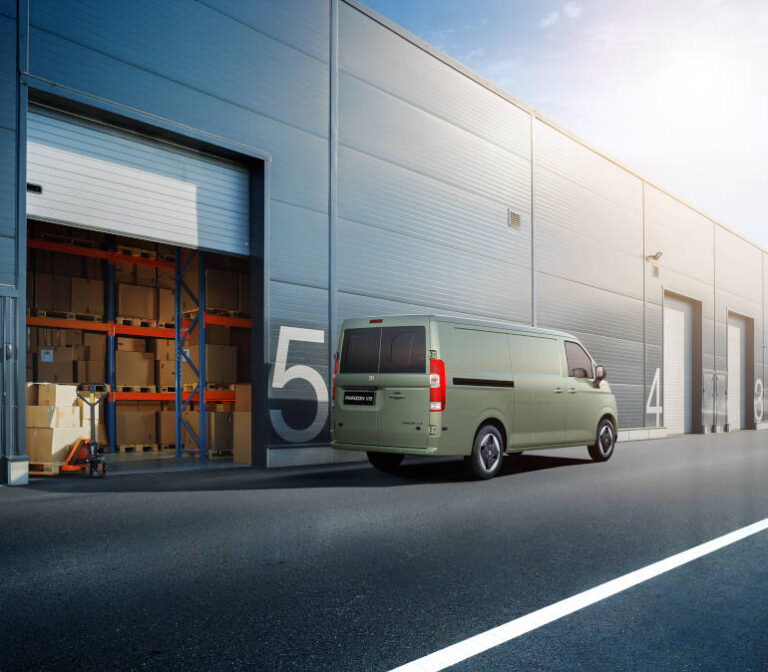
But the arrival of the Farizon V7E signals a shift. Not because it replaces the HiAce overnight—but because it introduces a realistic electric alternative at a price point and payload level that fleet buyers can finally take seriously.
For ute buyers and fleets looking to reduce emissions without sacrificing productivity, this comparison is less about technology and more about fit-for-purpose decision making.
The Benchmark: Toyota HiAce Diesel
The HiAce remains the yardstick for capability and operational confidence. It offers strong towing capacity, proven reliability and a dealer network that supports fleets in regional and metro areas.
From a fleet management perspective, it’s the low-risk choice. Everything about the vehicle is predictable—fuel range, resale value, service processes and driver familiarity.
Key capability highlights include:
- Up to 1,900kg braked towing capacity depending on variant
- Gross Vehicle Mass up to 3,500kg for higher-capacity models
- Proven 2.8-litre turbo-diesel engine producing up to 450Nm torque
- Cargo volume up to 9.3m³ in the Super Long Wheelbase configuration
Safety is also comprehensive, with Toyota Safety Sense including:
- Autonomous emergency braking
- Lane tracing assist
- Blind spot monitoring
- Rear cross traffic alert
- Up to 10 airbags depending on grade
In short, the HiAce is designed to handle almost any commercial task—from towing trailers to carrying heavy payloads across long distances.

The Challenger: Farizon V7E Electric Van
The Farizon V7E is not trying to be a diesel replacement in every scenario. Instead, it targets the growing number of fleets operating predictable urban routes—delivery services, maintenance crews, council operations and last-mile logistics.
Its biggest disruption is not the drivetrain—it’s the economics.
The V7E enters the market from $49,990 drive-away, positioning it directly against traditional diesel vans rather than premium EV alternatives .
Looking at the technical specifications, the V7E offers:
- Payload up to 1,338kg
- Cargo volume of 6.95m³
- Braked towing capacity of 1,000kg
- WLTP range up to 329km depending on battery size
Safety technology is extensive for a vehicle in this price category, including:
- Adaptive cruise control
- Forward collision warning
- Lane keeping assist
- Blind spot detection
- 360-degree camera system
These features reflect the design focus—urban productivity, driver safety and predictable daily operations.
Specifications Comparison
| Specification | Toyota HiAce Diesel (LWB/SLWB typical) | Farizon V7E Electric |
|---|---|---|
| Powertrain | 2.8L turbo-diesel | Electric motor |
| Payload | ~1,000–1,300kg (variant dependent) | Up to 1,338kg |
| Cargo Volume | Up to 9.3m³ | 6.95m³ |
| Braked Towing | Up to 1,900kg | 1,000kg |
| GVM | Up to 3,500kg | 3,150kg |
| Range / Fuel | Diesel | 240–329km WLTP |
| Safety Systems | Toyota Safety Sense suite | Full ADAS suite incl. ACC, AEB |
| Best Use Case | Heavy-duty, mixed operations | Urban delivery, predictable routes |
Towing and Payload: Where Diesel Still Leads
For many ute buyers considering a move to vans, towing capacity is the deciding factor.
HiAce advantage:
- Up to 1,900kg towing capacity
- Higher GVM options
- Proven performance under heavy loads
V7E advantage:
- Competitive payload
- Lower operating costs
- Simpler mechanical systems
But if your fleet regularly tows trailers, generators or equipment, diesel still has a clear operational edge.
Safety: The Gap Has Closed
Historically, electric commercial vehicles lagged behind diesel models in safety features. That is no longer the case.
Both vehicles now offer advanced driver assistance systems designed to reduce incidents and improve driver confidence.
From a Fleet Manager perspective, the key difference is not capability—it’s maturity.
The HiAce benefits from years of real-world fleet experience. The V7E brings newer technology and automation into the segment.
Applications: Choosing the Right Tool for the Job
Choose the HiAce if your fleet:
- Tows trailers regularly
- Operates in regional or remote areas
- Carries heavy or bulky loads
- Requires maximum uptime flexibility
Typical industries:
- Construction
- Utilities
- Trades
- Service technicians
Choose the Farizon V7E if your fleet:
- Operates predictable daily routes
- Works primarily in metro areas
- Wants to reduce fuel and maintenance costs
- Has access to charging infrastructure
Typical industries:
- Courier and parcel delivery
- Local government services
- Facilities maintenance
- Urban logistics
Why This Comparison Matters for Ute Buyers
Many fleets are still defaulting to dual-cab utes—even when the job does not require off-road capability. That habit is becoming expensive. Vans—particularly electric vans—are increasingly the smarter operational choice for:
- Safety
- Cargo security
- Emissions reduction
- Whole-of-life cost
The shift will not happen overnight. But the arrival of vehicles like the V7E makes the transition easier to justify.
The Bottom Line for Fleet Buyers
The Toyota HiAce remains the benchmark for capability and versatility. It is the safe, proven option for demanding workloads.
The Farizon V7E represents the next phase of commercial vehicle evolution—lower operating costs, lower emissions and sufficient capability for many urban fleet tasks.
The real question is not which vehicle is better. It is whether your fleet actually needs diesel capability—or whether it is time to match the vehicle to the task.