
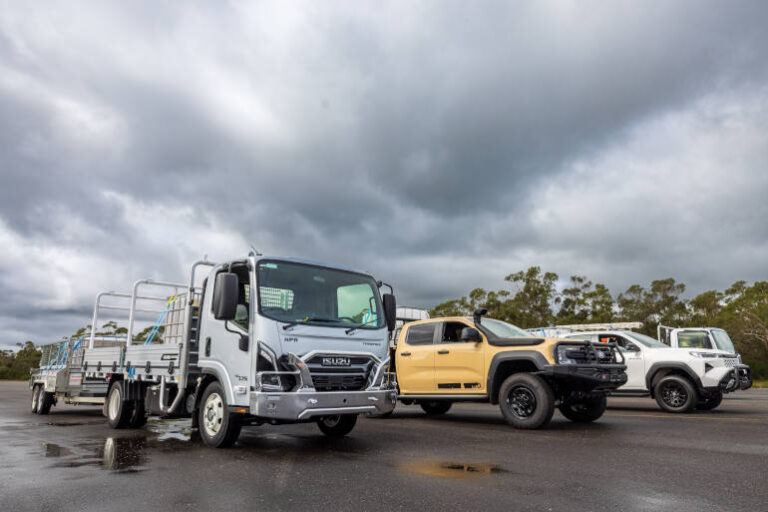
It started as a straightforward comparison. Same load. Same conditions. Same job.
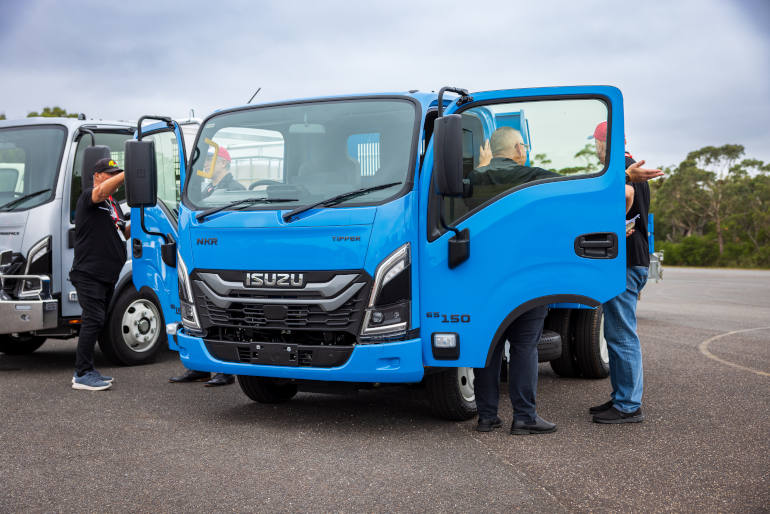
But this wasn’t a random test. It was part of a deliberately staged demonstration run by Isuzu Trucks in March, where a group of motoring journalists were invited to put light trucks and utes through identical tasks. The objective was clear enough: show — rather than tell — that when there’s real work to be done, a truck may be the better tool.
Fleet News Group was given the opportunity for back-to-back driving comparisons between loaded utes and trucks, with matching payloads and trailers, to experience the differences first-hand rather than rely on specifications or marketing claims.
What followed was less about theory and more about practical reality.
Same Load, Different Effort
The test took place on a controlled driving circuit, with both vehicles loaded to simulate a typical day on the job. The ute carried material in the tray and towed a trailer, while the truck carried the same load within its own body.
From the driver’s seat, the difference was immediate.
Under acceleration and braking, the ute felt like it was working harder. Climbing hills required more effort from the drivetrain, and descending with weight on the trailer placed noticeable strain on the braking system. The truck, by comparison, handled the same conditions with less effort and greater stability.
As one observer noted during the test, the ute was clearly under more stress while “with the truck, it was much easier” to manage the load across braking, cornering and hill climbs.
That difference matters, not just for performance, but for long-term durability and operating costs.
One Vehicle Instead of Two
For many trades and service businesses, the real-world difference between a ute and a truck comes down to how the load is carried.
In this test, the ute required a trailer to transport the required equipment and materials. The truck carried everything in one vehicle. That single change altered the entire driving experience.
Reversing became simpler. Manoeuvring through tight turns required less planning. There was no need to manage trailer sway or additional braking distance. The driver could focus on the job rather than the logistics of moving the load.
“It’s just so much easier when you’ve got everything in one unit,” was the conclusion after completing the manoeuvring exercises.
This is where the productivity argument for trucks often begins. Fewer trips. Less time loading and unloading. Reduced complexity on the road.
Designed for the Work
The comparison also highlighted a fundamental difference in vehicle design.
Light trucks are engineered from the ground up to carry heavy loads every day. Utes, by contrast, often serve dual roles — work vehicle during the week and personal transport on weekends. That flexibility can become a limitation as workloads grow.
Industry data reinforces the point. Rigid trucks move significantly more freight per vehicle than smaller commercial vehicles, reflecting their purpose-built role in heavy-duty operations.
For businesses operating near payload limits or towing regularly, that design difference can translate directly into productivity and reliability.
Trucks Are Changing — And That’s Part of the Pitch
Another theme running through the test drive was how much modern trucks have changed.
The latest generation models were presented as being closer to passenger vehicles in terms of comfort, safety and ease of operation — part of a broader push to attract buyers who traditionally default to utes.
Across the newest range, upgrades include improved ergonomics, more advanced safety systems and smoother drivetrains designed to make trucks easier to drive in everyday conditions.
For many drivers, that shift lowers the barrier to considering a truck for the first time.
The Bigger Question
The demonstration wasn’t subtle. It was designed to challenge assumptions — particularly the idea that a ute is always the default work vehicle.
And to be fair, both vehicle types still have a place. But the exercise highlighted a practical reality that many businesses eventually encounter:
When the workload increases, the difference becomes obvious.
For operators carrying heavier loads, towing regularly or running multiple trips each day, a truck can reduce strain on equipment, simplify logistics and improve productivity. For lighter duties or mixed personal use, a ute may still be the right choice.
What the journalists experienced in March wasn’t a marketing message. It was a side-by-side comparison of two vehicles doing the same job — and the results spoke for themselves.