

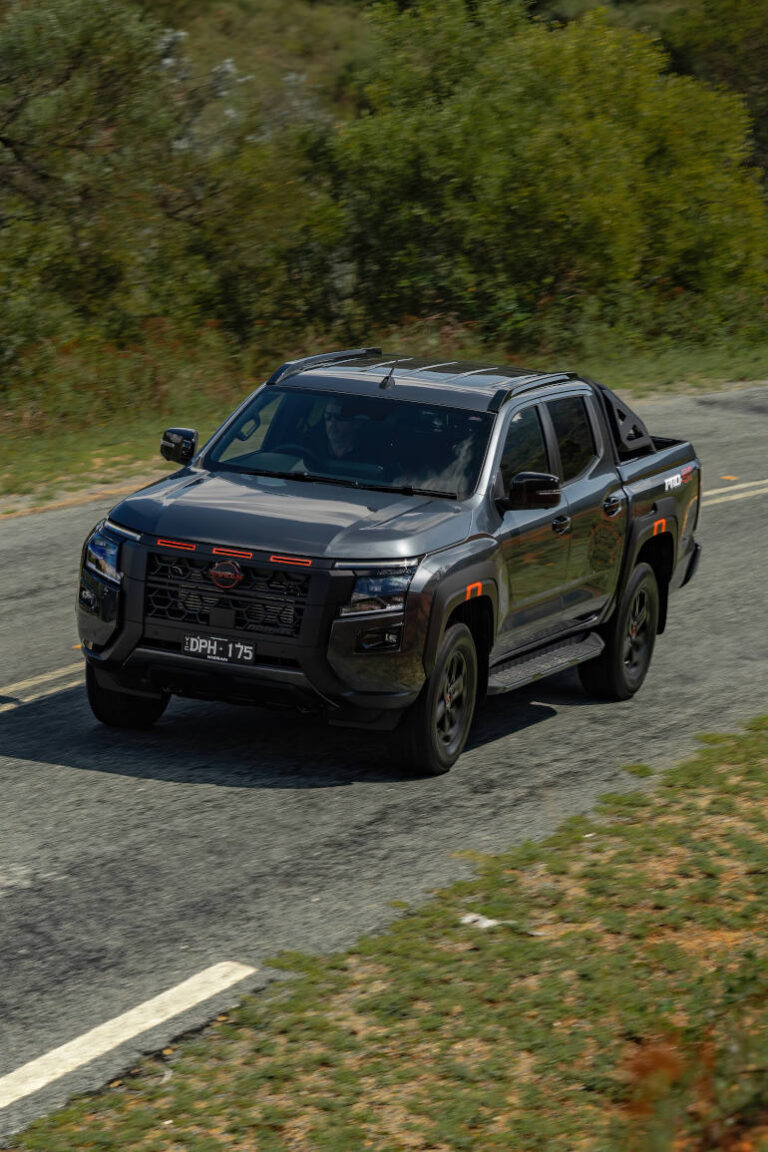
Nissan has taken a more deliberate approach to the dual cab ute segment with the launch of the new Navara in Australia—moving away from a “one-size-fits-all” setup and instead designing the vehicle around how customers actually use it.
Now on sale across the country, the fifth-generation Navara has been developed with a clear focus on improving confidence behind the wheel—whether that’s on a worksite, towing on the highway, or navigating rough regional roads.
Designed around how fleets actually operate
For Fleet Managers, one of the most relevant changes is how Nissan has structured the range.
Instead of simply offering different trim levels, the new Navara has been engineered with distinct use cases in mind. That starts with four dual cab 4×4 variants—SL, ST, ST-X and PRO-4X—but the real difference sits underneath.
Each variant has its own suspension calibration, tuned specifically for the type of work or lifestyle it’s expected to support.
That might sound like a small detail, but it addresses one of the biggest challenges in the ute segment—balancing ride comfort with load carrying and towing performance.
A shift away from compromise
Traditionally, utes have required compromise. A setup that works well when empty can feel unsettled under load, while a heavy-duty setup can be harsh in everyday driving.
Nissan’s approach with the new Navara is to remove that compromise.
- SL and ST are tuned with real-world loads in mind—ideal for trades and service fleets carrying tools and equipment every day
- ST-X targets mixed-use drivers, balancing comfort with capability
- PRO-4X focuses on off-road performance and recreational use
This segmentation gives Fleet Managers more control when matching vehicles to operational roles, rather than trying to make one configuration fit everything.
Australian conditions drive the engineering
A key part of the story is the level of local development.
Working with Premcar, Nissan has put the Navara through extensive Australian testing, covering everything from city streets to corrugated regional roads. The engineering team worked through 137 damper configurations and hundreds of component changes to refine ride and handling.
The outcome is a vehicle that feels more predictable across a wider range of conditions—particularly important for fleets operating across metro, regional and remote environments.
Focus on driver confidence
Rather than chasing headline numbers, Nissan’s engineering focus has been on how the vehicle behaves in real-world driving.
That includes:
- More linear and predictable steering response
- Reduced body movement when cornering or braking
- Improved comfort over broken road surfaces
- Greater stability when towing
The introduction of electronic power steering plays a role here as well, adjusting effort depending on speed and driving conditions. This makes low-speed manoeuvring easier while maintaining control at highway speeds.
Capability still central to the package
While the focus has shifted toward refinement and usability, the core capability expected from a one-tonne ute remains intact.
All models are powered by a 2.4-litre twin-turbo diesel delivering 150kW and 470Nm, paired exclusively with an automatic transmission.
Key capability figures include:
- 3500kg braked towing capacity
- 1000kg+ payload (depending on variant)
- Improved ground clearance and off-road angles
For fleets, that means no compromise on the core requirements—just a more refined platform to deliver it.
Two approaches to four-wheel drive
Nissan has also split its 4WD systems to better match customer needs.
Work-focused variants (SL and ST) use a traditional part-time system, while higher grades (ST-X and PRO-4X) gain a more advanced setup with automatic torque distribution.
This gives fleets flexibility depending on operating conditions—whether that’s urban driving, regional work, or mixed terrain use.
A more targeted ute for modern fleets
The new Navara reflects a broader shift in the ute market. Buyers are no longer looking for a single vehicle that does everything poorly—they want one that does their specific job well.
For Fleet Managers, that means:
- Better alignment between vehicle and task
- Improved driver comfort and confidence
- Reduced compromise across different use cases
Nissan’s decision to focus on local tuning, role-specific suspension, and real-world usability suggests the Navara is aimed squarely at fleets that value practical performance over marketing claims.
It’s a subtle shift—but one that could make a noticeable difference across day-to-day operations.